


What is operational organization?
Operational organization describes the entirety of regulations that determine the structure, processes, and cooperation within a company.
The aim is to use resources efficiently, assign responsibilities clearly, and ensure the smooth coordination of all operational activities.
A basic distinction is made between:
- Structural organization:
This regulates the hierarchical structure of the company — i.e., who reports to whom, how departments are structured, and what areas of responsibility exist. - Process organization:
This refers to the chronological and logical sequence of work processes—such as how tasks are distributed, information is passed on, or decisions are made.
Factors influencing organization
The structure of a company’s organization depends on various internal and external factors:
- Company size: Larger companies require more complex structures than small businesses.
- Industry and market requirements: Highly dynamic markets (e.g., the tech industry) require flexible organizational forms.
- Corporate culture and management style: A cooperative management style has a different effect on processes than an authoritarian one.

- Degree of digitization: The more digitized a company is, the more processes can be automated and networked.
- Legal framework: Labor law, data protection, and collective bargaining agreements can influence the design.
The importance of surveys in companies
Surveys are systematic collections of opinions, assessments, or experiences of specific groups—in a business context, usually employees.
They enable structured information gathering that would otherwise be difficult to access.
They serve to diagnose current situations, evaluate measures, and help shape change processes.
Goals of company surveys
Company surveys can pursue many different goals, including:
- Measuring employee satisfaction: Regular satisfaction surveys help to identify moods and take targeted countermeasures.
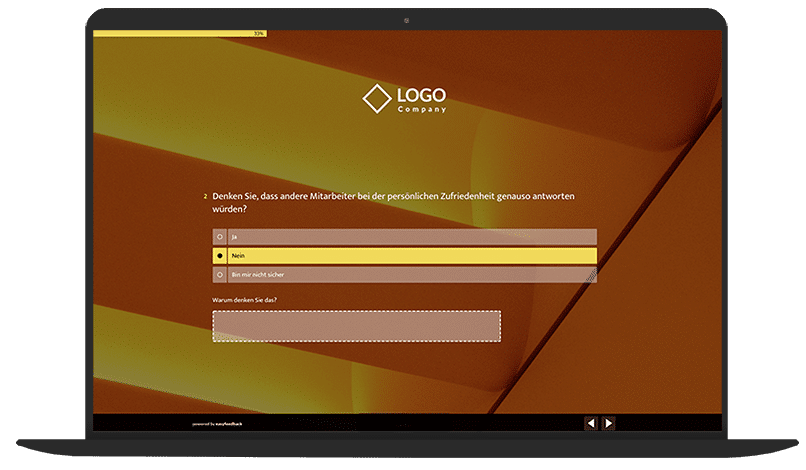
- Supporting organizational development: Surveys provide important feedback during change processes (e.g., restructuring or the introduction of new technologies).
- Evaluating communication and leadership: How are managers perceived? Which communication channels work well — and which don’t?
- Capturing culture and values: Surveys can provide insight into the corporate culture as it is lived and serve as a basis for cultural change.
Types and methods of surveys
Different types of surveys are used in the workplace:
- Online surveys: Fast, efficient, and cost-effective — often conducted using tools such as easyfeedback.
- Paper-based surveys: Used less frequently, but still relevant in certain areas (e.g., in production without PC access).
- Interviews and focus groups: Qualitative methods that are often used to supplement standardized surveys.
- Pulse surveys: Short, regular surveys that provide a continuous picture of sentiment.

Success factors for good surveys
Certain conditions must be met for surveys to deliver effective results:
- Anonymity and trust: Employees must be confident that their responses will be treated confidentially.
- Clear objectives: What is the survey intended to achieve? The more precise the objective, the more targeted the questions will be.
- Professional design: Questions should be formulated in a way that is understandable, neutral, and relevant.
- Transparent communication: The results and the measures derived from them must be communicated openly in order to create credibility.
- Consistent implementation: Even the best survey is useless if no concrete steps are taken as a result.
Challenges and risks

Despite their many advantages, surveys can also present challenges:
- Low participation rates: Without sufficient participation, the results are not meaningful.
- Skepticism about their impact: If surveys are conducted regularly but no consequences are ever visible, willingness to participate declines.
- Over-surveying: Too frequent or poorly coordinated surveys lead to fatigue among employees.
Conclusion
Surveys are a key tool in modern business organizations.
They enable companies to systematically gather the “voice of the employee” and use it as a basis for informed decisions.
However, in order for them to be fully effective, they must be professionally planned, transparently communicated, and, above all, taken seriously.
When used correctly, they contribute significantly to an open corporate culture, higher employee motivation, and ultimately to the success of the company.