
The Organizational Signals Platform
Employee surveys that reveal what is really going on within the company
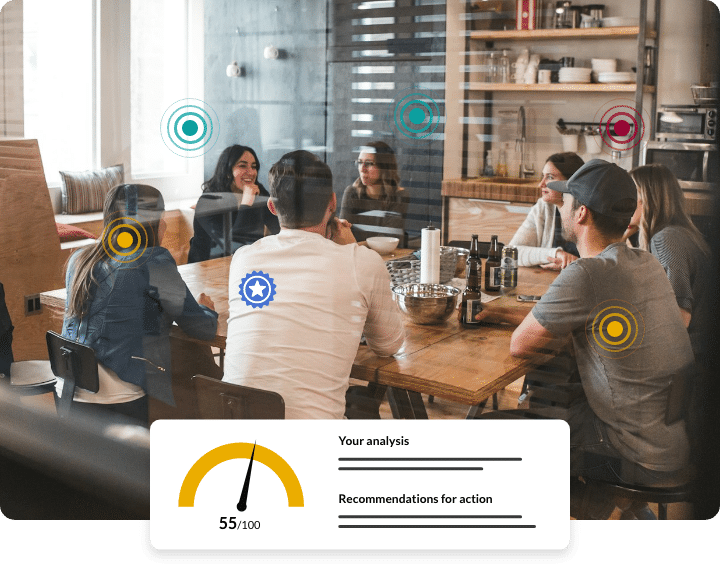
Identify problems, tensions and areas of potential within teams at an early stage — before they affect performance, motivation or staff retention.
Using a structured employee survey, easyfeedback automatically analyzes employee feedback and highlights areas where action is needed.



GDPR-compliant · Made in Germany · Over 10,000 companies rely on easyfeedback






Most employee surveys merely collect data
Companies carry out staff surveys, receive the results — and yet still don’t know:
- Where the real problems lie
- Which teams are at risk
- Where leadership causes problems
- Which risks require urgent attention
After all: gathering feedback is easy.
The challenge: lies in recognising the right signals and using them to identify specific actions.

Employee feedback is more than just feedback
Every organisation sends out signals:
- Declining motivation
- Silent frustration
- Leadership issues
- Lack of identification
- Increasing willingness to change jobs
- Workload in teams
Most companies only recognise these developments once the effects are already becoming apparent. easyfeedback helps to highlight these signs at an early stage — automatically.
Detect what matters before it escalates.
From an employee survey to genuine guidance
Record feedback
Create professional employee surveys using flexible questionnaires, templates and automated survey processes.
Recognising signals
easyfeedback automatically analyses responses and identifies critical trends, patterns and risks within teams and organisations.
Derive the plot
Gain clear insights and practical starting points to resolve issues at an early stage and develop your teams in a targeted manner.
Problems don’t just crop up out of the blue.
They send clear signals beforehand!
Employees rarely hand in their notice out of the blue. Teams don’t lose their performance overnight. Poor leadership doesn’t develop overnight.
The key indicators are usually already there — they’re just recognised too late. With easyfeedback, you can identify these trends at an early stage.
What signals can be detected?
Falling motivation
Identify changes in satisfaction and engagement at an early stage.
Leadership problems
Highlight uncertainties, communication problems and a loss of trust.
Workload in teams
Identify signs of stress and strain before performance begins to decline.
Risks associated with change
Identify at an early stage the signs that employees are mentally checking out.
Lack of identification
Recognise signs of declining loyalty to teams or organisations.
Barriers to change
Highlight any resistance and uncertainty surrounding change.
Create professional staff surveys with ease
From the initial idea to ongoing analysis: easyfeedback covers all common employee surveys.
- Create online staff surveys
- Templates for staff surveys
- GDPR-compliant implementation
- Anonymous staff surveys
- Automatic analyses
- Team and departmental comparisons
- Recurring surveys
- 360-degree feedback
- Snap polls
- Real-time results
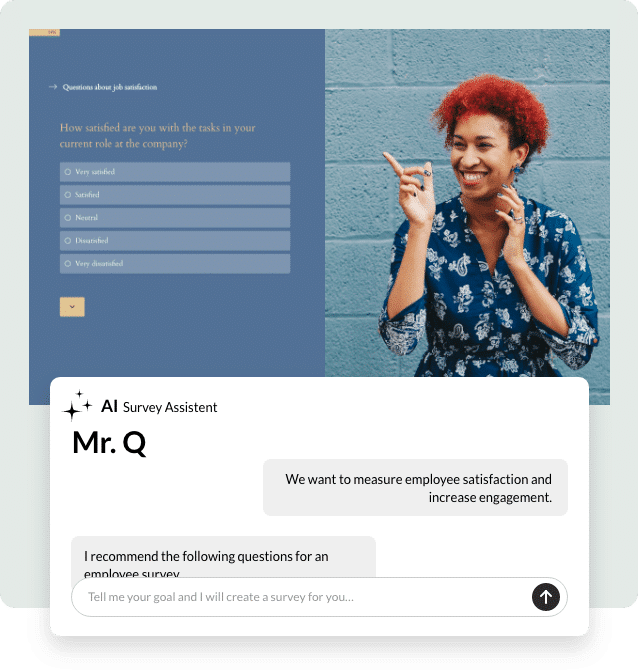
Mr Q – our survey assistant – will design the absolutely perfect survey for you. Just tell him what signals you’re looking for.

Why modern companies rely on organisational signals
Because good decisions shouldn’t be based on guesswork.
easyfeedback helps companies to:
- Identifying problems at an earlier stage
- Highlighting risks
- Understanding teams better
- To improve leadership in a targeted manner
- Retaining staff in the long term
- Strengthening the employer brand through an honest employee survey
No need for complicated enterprise software.
No need for your own team of analysts.
Enterprise-level insights. Without enterprise complexity.
More than 90 professional surveys
Access over 90 survey templates for free, or use our survey wizard, ‘Mr Q’
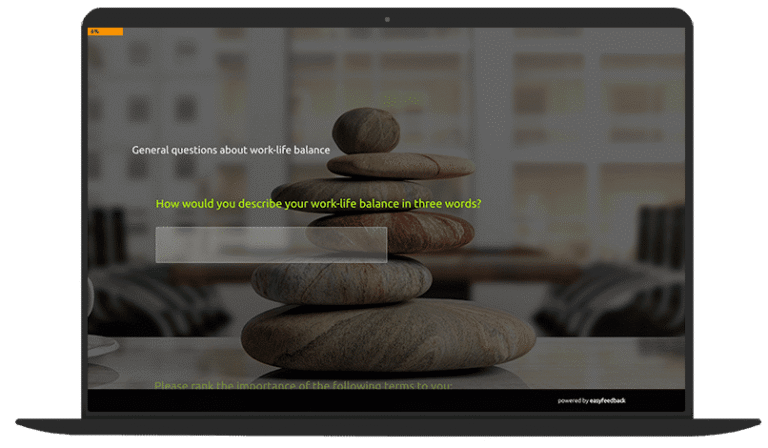
Guidance & Implementation of an Employee Survey
Thousands of companies already have a better understanding of what really drives their organisation
Better decisions | Problems identified earlier | Improved teams | Reduced staff turnover
4,8


Gain an early understanding of what is really going on in your business
Create staff surveys, automatically identify critical trends and take action before problems escalate.
We’re here for you
When you create an employee survey using easyfeedback, you’ll have access to the survey tool and all the survey templates it contains.
When you signed up, we set up a demo survey in your account. This already includes a ready-made questionnaire and results.
This allows you to see straight away how the survey tool works and what it has to offer.
If you have any questions, simply visit the help center or get in touch with us.
How do I create an employee survey using easyfeedback?
With easyfeedback, you can carry out employee surveys easily, quickly and professionally — from creation right through to automatic analysis.
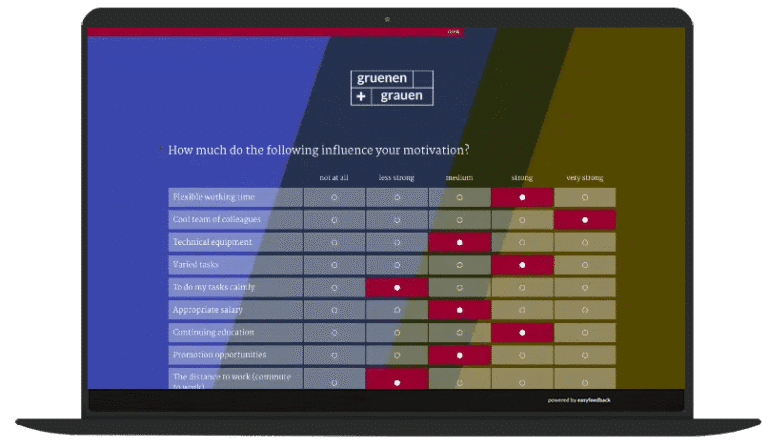
You start by creating a bespoke questionnaire or using tried-and-tested templates for various use cases, such as employee satisfaction, leadership, collaboration or change processes.
You then invite your staff to take part via email, a link or a QR code. The survey is conducted entirely online and can be made anonymous if desired.
Once the staff survey is complete, easyfeedback automatically analyses the results and highlights relevant trends, risks and opportunities within the organisation.
The results are clearly presented in dashboards and reports, enabling you to quickly identify:
- where action is needed
- which teams require particular attention
- and what appropriate measures can be derived.
This transforms a traditional employee survey into a valuable tool for gaining an early understanding of what is really happening within your organisation.
What is an employee survey used for?
Employee surveys are used to systematically identify opinions, sentiments and trends within the organisation.
Companies use employee surveys, amongst other things, to:
- measure employee satisfaction
- assess leadership and collaboration
- improve working conditions
- highlight the corporate culture
- support change processes
- strengthen employee retention
- identify stress and conflicts at an early stage
The primary goal of an employee survey is always the same: to make informed decisions based on genuine feedback rather than on assumptions.
A professional employee survey provides far more than just feedback.
It helps companies to recognise important signals from teams and departments at an early stage, to better understand developments and to make informed decisions — before minor problems turn into major challenges.
Through automated evaluations and intelligent analyses, organisations can identify specific areas for action and implement targeted measures to improve motivation, collaboration and employee retention.
Advantages and disadvantages of an employee survey
Advantage:
The greatest advantage of an employee survey is that it provides early insight into honest — and, if desired, anonymous — feedback from within the organisation.
This gives companies valuable insights into:
- Motivation and satisfaction
- Teamwork
- Leadership behaviour
- Stress and conflicts
- Willingness to embrace change
- Risks of staff turnover or declining performance
A professional employee survey helps to identify critical developments at an early stage — before they develop into major problems.
Digital employee surveys, in particular, can be implemented quickly and efficiently today. No other tool provides such clear signals from a company’s own workforce within such a short time.
Through automated analyses and intelligent evaluations, companies can not only collect data, but also identify specific areas for action and devise targeted measures.
Disadvantage:
One potential disadvantage of staff surveys is that staff may hold back on their answers or not answer completely honestly if they are uncertain about the possible consequences.
This risk can be significantly reduced by conducting anonymous staff surveys. Transparent communication and trust are crucial factors for success in this regard.
However, a far greater disadvantage arises when the results do not lead to any visible action.
If identified problems or suggestions for improvement are consistently ignored, employees’ willingness to take part in future surveys will decline in the long term. Feedback then loses its credibility and impact.
It is therefore important to communicate results openly, set priorities transparently and clearly implement concrete measures — even if, for organisational reasons, not every single idea can be put into practice.
Companies that take employee feedback seriously and actively use it to drive change strengthen trust, engagement and staff retention in the long term.
What should you look out for when choosing an employee survey tool or provider?
When selecting an employee survey tool, provider or service provider, companies should not only focus on the creation of questionnaires, but above all on the insights and opportunities for action that arise from the results.
A professional employee survey tool should:
- be simple and intuitive to use
- enable anonymous employee surveys
- comply with the GDPR
- provide automatic analysis
- highlight trends and risks at an early stage
- deliver clear reports and dashboards
- support concrete recommendations for action
Many providers and service providers of employee survey solutions focus primarily on data collection. However, what really matters is how quickly companies can identify relevant signals and derive measures from them.
easyfeedback combines the simple administration of employee surveys with automated analyses and intelligent evaluations, enabling companies to better understand what is really happening within teams and organisations.
Should staff surveys be carried out anonymously?
Yes, employee surveys should, in most cases, be conducted anonymously in order to obtain honest, open and reliable feedback.
Anonymity builds trust and increases both the willingness to participate and the quality of the responses. Employees are much more open about expressing criticism, concerns or suggestions for improvement when they do not have to fear any personal repercussions.
This gives companies more realistic insights into:
- Mood and satisfaction
- Leadership behaviour
- Teamwork
- Stress and conflicts
- Change processes within the organisation
With easyfeedback, anonymity is technically guaranteed, so that no conclusions can be drawn about individual people. At the same time, automated analyses help to highlight relevant developments and critical signals within the organisation at an early stage.
In certain cases — for example, with small teams, workshops or individual development processes — a non-anonymous staff survey may also be appropriate. In such cases, it is important to communicate transparently with staff.
What questions should I ask in an employee survey?
The questions in an employee survey should be clear, easy to understand and focused on specific objectives. The key is not just to gather feedback, but to highlight the right issues within the organisation.
Typical topics covered in an employee survey include:
- Job satisfaction
- Leadership and communication
- Teamwork
- Workload and stress
- Corporate culture
- Motivation and staff retention
- Change processes and development opportunities
It is important to tailor the questions to the objectives of the employee survey and to use a balanced mix of rating-scale questions, multiple-choice questions and open-ended questions.
Well-formulated questions help companies to identify trends at an early stage, gain a better understanding of problems and derive concrete measures.
easyfeedback supports you in this with tried-and-tested templates, proven questions and flexible customisation options for different applications of employee surveys.
You can find specific examples of employee surveys and sample questions in our overview of questions, examples, and templates.
Does the works council have to give its approval for an employee survey?
In many cases, the works council should be involved at an early stage in the planning of an employee survey. In particular, where the survey enables conclusions to be drawn about behaviour, working practices, satisfaction or organisational developments, co-determination may be required.
The exact extent of involvement depends, amongst other things, on the structure of the employee survey, the data collected and the intended purpose.
Transparent cooperation with the works council fosters:
- trust among employees
- greater acceptance of the survey
- legal certainty
- better conditions for honest feedback
The following are particularly important in this regard:
- clear communication rules
- transparent objectives of the employee survey
- data protection and anonymity
- transparent use of the results
With easyfeedback, employee surveys can be conducted in compliance with the GDPR and, if desired, completely anonymously. At the same time, companies are able to identify relevant trends and organisational signals at an early stage — without drawing conclusions about individual employees.
In addition, easyfeedback provides support through transparent data protection information, a sample agreement for the works council, and technical settings that can also be made available to the works council.
Tips and best practices for conducting an employee survey
Clear objectives, transparent communication and a process based on trust are crucial for a successful employee survey.
Employees should understand in advance:
- why the employee survey is being conducted
- what the objectives are
- how the results will be handled
- and how anonymity and data protection will be ensured
Another key factor for success is a clearly structured and relevant questionnaire. Employee surveys that are too long or unclear often have a negative impact on the response rate and the quality of the answers.
Employee surveys are particularly effective when companies not only gather feedback but also actively identify:
- where problems arise
- which teams need support
- and which developments require early attention
Following the evaluation, results should be communicated transparently and concrete measures clearly derived from them. Employees must recognise that their feedback is taken seriously and can bring about change.
With easyfeedback, companies benefit from automated evaluations, clear reports and intelligent analyses that highlight relevant trends and organisational signals at an early stage and support the identification of appropriate measures.