

“Identifying user needs is at the heart of our business. easyfeedback has been helping us with this task for several years now. We particularly appreciate its intuitive usability and professional support.”

“We use easyfeedback for internal and external surveys—it’s fast, convenient, and easy! The uncomplicated and friendly support puts a smile on our faces, and we are delighted with the continuous development of the platform.”
Motivated employees are one of the most important drivers of business success. But what happens when motivation starts to decline?
In most cases, performance drops. Tasks still get completed, but employees are less likely to go the extra mile or deliver outstanding results.
Low motivation can also spread quickly throughout a team, leading to higher absenteeism, lower morale, and even employee turnover.
The consequences include disrupted workflows, increased recruitment costs, and the loss of valuable knowledge and experience.
The good news? It doesn’t have to be this way.
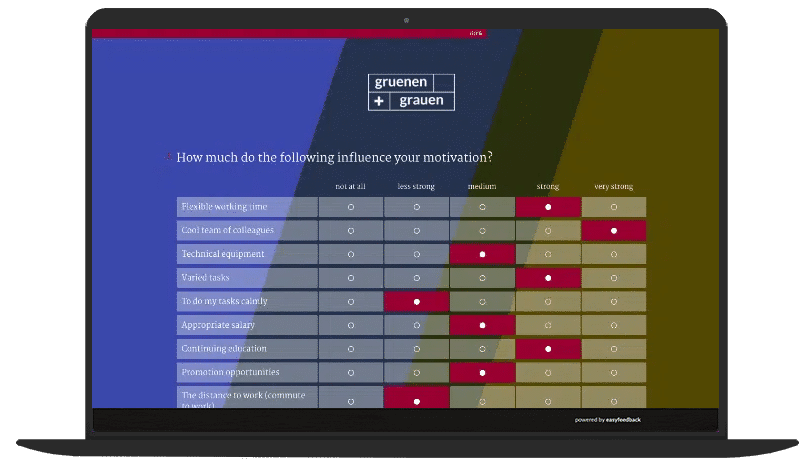
Our employee motivation survey template helps you identify changes in employee sentiment early and understand what truly motivates your workforce.
With these insights, you can better address your employees’ needs and implement targeted measures that make a real difference.
The result: lower turnover, higher employee motivation, stronger engagement, and long-term talent retention.
Contents of the template:
Objectives of the survey:
Helpful features for the survey:

Data protection „made in Germany“ (GDPR)

Anonymity function for honest feedback
Employee motivation refers to the internal and external factors that influence an employee’s willingness and drive to perform their work with commitment, efficiency, and purpose.
It is a key aspect of people management and plays a vital role in employee performance, engagement, and satisfaction.
Employee motivation has a significant impact on an organization’s overall success.
Motivated employees complete their tasks reliably, contribute new ideas, identify with their organization, and actively support the achievement of business goals. They are more engaged, perform at a higher level, and generally enjoy coming to work.
When motivation is lacking, the effects can be far-reaching. Performance often declines, team morale suffers, and the overall workplace atmosphere can deteriorate. In addition, employees are more likely to leave the organization, resulting in higher recruitment and onboarding costs as well as potential disruptions to business operations.
For this reason, it is essential for organizations to identify the factors that influence employee motivation at an early stage. Understanding employees’ needs and addressing them with targeted initiatives helps create meaningful incentives, strengthen engagement, and improve long-term employee retention.
High employee motivation delivers lasting business benefits. It reduces employee turnover, increases productivity, and contributes to a healthier workplace culture. Motivated employees feel a stronger connection to their organization, collaborate more effectively, and make a valuable contribution to sustainable business success.
Investing in employee motivation is therefore an essential part of building a successful, resilient, and future-ready organization.
Employee motivation offers numerous benefits that are highly valuable for both organizations and employees.
Here are some of the key benefits:
1. Benefit: Increased Productivity
Motivated employees work more efficiently and with greater commitment.
They are willing to go the extra mile to perform their tasks to the best of their ability.
This leads to higher productivity and better business results.
2. Benefit: Higher Employee Satisfaction
Motivation plays a key role in employee satisfaction.
When employees feel valued and enjoy their work, their job satisfaction increases, contributing to a more positive workplace culture.
3. Benefit: Lower Employee Turnover
Motivated employees are more likely to stay with the organization over the long term.
High employee motivation reduces employee turnover, lowering the costs associated with recruiting and onboarding new employees.
4. Benefit: A Better Workplace Culture
A motivated team contributes to a positive and collaborative work environment.
When employees enjoy coming to work, they are more supportive, helpful, and work together more effectively.
5. Benefit: Greater Creativity and Innovation
Motivated employees are often more creative and more willing to contribute innovative ideas.
They feel encouraged to develop new solutions and suggest improvements, helping the organization gain a competitive advantage.
6. Benefit: Stronger Customer Loyalty
Happy and motivated employees interact more positively with customers, resulting in higher customer satisfaction and stronger long-term customer loyalty.
Motivated employees represent the organization in a way that builds customer trust and loyalty.
7. Benefit: Reduced Absenteeism
Motivation also has a positive impact on employee health and well-being.
Motivated employees are less likely to take sick leave, resulting in lower absenteeism and more consistent performance.
8. Benefit: Achievement of Business Goals
A motivated workforce is essential for achieving an organization’s strategic objectives.
Motivated employees work with greater focus and are more committed to contributing to the organization’s success.
9. Benefit: Stronger Organizational Commitment
Motivated employees feel a stronger connection to their organization.
They identify with the organization’s values and goals and are more willing to contribute their skills, knowledge, and expertise to its success.
1. Type: Intrinsic Motivation
This type of motivation comes from within the employee, for example through enjoyment of work, personal goals, or the feeling of making a meaningful contribution.
Intrinsically motivated employees often work out of their own initiative because they find their work fulfilling and challenging.
2. Type: Extrinsic Motivation
This type of motivation is driven by external factors such as salary, bonuses, recognition, or career opportunities.
Extrinsic incentives can increase performance in the short term, but they are often less sustainable than intrinsic motivation.
The motivation to perform a job ultimately varies from employee to employee. A young professional starting their career has very different expectations of their employer compared to a parent of two children.
Nevertheless, there are some general factors that influence employee motivation, which we have summarized below:
1. Factor: Salary
Although money is usually not the number one motivator, it still plays an important role.
An employee’s financial situation can have a significant impact on their motivation.
If the salary does not meet employees’ needs and expectations, even the most interesting job can become demotivating.
Employees who feel financially overstretched or struggle to cover their basic needs may not be able to perform at their full potential.
This can lead to dissatisfaction, frustration, and ultimately a lack of engagement.
A fair salary also signals appreciation from the employer and can strengthen employees’ sense of belonging and respect.
On the other hand, insufficient compensation can negatively affect trust and employee loyalty, potentially leading to higher turnover in the long term.
Therefore, it is important that companies not only focus on working conditions and employee development opportunities but also ensure that compensation is fair and aligned with market standards.
Regularly reviewing and adjusting salary structures based on current economic conditions and industry standards is essential to ensure long-term employee motivation and retention.
2. Factor: Career Opportunities
Especially for younger employees, the opportunity to develop within the organization, take on more responsibility, or advance their career is an important goal.
Without these opportunities, employees may quickly become demotivated and frustrated.
People who lack future prospects are more likely to look for new opportunities elsewhere.
The prospect of professional development and growth opportunities is a key motivational factor for employees, particularly those at the beginning of their careers.
The desire for personal and professional growth is a natural driver that helps maintain engagement and motivation.
If employees are not provided with clear opportunities to expand their skills or pursue their career goals, this can significantly reduce their motivation.
An organization that provides clear career paths, training opportunities, and chances to take on responsibility not only increases employee motivation but also strengthens long-term employee retention.
Through targeted talent development programs and regular feedback discussions, employers can ensure that employees remain motivated and engaged while having the opportunity to reach their full potential.
The lack of career opportunities within an organization can not only result in talented employees leaving the company but can also lead to a loss of internal expertise and weaker identification with organizational goals.
Companies should therefore strive to promote a culture of continuous development and growth in order to strengthen employee motivation and retention while ensuring long-term success.
3. Factor: Manager / Supervisor
A good manager recognizes the talents of their employees, supports their development, and assigns tasks based on their individual strengths.
A supervisor who listens to employees, supports them, and takes their concerns seriously plays a major role in increasing employee motivation.
Even genuine recognition and praise from a manager can quickly boost an employee’s motivation.
In contrast, a poor relationship with a supervisor can place a significant burden on employees.
If managers are unavailable, do not listen to their employees, or apply excessive pressure due to their position of authority, this can quickly lead to demotivation.
The relationship between managers and employees plays a crucial role in the motivation and performance of a team.
A respectful and supportive relationship builds trust and encourages collaboration within the team.
Employees feel valued and are more willing to give their best to achieve shared goals.
On the other hand, an authoritarian or distant leadership style can negatively impact the workplace atmosphere and result in reduced engagement.
Employees who do not feel heard or supported are less likely to identify with their work and may even start looking for other career opportunities.
Therefore, it is essential for managers to maintain open communication, respond to employees’ needs, and create an environment where people feel valued and supported.
Through positive and respectful leadership, managers can help increase employee motivation and satisfaction while contributing to the long-term success of the organization.
4. Factor: Daily Work Environment
What does a typical workday look like for you?
Are piles of documents so high that you can no longer see the person sitting across from you? Is the phone constantly ringing? Are tasks impossible to complete because important information is missing? Sounds like a nightmare?
Yet for many companies, this is part of the everyday work routine.
Stress and feeling overwhelmed are among the main causes of workplace demotivation.
In contrast, a well-structured workday with fair task distribution and the mindset of “We can achieve this together!” can significantly contribute to increasing motivation.
A reasonable workload and clear priorities help employees manage their responsibilities more effectively and reduce stress.
Open communication about workload and the ability to receive support from colleagues or managers are also important factors in preventing situations of excessive pressure.
In addition, company culture plays a crucial role in dealing with stress and workload challenges.
Organizations that foster a culture of appreciation and teamwork create an environment where employees support each other and overcome challenges together.
This not only strengthens team spirit but also contributes to individual motivation and satisfaction.
By providing employees with the necessary resources to perform their work effectively while promoting a positive and supportive workplace environment, organizations can help reduce stress and increase motivation.
5. Factor: Work-Life Balance
While it may be acceptable for someone at the beginning of their career to work overtime until late at night every day, this is usually not sustainable for a parent with family responsibilities.
A healthy balance outside of work is important to recharge and regain energy for the next day.
If personal life suffers because of work, dissatisfaction can quickly develop. Flexible working hours and overtime compensation can help address this issue.
It is important to recognize that every employee has different needs and responsibilities that influence their working life.
While some employees may accept overtime and a high workload to achieve professional goals, others may not have the same flexibility due to personal circumstances, such as family responsibilities, health considerations, or other commitments.
Flexible working arrangements allow employees to adapt their schedules to their individual needs and create a better balance between work and personal life.
This may include starting work earlier and finishing earlier to spend more time with family or occasionally working remotely to avoid long commuting times.
In addition, overtime compensation ensures that employees are appropriately rewarded for additional working hours while also having the opportunity to rest and enjoy their personal time.
This not only promotes work-life balance but also helps prevent burnout and workplace stress.
By introducing flexible work models and overtime compensation mechanisms, organizations can increase employee satisfaction and motivation while creating a healthy and productive work environment.
6. Factor: Identification with the Organization and Its Goals
Identification with the organization also plays an important role in employee motivation.
When employees identify with the company’s goals and consider them personally meaningful, they are more motivated to contribute to achieving these objectives. This positive effect can often be seen in organizations working in the social sector.
Employees who identify with their organization’s values, mission, and vision often develop a deeper sense of connection and commitment.
They see their work not merely as a way to earn money but as a contribution to a larger shared purpose.
This can create a sense of fulfillment and meaning that increases employee motivation and willingness to perform.
Companies that focus on social or environmental goals often provide employees with an additional source of motivation.
Employees who are passionate about these goals see their work as an opportunity to create positive change in society and are therefore willing to contribute with greater dedication and commitment.
To strengthen employee identification with the organization, it is important to communicate a clear company culture and values and ensure that these values are reflected in everyday work.
Through regular communication and employee participation, organizations can ensure that employees feel heard and involved, helping them develop a stronger connection with the company.
Organizations that succeed in creating a positive and inspiring company culture where employees identify with shared goals and values will benefit in the long term from motivated and engaged employees who are willing to give their best to achieve common objectives.
Measuring employee motivation is essential to understanding how engaged and satisfied your employees are and to developing targeted measures to improve motivation.
Here are some methods and tools for measuring employee motivation:
1. Method: Employee Surveys
2. Method: Employee Discussions and Feedback
3. Method: Engagement Index
4. Method: Employee Turnover Rate
5. Method: Performance Metrics
6. Method: 360-Degree Feedback
7. Method: Observations
8. Method: Workplace Climate and Culture Analysis
9. Method: Motivation and Engagement Tools
10. Method: Exit Interviews
What examples and opportunities are there to promote employee motivation?
There are many practical examples of how employee motivation can be encouraged and strengthened.
Here are some proven methods and approaches:
1. Example: Recognition and Appreciation
Regular recognition and appreciation of employee achievements are powerful motivators.
A simple “thank you” or public recognition for a job well done can boost self-esteem and increase employee engagement.
Example:
A company introduces monthly employee meetings where outstanding achievements of individual employees are highlighted and rewarded, for example through an “Employee of the Month” program.
2. Example: Goal Setting
Clear and achievable goals motivate employees to stay engaged and improve their performance.
By involving employees in the goal-setting process, they feel more committed to achieving these objectives.
Example:
A sales team is encouraged to set individual sales targets together with their team leader. When these goals are achieved, employees receive bonuses or other rewards.
3. Example: Training and Development Opportunities
Investing in employee training demonstrates that the organization values their professional growth and development.
This motivates employees to expand their skills and advance their careers within the organization.
Example:
A company offers regular training sessions, workshops, or opportunities to attend conferences to support employees’ professional development.
4. Example: Flexible Working Hours
Flexible working models can improve work-life balance and increase employee motivation.
When employees can adjust their working hours to their personal needs, they often feel more satisfied and productive.
Example:
A company allows employees to arrange their working hours flexibly or work remotely, which can be particularly motivating for parents or people with long commutes.
5. Example: Employee Involvement in Decision-Making
Including employees in decision-making processes gives them the feeling that their opinions are valued and that they have a real influence on the organization.
This can significantly increase motivation and engagement.
Example:
A company organizes regular team workshops where employees can share ideas and suggestions that are taken into consideration when making strategic decisions.
6. Example: Health and Wellness Programs
Programs that support employees’ physical and mental health can increase motivation by improving overall well-being and energy levels.
Example:
A company provides employees with access to a fitness center, regular health check-ups, or mindfulness workshops to support their health and well-being.
7. Example: Performance-Based Incentives
Financial incentives such as bonuses or profit-sharing programs linked to performance can provide a strong motivational boost.
These rewards encourage employees to make additional efforts to achieve organizational goals.
Example:
A company offers an annual profit-sharing program in which a portion of the company’s profits is distributed among employees based on their individual performance.
8. Example: Career Opportunities
Clear promotion opportunities and career paths within the organization motivate employees to stay with the company long term and continue developing professionally.
Example:
A company implements an internal development program that prepares employees for higher positions and provides clear career progression opportunities.
9. Example: Company Culture and Team Spirit
A positive company culture that promotes collaboration, openness, and respect can significantly increase employee motivation.
A strong sense of community helps employees feel comfortable and connected within the organization.
Example:
A company organizes regular team events such as shared lunches, company outings, or celebrations to strengthen team spirit and promote a positive company culture.
10. Example: Encouraging Innovation
Encouraging employees to contribute new ideas and drive innovation can be highly motivating.
When employees see that their suggestions are valued and implemented, their motivation increases.
Example:
A company establishes an “innovation lab” where employees can present and test their ideas, with the best suggestions being implemented in practice.
If you want to better understand employee motivation within your organization, targeted questions can help you gain valuable insights.
Here are some questions you can ask to assess your employees’ motivation:
1. Category: Job Satisfaction
2. Category: Recognition and Appreciation
3. Category: Goals and Expectations
4. Category: Professional Development
5. Category: Work Environment
6. Category: Communication and Collaboration
7. Category: Work-Life Balance
8. Category: Company Culture
9. Category: Rewards and Incentives
10. Category: Feedback and Support