
“Identifying user needs is at the heart of our business. easyfeedback has been helping us with this task for several years now. We particularly appreciate its intuitive usability and professional support.”

“We use easyfeedback for internal and external surveys—it’s fast, convenient, and easy! The uncomplicated and friendly support puts a smile on our faces, and we are delighted with the continuous development of the platform.”
Individual stress in the workplace is often difficult to recognize and frequently only becomes apparent after a delay.
In most cases, it only becomes noticeable when performance has already declined as a result of the stress—often too late to take timely countermeasures.
Targeted employee surveys make it possible to identify emerging stress factors at an early stage.
They offer valuable insights into the actual workplace situation and satisfaction in various areas.
Anonymous surveys can also reveal the underlying causes of stress.
This allows undesirable developments to be identified at an early stage and problems such as discrimination to be avoided.
Enable timely action to prevent excessive increases in workplace stress and promote a healthy working environment.
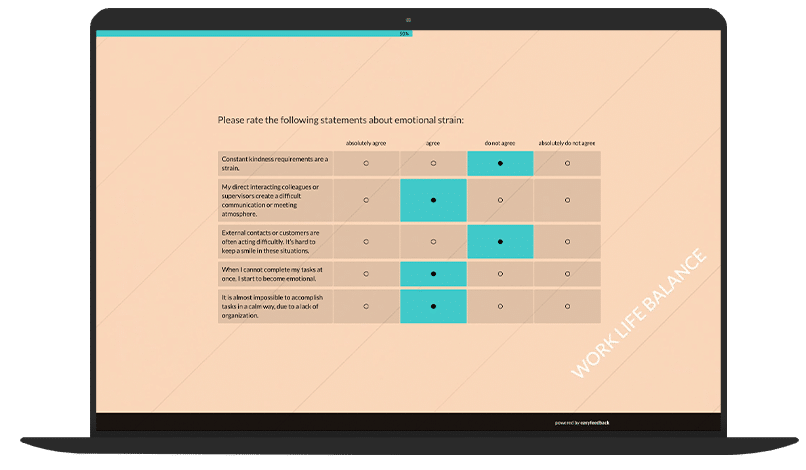
Contents of the template:
Objectives of the survey:
Helpful features for the survey:

Data protection „made in Germany“ (GDPR)

Anonymity function for honest feedback
In general, psychological stress refers to all external factors that arise during work and have a psychological impact on a person.
Factors such as a temporarily increased workload, occasional overtime, or a bad-tempered manager can occur in an employee’s daily work routine from time to time. In most cases, these situations do not have any direct consequences.
However, if psychological stress in the workplace continues over a longer period of time, for example due to permanently high workloads caused by staff shortages, it can have negative consequences.
One possible consequence is an employee’s internal resignation. This means that the employee has already mentally disengaged from the company, which can negatively affect their willingness to perform and the overall atmosphere within the team.
Other negative consequences may include an actual resignation or absence due to illness.
According to a study by Wellnow, 85% of employees feel stressed by their work. For 77% of respondents, stress has physical effects, while 38% experience psychological effects.
From a business perspective, it is therefore beneficial to counteract excessive psychological stress in the workplace in order to prevent potential employee absences and declining company efficiency.
What are the consequences of psychological stress in the workplace?
The consequences of psychological stress in the workplace can be diverse.
They include stress, anxiety, depression, burnout, sleep disorders, concentration problems, reduced motivation, increased absenteeism, and a disrupted work environment.
In the long term, these consequences can negatively affect employees’ health and impair their performance and quality of work.
What are examples and causes of psychological stress in the workplace?
Examples of psychological stress factors in the workplace include:
These stress factors can lead to stress, anxiety, depression, burnout, and other mental health issues.
It is important to identify these factors and address them through appropriate measures, such as healthy work organization, support from managers and colleagues, and initiatives that promote mental health in the workplace.
Physical strain in the workplace refers to all physical demands and stresses that can occur while performing work-related activities.
This includes, for example, heavy physical work, repetitive movements, awkward postures, one-sided physical strain, vibrations, noise, and heat.
Such physical demands can lead to musculoskeletal disorders, injuries, fatigue, and other health problems if they are not managed appropriately.
It is important to identify physical strain in the workplace and minimize it through ergonomic measures in order to protect employees’ health and safety.
What are examples and causes of physical strain in the workplace?
Examples of physical strain in the workplace include:
These physical demands can lead to health issues such as musculoskeletal disorders, injuries, fatigue, and other physical complaints.
It is important to identify these factors and minimize them through ergonomic measures in order to protect employee health.
A comprehensive risk assessment for psychological and physical workplace hazards can be carried out through the following steps:
1. Step: Data Collection
Gather information about the work organization, work tasks, the working environment, interpersonal relationships, and physical working conditions such as noise, lighting, and room climate.
2. Step: Identification of Stress Factors
Identify potential stress factors affecting both the psychological and physical health of employees. These may include high workloads, conflicts, physically demanding tasks, unfavorable working hours, or ergonomic risks.
3. Step: Evaluation of Stress Factors
Assess the severity, frequency, and duration of the identified stress factors as well as their potential impact on employees’ health and safety.
4. Step: Development of Measures to Reduce Workload and Stress
Develop suitable measures to reduce or eliminate the identified stress factors.
These may include redesigning work processes, improving ergonomics, providing training, or implementing support programs.
5. Step: Implementation of Measures
Consistently implement the developed measures to reduce workplace strain and ensure that they are accepted and supported by employees.
6. Step: Review and Adjustment of Measures
Regularly review the effectiveness of the implemented measures and adjust them if necessary to ensure that employees’ health and safety are protected in the long term.
According to the Ärzteblatt , the number of mental health disorders (mainly depression, burnout, anxiety disorders, and addiction-related illnesses) has increased significantly over the past 20 years. The number of sick days caused by mental health issues has also risen.
Compared to other illnesses, the absence periods of affected employees are three times longer.
An important approach to addressing this issue is therefore prevention.
But where can you obtain the necessary information about which areas of the workplace are particularly affected by high levels of stress? And where can you take action?
Every person deals differently with the many small and major challenges of everyday working life. One employee may be motivated by learning a new area of responsibility, while another may feel overwhelmed by the same challenge.
Therefore, individual workplace stress is rarely immediately visible from the outside. The effects often only become apparent after some time.
To identify psychological stress factors in the workplace, a regular employee survey is therefore particularly suitable.
Based on the results, you can identify negative developments at an early stage and prevent problems, such as those caused by workplace bullying.
You also gain the opportunity to take action and keep workplace stress levels under control. This allows you to prevent employee absences due to illness while also positively influencing the overall effectiveness of your company.
Both your employees and your organization benefit from this.
Please note:
Changing working conditions rarely requires high financial investment. In most cases, it mainly requires initiative and a willingness to rethink existing processes within the company.
Therefore, take action and create a sustainable positive impact on the working environment for your employees.
In general: Design your questionnaire for measuring workplace stress in a clear and structured way and focus on the most important questions.
First, develop a concept. Which employees do you want to survey? In which areas, for example, is the workload or sickness absence proportionally higher than in others?
It is important to measure mental, physical, and emotional stress levels and to identify possible overload situations and experiences of discrimination.
Ask your employees to rate their job satisfaction, for example, using a rating scale. As a next step, you can ask about the reasons behind their rating.
Questions regarding relationships with colleagues and supervisors can also provide valuable insights.
Tip:
Very few employees like to openly admit that they are overwhelmed by their workload. The fear of being perceived as “not capable enough” is often too strong. Therefore, conduct the employee survey anonymously. This allows you to gain an honest insight into your employees’ daily working experiences.
Creating an employee survey is simple. With easyfeedback, you can quickly and easily create your own questionnaire on workplace stress or use our ready-made survey template.
For a survey to assess psychological and physical workplace stress, you can ask a variety of questions covering different aspects.
Here are some examples of questions that you could include in your survey:
Questions regarding psychological stress
Questions regarding physical stress
These questions can serve as a starting point for your workplace stress survey.
Depending on the specific requirements and context of your organization, you can add further questions or adapt the existing ones.
It is important to ensure that the questions are clearly formulated, easy to understand, and non-leading in order to obtain reliable and meaningful data.
The analysis and evaluation of psychological and physical workplace stress is an important step in reviewing the effectiveness of implemented measures and making adjustments where necessary.
Here are some steps that can help with this process:
1. Step: Data Analysis
Evaluate the results of the risk assessment as well as other relevant data sources, such as sickness absence statistics, employee feedback, and accident reports.
2. Step: Identification of Trends
Identify long-term trends or recurring patterns related to psychological and physical workplace stress factors.
3. Step: Evaluation of Measures
Review the effectiveness of the implemented measures for reducing and preventing workplace stress.
Determine whether the measures have effectively addressed the identified stress factors and whether positive changes have occurred in the working environment and employee health.
4. Step: Collecting Employee Feedback
Survey employees regularly about their perception of working conditions, stress factors, and the effectiveness of the implemented measures.
5. Step: Health Monitoring
Regularly monitor employee health to identify potential health issues at an early stage and take appropriate action.
6. Step: Continuous Improvement
Based on the results of the analysis and evaluation, make adjustments and improvements to further optimize working conditions and promote employee health and safety in the long term.
A questionnaire on employee satisfaction and workplace stress is a valuable tool for obtaining honest employee feedback.
It provides insights into your employees’ daily physical and psychological workplace stress levels as well as their satisfaction in different areas.
Based on the results, you can first determine the current situation.
You can identify which areas are affected by problems and what type of issues exist.
In the second step, you can then specifically address these challenges and develop concrete recommendations for action.
This allows you to improve your employees’ working conditions and strengthen their commitment to the company by increasing overall employer attractiveness.
In this way, you also fulfill your duty of care as an employer and help prevent employee absences caused by workplace stress.