

“Identifying user needs is at the heart of our business. easyfeedback has been helping us with this task for several years now. We particularly appreciate its intuitive usability and professional support.”

“We use easyfeedback for internal and external surveys—it’s fast, convenient, and easy! The uncomplicated and friendly support puts a smile on our faces, and we are delighted with the continuous development of the platform.”
How does information flow within your company? Is internal communication clear, efficient, and targeted? Are all employees always included in the flow of information?
The quality of internal communication can be crucial to the success of your company.
By providing your employees with all relevant information and at the same time valuing their participation, you not only promote transparency, but also commitment and trust.
Use regular employee surveys to identify weaknesses in communication. Your employees know best where improvements are needed.
A fresh perspective makes it possible to implement targeted measures for improvement, thereby sustainably increasing efficiency and the working atmosphere.
Contents of the template:
Objectives of the survey:
Helpful features for the survey:

Data protection „made in Germany“ (GDPR)

Anonymity function for honest feedback
According to author Philip Meier , internal communication is an instrument that regulates all communication and information relationships within an organization through clearly defined or situationally applied communication channels and media.
As a part of overall corporate communication, internal communication includes the exchange of information between management and employees as well as communication among employees themselves.
A distinction is made between formal internal communication and informal internal communication.
Formal internal communication refers to the targeted distribution of information to all relevant stakeholders, for example through meeting minutes, official announcements, or communication within scheduled meetings.
Informal communication, on the other hand, refers to the usually unstructured exchange of information, for example during an accidental encounter at the coffee machine, in the cafeteria, or through a spontaneous conversation with a colleague.
Internal and external communication are two essential aspects of communication management within organizations.
Both have different target groups and purposes, but they are crucial for the overall success of a company.
Internal Communication
Internal communication refers to the exchange of information, ideas, and messages within an organization. It includes all communication channels and methods used to inform, motivate, and coordinate employees, teams, and departments.
Target groups:
Objectives:
Examples of internal communication tools:
External Communication
External communication refers to the exchange of information, ideas, and messages between an organization and external stakeholders. It includes all communication channels and methods used to communicate with customers, partners, suppliers, investors, the media, and the general public.
Target groups:
Objectives:
Examples of external communication tools:
Communication is the key element for every successful relationship.
When there is a balanced relationship between speaking and listening and communication is based on mutual respect, it has a positive impact on the relationship.
However, if communication is one-sided or there is little exchange between people, problems can quickly arise.
This also applies to communication within an organization.
If communication processes within a company are not functioning properly, this can become a significant challenge that affects all areas of the organization and its employees.
Therefore, it is essential for companies to actively address this aspect.
For example, imagine an employee who constantly lacks important information needed to complete their tasks.
This could result in the employee being unable to fulfill assigned responsibilities or a decline in the quality of their work.
This would negatively affect both the employee’s motivation and the achievement of the company’s goals.
On the other hand, effective internal company communication can significantly improve organizational efficiency.
A respectful and appreciative working environment has a positive impact on employee motivation. Employees develop a stronger connection to the company and work more productively.
Internal communication therefore has a major influence on achieving business objectives and shaping the company culture.
It strengthens the sense of belonging and promotes open communication and transparency throughout the organization.
To ensure effective communication, companies can implement various measures, such as regular team meetings, the introduction of communication tools for information exchange, or the creation of an open and transparent communication environment where employees feel encouraged to share their concerns and submit their ideas and suggestions.
Internal communication has several important objectives that help promote efficiency, collaboration, and employee well-being within an organization.
Here are some of the main objectives:
1. Objective: Information sharing
Ensuring that all employees are informed about important news, changes, policies, and company goals. This prevents misunderstandings and ensures that everyone has access to the same information.
2. Objective: Employee engagement
Promoting employee motivation and employee engagement through transparent communication, recognition, and involvement in decision-making processes. Engaged employees are generally more productive and loyal to the organization.
3. Objective: Promoting corporate culture
Communicating and strengthening the company’s values, vision, and culture. A strong corporate culture contributes to a positive working environment and creates a shared sense of identity.
4. Objective: Collaboration and teamwork
Facilitating cooperation and knowledge exchange between departments and teams. Effective internal communication supports collaboration and the sharing of expertise, leading to innovative solutions and improved results.
5. Objective: Feedback and improvement
Enabling employee feedback and employee input to support continuous improvement and organizational development. This creates a sense of appreciation and involvement among employees.
6. Objective: Building trust
Developing and strengthening trust between employees and management through open, honest, and transparent communication. Trust is the foundation for successful collaboration and a positive working environment.
7. Objective: Conflict prevention and resolution
Identifying and addressing issues and conflicts at an early stage to prevent escalation and find effective solutions. Good communication supports both conflict prevention and conflict resolution.
8. Objective: Increasing efficiency
Optimizing workflows and reducing duplicated efforts through clear and precise communication. This saves time and resources while improving the overall efficiency of the organization.
9. Objective: Employee development
Supporting employees’ professional development by providing information about training opportunities, further education, and career paths. This encourages employee growth and long-term development within the organization.
10. Objective: Safety and well-being
Ensuring that all employees are informed about safety guidelines and procedures to maintain a secure working environment. In addition, effective internal communication contributes to employees’ overall well-being and satisfaction.
The central pillars of internal communication include the communication strategy, the communication culture, and the communication structure.
Together, they form the foundation for effective information exchange within an organization and make a significant contribution to efficient collaboration.
1. Pillar: Communication Strategy
The communication strategy includes both the conceptual and strategic planning of internal communication.
The central question is which information employees need in order to successfully and effectively perform their tasks.
An effective communication strategy focuses on the needs of employees and ensures that relevant information is communicated to the appropriate target groups at the right time and in an appropriate format.
This creates transparency and strengthens the overall ability of the organization to act effectively.
2. Pillar: Communication Culture
Communication culture focuses on the way people communicate with each other within the organization.
It addresses the tone of communication and the fundamental values required for achieving common goals and maintaining respectful cooperation.
A positive communication culture promotes openness, trust, and mutual respect, creating an environment in which employees feel heard and valued.
This applies not only to communication between managers and employees, but also to the exchange of information among colleagues.
Communication culture is often closely linked to the company philosophy, a corporate mission statement for collaboration, and a leadership strategy based on transparency, dialogue, and employee participation.
3. Pillar: Communication Structure
The communication structure describes the organizational processes and framework conditions that enable effective communication.
It defines how information is distributed within the company, which communication channels are used, and who is responsible for sending, receiving, and forwarding information.
A distinction is made between centralized structures with fewer, shorter, and therefore faster communication paths, and decentralized structures with multiple and longer communication paths.
A clearly defined and efficient communication structure plays a crucial role in ensuring smooth information flow, preventing misunderstandings, and accelerating decision-making processes.
Success factors in internal communication are crucial for designing the flow of information within a company in an effective and efficient way.
Here are some of the most important success factors:
1. Factor: Transparency
Openness and clarity in communication promote trust and understanding. Information should be shared as transparently as possible.
2. Factor: Regularity
Continuous and consistent communication ensures that employees are always up to date and feel well informed.
3. Factor: Relevance
Information must be relevant and useful for the recipients. Unnecessary or irrelevant messages should be avoided.
4. Factor: Accessibility
Information should be easily accessible. Use different channels such as intranets, emails, apps, and meetings to ensure that all employees have access to important information.
5. Factor: Feedback Culture
A culture that enables and values regular feedback significantly improves internal communication. Employees should be encouraged to share their opinions and ideas.
6. Factor: Clarity and Understandability
Information must be communicated in a clear and understandable way. Avoid technical jargon and complex wording that could lead to misunderstandings.
7. Factor: Interactivity
Communication should not be a one-way process. Encourage dialogue and interaction between employees and different levels of management.
8. Factor: Leadership Skills
Managers play a key role in internal communication. They should be well trained and act as role models.
9. Factor: Variety of Communication Channels
Use different communication channels to address the diverse needs and preferences of employees.
10. Factor: Timeliness
Information should be shared at the right time to avoid delays and misunderstandings.
11. Factor: Trust and Credibility
Honest and open communication strengthens employee trust and increases the credibility of managers and leaders.
12. Factor: Cultural Sensitivity
Consider cultural differences within the workforce and adapt communication strategies accordingly.
13. Factor: Technological Support
Use modern technologies and tools to make communication more efficient and effective.
Effective internal communication is essential for the success of a company.
Here are some strategies to improve internal communication:
1. Strategy: Transparent and Open Communication
Promote a culture of transparency and openness where information is shared regularly and honestly. Employees should feel that they can ask questions and provide feedback at any time.
2. Strategy: Regular Updates and Meetings
Hold regular meetings and updates to keep employees informed about current developments, company goals, and achievements. This can be done through weekly or monthly team meetings or regular email updates.
3. Strategy: Use a Variety of Communication Channels
Use a wide range of communication channels to ensure that all employees are reached. These may include emails, intranets, internal social networks, video conferences, messaging apps, and personal meetings.
4. Strategy: Involve Employees
Actively involve employees in the communication process by asking for their opinions and ideas. This can be achieved through surveys, feedback forms, workshops, or regular feedback sessions.
5. Strategy: Clarity and Consistency
Ensure that communication is clear, precise, and consistent. Avoid technical jargon and complex terms that may not be understood by all employees.
6. Strategy: Managers as Role Models
Managers should serve as role models for effective communication. They should be transparent, approachable, open to feedback, and communicate regularly with their teams.
7. Strategy: Celebrate Successes and Milestones
Celebrate company achievements and milestones as well as employees’ personal successes. This promotes a positive work environment and shows employees that their contributions are valued.
8. Strategy: Training and Professional Development
Offer training and professional development opportunities to improve employees’ communication skills. This may include workshops on effective communication, conflict resolution, or presentation techniques.
9. Strategy: Establish a Feedback Culture
Promote a culture of continuous feedback where employees regularly give and receive constructive feedback. This helps resolve misunderstandings and improves communication.
10. Strategy: Use Technology Effectively
Implement modern communication technologies that facilitate collaboration and information exchange. Ensure that all employees have access to the necessary tools and platforms.
11. Strategy: Develop Internal Communication Plans
Create clear communication plans that define the goals, target groups, messages, and channels of internal communication. This helps structure communication and ensures that important information is shared effectively and at the right time.
Effective internal communication can only be managed strategically if it is measurable.
Key performance indicators (KPIs) help evaluate the reach, usage, understanding, and impact of communication measures.
They show whether information reaches employees, how they respond to it, and where there is potential for improvement.
With a coordinated KPI framework, internal communication can be analyzed based on data and continuously improved.
The following are some important metrics:
1. Metric: Employee Satisfaction
Employee satisfaction surveys can provide insights into how employees perceive internal communication. Questions may focus on the clarity, frequency, and usefulness of the information received.
2. Metric: Engagement Rates
Participation in internal communication platforms such as intranets, forums, or internal social networks can be measured. This includes metrics such as login frequency, number of posts, comments, and likes.
3. Metric: Information Reach
Analysis of the reach of internal communications, for example, how many employees open an email, access intranet posts, or participate in meetings and webinars.
4. Metric: Feedback Rate
The quantity and quality of employee feedback received after internal communication initiatives. High feedback rates indicate active participation and interest among employees.
5. Metric: Usage Statistics
Tracking the use of internal communication tools and channels. This may include the number of visits, time spent on platforms, and interaction rates.
6. Metric: Communication Satisfaction Scores
Specific questions about satisfaction with internal communication in regular employee surveys can provide valuable insights.
7. Metric: Consistency and Clarity of Communication
Employee assessments of whether internal communication is consistent and clear can be collected through regular surveys.
8. Metric: Timeframe for Information Distribution
The speed at which important information is shared with all relevant employees can serve as an indicator of the efficiency of internal communication processes.
9. Metric: Participation and Completion Rates of Training Sessions and Meetings
The participation and completion rates of internal training sessions, meetings, and webinars provide insights into how well communication initiatives are accepted.
10. Metric: Analysis of Communication Channels
Evaluation of the effectiveness of different communication channels (email, intranet, personal meetings, etc.) based on usage and interaction data.
11. Metric: Net Promoter Score (NPS) for Internal Communication
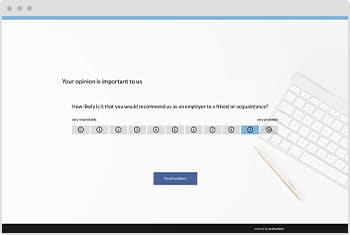
A specific NPS survey on internal communication can provide insights into how likely employees are to recommend the company’s communication processes.
By regularly monitoring these metrics, a company can evaluate the effectiveness of its internal communication and make necessary adjustments to continuously improve communication and employee engagement.
An effective internal communication survey primarily serves to analyze the current state of information flows and communication processes within your company.
The aim is to identify what is already working well, but also where there is still potential for improvement.
Through targeted employee surveys, you gain valuable insights into employees’ perspectives, experiences, and needs regarding communication in their daily work environment.
Based on the responses, you can derive concrete measures to sustainably optimize your internal communication – for example, by selecting suitable communication tools, improving information sharing, or establishing clearer responsibilities.
Below, we have compiled some example questions for you:
These questions help you create a differentiated picture of internal communication processes – both at team level and at management level.
You can find additional possible questions in our internal communication questionnaire template.
easyfeedback can support internal communication in various ways and help improve communication within a company.
Here are some of the benefits and features that easyfeedback offers:
1. Benefit: Easy Creation of Surveys
With easyfeedback, you can quickly and easily create surveys to collect employee feedback on various topics. These surveys can be conducted regularly to measure employee sentiment and identify areas for improvement.
2. Benefit: Promoting a Feedback Culture
easyfeedback supports the establishment of a feedback culture by providing employees with a simple way to share their opinions and suggestions anonymously or by name. This promotes openness and trust within the team.
3. Benefit: Measuring Employee Satisfaction
Regular employee satisfaction surveys can provide valuable insights into employees’ needs and expectations. easyfeedback enables companies to conduct these surveys in a professional and efficient manner while presenting the results in a clear and structured way.
4. Benefit: Data Analysis and Evaluation
easyfeedback provides comprehensive analysis options for evaluating collected data. This helps identify trends and patterns and enables companies to make informed decisions based on employee feedback.
5. Benefit: Integration into Existing Systems
easyfeedback can be integrated with various other applications and systems, making communication and data exchange easier. This allows feedback and communication processes to be seamlessly integrated into the existing workflow.
6. Benefit: Fast Response Opportunities
By using easyfeedback, companies can respond quickly to feedback and implement appropriate measures. This shows employees that their opinions are valued and contributes to the improvement of internal communication.
7. Benefit: Promoting Collaboration
Regular surveys and feedback sessions can help strengthen collaboration and team spirit by ensuring that all employees have the opportunity to contribute their thoughts and ideas.
8. Benefit: Improving Decision-Making
The collected data and insights from surveys help managers make informed decisions based on employees’ actual needs and expectations.
In summary, easyfeedback can serve as an effective tool for internal communication by optimizing feedback processes, improving employee satisfaction, and promoting an open and transparent communication culture.