

“Identifying user needs is at the heart of our business. easyfeedback has been helping us with this task for several years now. We particularly appreciate its intuitive usability and professional support.”

“We use easyfeedback for internal and external surveys—it’s fast, convenient, and easy! The uncomplicated and friendly support puts a smile on our faces, and we are delighted with the continuous development of the platform.”
According to the Gallup Engagement Index of 2020 , 68% of employees in Germany have a low emotional attachment to their employer. 15% feel no connection at all.
These figures are alarming. Especially in times of skilled labor shortages, loyalty to the company is crucial, because finding qualified personnel is difficult.
To strengthen employee retention, the first step is to determine employee satisfaction with aspects such as working conditions and work-life balance.
The Employee Net Promoter Score (eNPS) helps to quickly measure loyalty with just one question.
It provides a precise indication of employee satisfaction and retention and is a valuable metric for reducing turnover.
Contents of the template:
Objectives of the survey:
Helpful features for the survey:

Data protection „made in Germany“ (GDPR)

Anonymity function for honest feedback
The Employee Net Promoter Score (eNPS) is a simple yet powerful metric that helps organizations measure how loyal and engaged their employees are.
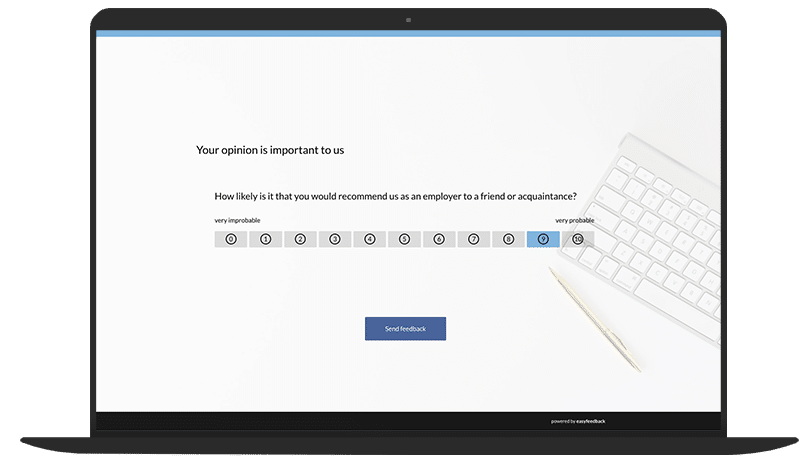
It is based on a single question that asks employees how likely they are to recommend the company as a place to work to friends or family, using a scale from 0 to 10.
Based on the survey responses, an overall eNPS score is calculated, providing valuable insights into the level of employee loyalty and engagement within the organization.
These insights enable organizations to identify trends, perform deeper analyses, implement targeted improvements, and strengthen both employee engagement and overall job satisfaction.
There are several reasons why organizations should measure employee loyalty and retention.
One key reason is that, in times of skilled labor shortages, attracting and hiring qualified employees has become increasingly challenging.
Another important factor is the need to retain valuable employees and prevent them from leaving due to dissatisfaction.
Conducting an eNPS survey can also help increase employee motivation, as engaged and loyal employees are generally more productive and committed than employees who feel disconnected from the organization.
Regardless of the specific reason for measuring the Employee Net Promoter Score, it provides an immediate overview of the current state of employee loyalty and engagement within the company.
At the same time, the eNPS serves as a valuable foundation for monitoring developments and identifying trends over time.
Through regular measurement of employee retention and engagement, organizations can identify potential challenges at an early stage and implement targeted actions to improve employee loyalty.
These actions may include introducing professional development opportunities, flexible working models, or employee benefits that help employees build a long-term connection with the organization and remain motivated.
Another important aspect is that high employee retention strengthens a company’s reputation as an attractive employer.
Satisfied employees are more likely to recommend the organization to others, which can make it easier to attract new talent and reduce recruitment costs.
The biggest advantage of the eNPS lies in its simple and efficient application.
The method is based on a single, clearly defined question: “How likely are you to recommend your company as an employer?”
This eliminates the need for lengthy preparation of complex questionnaires and creates an easy-to-understand key performance indicator.
This score allows organizations to quickly assess the current level of employee satisfaction and loyalty.
A high eNPS indicates engaged and satisfied employees, while a low score highlights areas where improvements may be needed.
The eNPS serves as a valuable baseline metric that can be complemented with more detailed analyses when required. This enables organizations to identify challenges and improvement opportunities in a targeted way.
Another major advantage is the ability to measure the eNPS at regular intervals.
By tracking the score over time, organizations can identify trends and developments in employee satisfaction and respond quickly to changes.
In addition, the short survey format of the eNPS typically results in a higher response rate compared to lengthy employee surveys.
The simple process and minimal time commitment increase employees’ willingness to participate.
Last but not least, the eNPS is also a cost-effective measurement method, as it does not necessarily require complex analysis tools or external consultants.
Summary of the advantages:
Thanks to these strengths, the eNPS is particularly suitable for organizations looking for a straightforward and effective way to regularly measure employee satisfaction and use the results to plan targeted improvement initiatives.
Calculating the Employee Net Promoter Score (eNPS) is not complicated, but it does require a brief explanation.
In an eNPS survey, employees answer the question about their likelihood of recommending the company as an employer on a scale from 0 to 10.
The higher the score given by an employee, the more likely they are to recommend the company to others.
Employees who give a rating of 9 or 10 are considered Promoters. They are highly satisfied, loyal, and likely to recommend the company as an employer.
Employees who give a rating of 7 or 8 are considered Passives. They are generally satisfied with the company but are not actively promoting it to others.
Employees who give a rating of 0 to 6 are considered Detractors. They are less satisfied and are unlikely to recommend the company. In some cases, they may even share negative experiences with friends and colleagues or consider leaving the organization.
To calculate the eNPS, you first need to determine the total number of responses.
Next, calculate the percentage of employees who are Promoters (ratings of 9 or 10) and the percentage of employees who are Detractors (ratings of 0 to 6).
Finally, subtract the percentage of Detractors from the percentage of Promoters.
The result is the Employee Net Promoter Score, which ranges from -100 to +100.
The closer the score is to +100, the stronger the employee loyalty within the organization.
A short example:
Imagine a company with 100 employees.
After conducting an eNPS survey, the results show:
The calculation of the Employee Net Promoter Score would be:
eNPS = 30% (Promoters) – 30% (Detractors) = 0
In this example, the company achieves an eNPS of 0, meaning that the number of employees who would recommend the company is equal to the number of employees who would not.
A good Employee Net Promoter Score (eNPS) indicates that employees are generally satisfied with their employer and would recommend the company to others.
But what exactly is considered a “good” eNPS score?
eNPS Rating Scale
An eNPS value of +30 or higher is generally considered a good score in practice.
Such values indicate a healthy company culture, trustworthy leadership, and a motivated workforce.
In many industries, even a score in the positive range (above 0) is already a sign that the organization is moving in the right direction.
Overview for classification:
So, what is a good eNPS?
The evaluation also depends heavily on the industry, company size, national culture, and the current situation of the organization.
An eNPS of +20 can already be a very positive result in more traditional industries such as finance or construction.
In start-ups or technology companies, where emotional connection and company culture often play a larger role, scores of +40 or higher may be the target benchmark.
Important to know
Development is more important than a single score
A single eNPS measurement is only a snapshot.
The most important factor is the development over time.
If the eNPS increases after implementing specific measures, this indicates that the organization is successfully responding to employee feedback and making the right improvements.
If the score decreases, organizations should take a closer look and investigate the underlying causes.
Yes, there are.
Here are four tips on what to consider when conducting an eNPS survey:
1. Tip: Ensure anonymity
Employee surveys are often a sensitive topic within organizations. Due to fear of negative consequences, participants may hesitate to provide honest feedback.
If you want employees to answer the eNPS question honestly, you should ensure that participation in the eNPS survey is anonymous.
Communicate this clearly to participants before the survey begins to eliminate concerns and increase the response rate.
2. Tip: Do not withhold information
When conducting an Employee Net Promoter Score survey, you can build trust among employees by providing complete and transparent information about the process.
Explain who is conducting the survey, what the survey is about, which goals should be achieved, and what benefits the results provide for employees.
Provide a contact person and contact details for any questions.
This information can be included in the invitation to the eNPS survey or in the introductory text of the questionnaire.
3. Tip: Be patient
Not every employee will have the time to complete your survey immediately.
Allow a few days for participation and send a reminder afterward.
Explain why participation is important and what advantages employees gain by sharing their feedback.
Be patient throughout the process. Excessive reminders or pressure may discourage employees from participating.
4. Tip: Offer flexible participation options
Not every employee is equally comfortable with modern technology.
Some employees may prefer using a smartphone, while others may participate from a computer. Some may work remotely in the home office, while others work on-site.
Therefore, provide employees with the option to participate in the survey flexibly from different devices and locations.
The easyfeedback tool can help you measure the Employee Net Promoter Score (eNPS) in an effective and simple way by providing the right tools and features to evaluate and improve employee satisfaction and loyalty.
Here are some of the ways easyfeedback supports you:
1. Advantage: User-friendly creation of eNPS surveys
With easyfeedback, you can create professional eNPS surveys within just a few minutes.
Thanks to the intuitive user interface, you can easily integrate the classic eNPS question (“How likely are you to recommend your company as an employer?”) along with additional supporting questions.
2. Advantage: Automated data analysis
The tool automatically calculates the eNPS score and presents it in clear charts and reports.
You can filter the data by teams, departments, or locations to identify specific areas for improvement.
3. Advantage: Anonymity for honest feedback
easyfeedback ensures anonymity, allowing employees to provide open and honest responses.
This increases the reliability of the results and helps you gain a realistic understanding of employee satisfaction.
4. Advantage: Flexible distribution options
Distribute your eNPS surveys via email, QR code, or direct link – easily and conveniently for all participants.
Employees can participate from any device, whether using a computer, tablet, or smartphone.
5. Advantage: Integration of follow-up questions
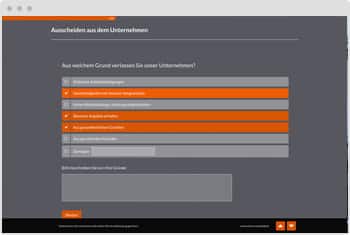
In addition to the core eNPS question, easyfeedback allows you to add qualitative follow-up questions, such as:
This means you receive not only a score but also valuable insights into the reasons behind the results.
6. Advantage: Long-term monitoring
With easyfeedback, you can conduct regular eNPS surveys to track trends over time.
This helps you evaluate the success of initiatives aimed at improving employee loyalty and satisfaction.
7. Advantage: Deriving targeted measures
Thanks to detailed (AI-based) analyses and reports, you can develop targeted measures to improve employee satisfaction and motivation.
The eNPS becomes a valuable management tool for your HR strategy.
Conclusion: easyfeedback as your eNPS partner
The easyfeedback tool makes measuring the Employee Net Promoter Score fast, straightforward, and precise.
It provides more than just a number – it delivers valuable insights into the mood and engagement within your organization.
Through its ease of use and in-depth analysis capabilities, easyfeedback helps you strengthen employee satisfaction and employee loyalty – creating the foundation for a productive and successful work environment.