

“Identifying user needs is at the heart of our business. easyfeedback has been helping us with this task for several years now. We particularly appreciate its intuitive usability and professional support.”

“We use easyfeedback for internal and external surveys—it’s fast, convenient, and easy! The uncomplicated and friendly support puts a smile on our faces, and we are delighted with the continuous development of the platform.”
The coronavirus pandemic has presented many companies with new challenges. In order to cope with this extraordinary situation, numerous companies have given their employees the opportunity to work from home.
This change has not only promoted the topic of working from home in the short term, but also shows great potential for establishing working from home as the norm in the future.
While working from home offers many advantages, for some, changes in work processes or personal circumstances can lead to problems that negatively impact work productivity.
It is therefore crucial to let your employees know that you support them, not only at the beginning of the transition, but also in the long term.
Regularly survey your employees about their satisfaction, the availability of necessary resources, and communication with colleagues and supervisors.
This will enable you to identify specific problems and improve and promote working from home for everyone involved in the long term.
Contents of the template:
Objectives of the survey:
Helpful features for the survey:

Data protection „made in Germany“ (GDPR)

Anonymity function for honest feedback
Home office is a flexible working arrangement that allows employees to work remotely from home instead of a traditional office.
With the help of digital communication technologies such as email, instant messaging, and video conferencing, home office has become an effective and practical alternative to the conventional workplace.
However, not all home office arrangements are the same.
Today, there are several different forms of remote work.
The specific arrangement depends on the extent to which an employee works from home.
One option is a full-time home office, where employees work exclusively from home and do not have a permanent workstation at the company’s office.
Another option is a hybrid work model, where employees alternate between working from home and working on-site.
In this case, they typically have a dedicated workspace both at home and at the office.
In addition, there is location-independent work.
With this type of work arrangement, employees have no fixed workplace, either at home or in the office.
Instead, their workplace travels with them, allowing them to work from virtually any location.
This mobile way of working is common among employees who travel frequently or regularly go on business trips.
Home office and mobile working primarily differ in terms of the working environment and the flexibility of the work location.
Home office means that employees perform their work from a permanent workspace at home.
This workspace is usually set up for long-term use and is designed to support daily work tasks.
It is often used on a regular basis, and employers may provide equipment or financial support for setting up the home office.
Mobile working, on the other hand, refers to a work arrangement in which employees can perform their tasks from various locations.
These locations are not fixed and may vary, including cafés, co-working spaces, while traveling, or any other location with a suitable working environment.
As a result, mobile working offers greater flexibility regarding where work is carried out, allowing employees to choose the location that is most convenient and productive for them.
Home office and telework primarily differ in terms of their level of formality and regulatory framework.
Home office refers to a flexible working arrangement in which employees work from home on an occasional or regular basis, often without formal agreements or specific legal requirements.
The setup and organization of the home workspace are generally the responsibility of the employee, although the employer may provide equipment or financial support.
Telework, on the other hand, is a formally regulated working arrangement in which employees work regularly from a fixed workstation outside the company’s premises, most commonly from home.
This type of work is subject to clear legal requirements and contractual agreements. The employer is responsible for providing and equipping the telework workstation and ensuring that it complies with applicable occupational health and safety regulations.
Home office has several key characteristics that distinguish it from other forms of work.
Here are the most important ones:
1. Characteristic: Work location
Home office means that employees perform their work primarily from home rather than at the company’s premises.
2. Characteristic: Flexibility
Employees often have the flexibility to manage their working hours, provided that they complete their tasks and attend scheduled meetings or other time-sensitive commitments.
3. Characteristic: Ergonomics
The home workspace should be ergonomically designed to help prevent health issues, although responsibility for setting up the workspace often lies with the employee.
4. Characteristic: Technology
A reliable internet connection and access to essential IT resources, such as a laptop, software, and communication tools, are crucial for working effectively from home.
5. Characteristic: Isolation
Home office can increase the risk of social isolation, as face-to-face interaction with colleagues is more limited.
6. Characteristic: Self-management
Working from home requires a high level of self-discipline, organization, and time management to minimize distractions and maintain employee productivity.
7. Characteristic: Communication
Communication takes place primarily through digital channels, including email, phone calls, video conferencing, and instant messaging platforms.
8. Characteristic: Work-life balance
It is important to establish clear boundaries between work and personal life to prevent overwork, stress, and burnout.
9. Characteristic: Employer support
Employers can support remote employees by providing equipment, training, and access to the necessary tools and resources to ensure an effective and productive home office environment.
Home office can take different forms depending on the level of flexibility, the working model, and the specific needs of both employees and employers.
Here are some of the most common types of home office:
1. Type: Full-time home office
Employees work exclusively from home without having regular office-based working days.
This arrangement requires a permanent and well-equipped home workspace and is typically governed by clear agreements between the employee and employer.
2. Type: Part-time home office
Employees alternate between working from home and from the office, for example on specific days of the week or according to a fixed rotation schedule.
This model combines the benefits of remote work with in-person collaboration.
3. Type: Flexible home office
Employees have the freedom to decide when and how often they work from home, depending on business needs and personal preferences.
This approach provides greater flexibility and supports individual working styles.
4. Type: Temporary home office
This arrangement is introduced for a limited period of time, such as during a special project, temporary illness, or following an emergency, including natural disasters or pandemics.
5. Type: Mobile home office
Similar to mobile working, employees are not limited to working from home and may work from cafés, co-working spaces, hotels, or while travelling.
This model offers maximum flexibility but may not always provide the same level of stability or ergonomic conditions as a dedicated home office.
6. Type: Hybrid home office
A combination of office-based and remote work, where employees work from the office on certain days and from home on others.
This model balances face-to-face collaboration with the flexibility of remote work.
7. Type: Remote home office
Employees work entirely outside the company’s office location, often from another city, region, or even another country.
This arrangement may require additional agreements regarding time zones, taxation, employment law, and compliance.
8. Type: Project-based home office
Employees work from home for the duration of a specific project.
This arrangement is typically limited to particular tasks or project phases and may change depending on project requirements.
What are the benefits of working from home for companies?
Working from home offers advantages not only for employees but also for employers.
Below are some of the key benefits:
1. Strengthening the employer brand
Offering home office options can significantly enhance a company’s employer brand.
Remote work has become an increasingly attractive benefit—not only for job seekers but also for existing employees.
For people balancing work with family responsibilities, flexible working arrangements are especially appealing, helping to improve employee satisfaction, engagement, and retention.
As a result, companies may experience lower employee turnover, reducing the costs associated with recruiting, hiring, and onboarding new staff.
2. A competitive advantage in recruitment
Jobs that offer home office opportunities are often more attractive to candidates, making it easier to recruit qualified talent.
Remote work also allows companies to expand their talent pool beyond their local area, enabling them to hire employees from across the country—or even internationally, where appropriate.
This increases access to skilled professionals who might otherwise not be available due to geographical limitations.
3. Increased productivity
Many employees are able to work more productively from home due to fewer workplace distractions, reduced office noise, and a more comfortable working environment.
With greater focus and fewer interruptions, employees can often complete tasks more efficiently while maintaining high-quality results.
Although home environments can sometimes introduce distractions, such as family responsibilities or household tasks, numerous studies have shown that remote work generally has a positive effect on employee productivity and well-being.
Higher productivity can ultimately lead to improved customer satisfaction and better business performance.
4. Better punctuality and fewer absences
Traffic congestion, delayed public transportation, and poor weather are common reasons why employees arrive late at the office.
These issues are largely eliminated when working from home.
Without the daily commute, employees can begin work on time and with less stress.
Remote work may also reduce sick leave in certain situations.
For example, employees with minor illnesses may still be able to work from home without exposing colleagues to infection.
Likewise, employees caring for sick children or dependent family members may be able to continue working more flexibly, depending on company policies and local regulations.
Home office arrangements can also make it easier for employees to return to work after parental leave or other extended absences.
5. Cost savings for employers
Remote work can help companies reduce operating costs.
With fewer employees requiring permanent office space, organizations may be able to downsize their offices and lower rental expenses.
Additional savings may come from reduced utility costs, office supplies, workplace equipment, refreshments, and other day-to-day operating expenses.
What are the benefits of working from home for employees?
As mentioned above, employees also benefit from working from home in several ways.
Fewer distractions, longer periods of focused work, and a familiar environment can contribute to higher employee productivity.
Without frequent interruptions from office conversations or background noise, many employees are able to work more efficiently and stay focused for longer periods.
Working from home can also improve work-life balance.
Depending on company policies, employees may have greater flexibility in organizing their working hours, provided that core business hours and deadlines are met.
This flexibility can make it easier to balance professional responsibilities with family commitments, childcare, or caring for relatives.
Achieving a healthy balance between work and personal life has become increasingly important for many employees and is closely linked to higher job satisfaction.
Home office can also provide financial savings.
Without a daily commute, employees save money on fuel, parking fees, or public transportation.
In addition, eliminating commuting reduces stress and saves valuable time, allowing employees to start their workday feeling more relaxed, focused, and productive.
What are the disadvantages of working from home for employers?
While working from home offers many benefits, it also presents several challenges for employers, both organizational and cultural.
Below are some of the most important considerations:
1. Communication and collaboration
Physical distance can make communication and collaboration more difficult.
Without face-to-face interactions, important information may take longer to circulate, and misunderstandings are more likely to occur.
2. Company culture
Maintaining and strengthening a strong company culture can be more challenging when employees primarily work remotely.
Team-building activities, informal interactions, and shared experiences are often more difficult to organize in a virtual environment.
3. Performance management and productivity
Monitoring employee performance and workload can be more complex in a remote work environment.
Some employers may have concerns about productivity and accountability because employees are not physically present in the workplace.
4. IT security
Working from home increases the risk of cybersecurity threats and data breaches.
Employers must implement additional security measures to ensure that sensitive company information remains protected outside the office environment.
5. IT equipment and support costs
Organizations may need to invest in additional IT equipment, software licenses, and cybersecurity solutions to provide employees with a secure and productive home working environment.
These investments can result in higher operating costs.
6. Data protection and compliance
Remote work creates additional challenges for data protection and regulatory compliance.
Since employers have limited control over employees’ home working environments, ensuring compliance with privacy and security regulations can be more difficult.
What are the disadvantages of working from home for employees?
Although working from home offers many advantages, it also presents several challenges for employees.
One of the most significant disadvantages is the potential for isolation and loneliness caused by the lack of regular face-to-face interaction with colleagues.
Over time, this isolation can have a negative impact on employee well-being and mental health.
Working from home can also introduce more distractions, such as family members, pets, or household responsibilities, which may reduce concentration and productivity.
Another common challenge is maintaining clear boundaries between work and personal life.
Without a physical separation between the office and home, employees may find themselves working longer hours or feeling constantly “on call,” increasing the risk of stress and burnout.
Many employees also lack an ergonomically designed home office, which can contribute to long-term health issues such as back pain, neck strain, or eye fatigue.
Communication with colleagues and managers may also become more difficult in a remote environment.
Misunderstandings are more common, and it can be harder to exchange information quickly or hold spontaneous discussions.
Technical issues, including unstable internet connections or limited IT support, can further disrupt daily work.
In addition, employees working from home may have less access to office resources such as specialized software, printers, or other workplace equipment, which can affect efficiency.
Finally, career development may be more challenging for remote employees.
Because they are less visible within the organization, they may be overlooked for promotions, leadership opportunities, or participation in high-profile projects.
These challenges demonstrate that while home office arrangements provide significant benefits, they also require thoughtful planning and effective management from both employers and employees.
One of an organization’s key responsibilities is not only to achieve its business objectives but also to support its employees and provide them with a suitable working environment.
To fulfill this responsibility, organizations should regularly collect employee feedback on topics such as job satisfaction, productivity, and the quality of the equipment and resources provided for working from home.
Employee surveys offer an effective platform for employees to share what is working well in their home office setup and where improvements are needed.
When challenges are identified and addressed, employees are more likely to feel comfortable, supported, and motivated while working remotely, leading to higher job satisfaction and better performance.
Regular employee feedback also enables organizations to better understand the needs and challenges associated with remote work and to implement targeted measures that continuously improve the remote working experience.
In addition, maintaining an open dialogue between employees and managers helps strengthen trust, engagement, and team spirit — even when teams work remotely.
When conducting a home office satisfaction survey, the first step should be to understand employees’ overall experience and current level of satisfaction with working remotely.
Questions such as:
provide an excellent starting point and are often enough to gain an initial understanding of how employees perceive remote work and whether they are able to work effectively from home.
The next area to explore is the home office setup and equipment.
To enable employees to perform at their best, organizations should ensure they have access to all the tools and resources they need.
Questions such as:
can help identify missing equipment, technical problems, or opportunities to improve employees’ home working environments.
Strong communication is particularly important in a remote work environment.
Since employees rely primarily on digital communication and collaboration tools to interact with colleagues and managers, these systems should function reliably and efficiently.
Easy access to coworkers and supervisors is essential for productive collaboration.
A short communication check-up with questions such as:
can provide valuable insights for continuously improving communication processes and digital collaboration tools.
To conclude the survey, consider including questions about employee productivity.
Some employees find they can concentrate better while working from home, while others experience more distractions from family responsibilities or household activities.
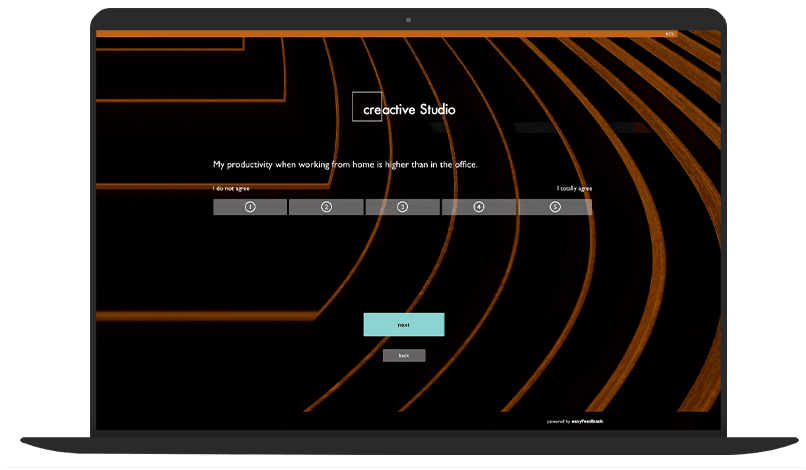
Questions such as:
can help organizations identify the most effective working arrangement for each employee and support flexible work models that maximize both productivity and employee well-being.