

“Identifying user needs is at the heart of our business. easyfeedback has been helping us with this task for several years now. We particularly appreciate its intuitive usability and professional support.”

“We use easyfeedback for internal and external surveys—it’s fast, convenient, and easy! The uncomplicated and friendly support puts a smile on our faces, and we are delighted with the continuous development of the platform.”
Why is an exit interview so important?
Quite simply, every resignation leaves a gap in the company. When an employee leaves, valuable knowledge and skills are lost that cannot be replaced quickly.
The search for a new employee is not only time-consuming but also costly, especially when you factor in the time and expense of training and familiarizing the replacement with the job.
During this transition period, the remaining employees often take on additional tasks, which can lead to overload and an increased error rate.
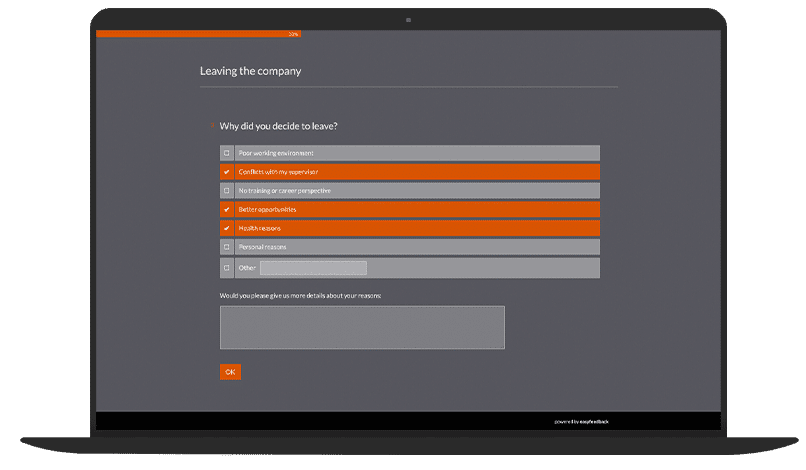
A targeted exit interview offers the opportunity to find out the real reasons for leaving through systematic employee surveys.
These valuable insights help to identify weaknesses in the company and take targeted measures to increase employee retention, reduce turnover, and improve the working environment in the long term.
Contents of the template:
Objectives of the survey:
Helpful features for the survey:

Data protection „made in Germany“ (GDPR)

Anonymity function for honest feedback
An exit interview is a structured final conversation with an employee who is leaving the company.
It provides a valuable opportunity to understand the reasons behind the employee’s resignation while also receiving honest and often very open feedback.
Only when companies understand why an employee has decided to leave can potential problems within the organization be identified and addressed in a targeted manner.
Especially in the case of unexpected resignations, it is crucial to understand the underlying reasons in order to identify recurring issues and prevent further employee turnover.
This not only helps reduce long-term costs for recruitment and onboarding new employees, but also supports structural improvements within the organization.
Exit interviews are therefore an effective tool for strengthening employee retention and improving the satisfaction of remaining employees.
In addition, these conversations provide a final opportunity to receive valuable feedback on the work environment, leadership styles, and internal processes from departing employees.
In many cases, employees are particularly open during exit interviews because they no longer need to fear negative consequences. This openness can provide valuable insights and serve as a starting point for positive changes.
Therefore, the exit interview should be considered an integral part of professional offboarding.
It signals appreciation and shows employees that their opinions matter – even beyond the end of their employment relationship.
Within the employee lifecycle, exit interviews play an equally important role as job interviews, as both conversations mark important transitions and shape the impression an employee has of the company.
In summary, an exit interview is much more than just a formal farewell.
It is a strategic tool that enables companies to actively work on their continuous improvement – both on a cultural and structural level.
Organizations that take the insights gained from these conversations seriously and translate them into concrete actions not only strengthen employee retention, but also position themselves as an attractive employer in the long term.
When an employee decides to leave the company, they essentially have “nothing left to lose”. For you, this creates an opportunity to receive honest feedback.
You should take advantage of this opportunity, because otherwise, along with the employee, valuable knowledge and important information will also leave the company.
An exit interview enables you to identify and address potential issues in human resources management. This allows you to reduce employee turnover within the company and improve the work environment.
Through an open conversation on equal terms, employees also feel heard and taken seriously. This allows you to strengthen employee retention even after resignation and benefit from positive word-of-mouth recommendations.
In addition, the exit interview provides insight into potential weaknesses within the company that may have contributed to the employee’s decision to leave. This can help identify and address systemic issues in order to prevent future employee departures.
Furthermore, the exit interview provides an opportunity to ask departing employees for possible improvement suggestions or ideas for the further development of the company.
These insights can provide valuable suggestions for optimizing work processes, working conditions, or company culture.
Overall, the exit interview helps to conclude the relationship between the departing employee and the company in a positive way and minimize potential conflicts.
It demonstrates appreciation for the employee’s work and enables a constructive discussion about their decision to leave the company.
It is recommended to integrate the exit survey permanently into the offboarding process.
Ideally, document the defined process in writing so that you do not have to redefine it every time.
To make this process easier for you, we have compiled the most important steps in a structured process plan:
Step 1: Select a neutral person for the interview
Choose a neutral person to conduct the exit interview.
For example, a colleague from the HR department who has a neutral relationship with the departing employee would be suitable.
The direct supervisor should never lead the interview, as honest feedback cannot be expected in this case.
A neutral person, such as a representative from the HR department, creates an atmosphere in which the employee can speak freely without having to fear negative consequences.
This increases the likelihood that the employee will speak openly and honestly about their reasons for leaving and provide constructive feedback.
In addition, a neutral person can respond to the employee’s feedback more objectively and without bias and can ask additional questions to gain a more comprehensive perspective.
Another advantage of involving someone from the HR department is that this person has the necessary expertise and experience to conduct the conversation professionally and respond appropriately to the employee’s concerns.
By choosing a neutral person for the exit interview, you signal to the departing employee that you take their feedback seriously and are interested in learning from their experiences and continuously improving the company.
This helps to end the relationship between the employee and the company on a positive note and make the transition as smooth as possible for both sides.
Step 2: Schedule the exit interview
The last working day is usually already quite busy for departing employees due to handovers to colleagues and various organizational tasks.
Therefore, another day should be chosen for the interview whenever possible. In general, a date during the final working week is recommended.
Also consider any remaining vacation entitlement.
A separate appointment for the exit interview allows the employee to fully focus on the conversation and take sufficient time for open questions and feedback.
This prevents the interview from being overlooked or neglected during an already stressful final working day.
In addition, scheduling the interview during the final working week gives the employee some distance from the company while the experience is still fresh, making them more open to constructive feedback and reflection.
At the same time, events and experiences within the company are still present enough to discuss relevant topics and concerns.
It is also important to consider that the employee may still have unused vacation days that need to be taken before departure.
By scheduling the exit interview during the final working week, any remaining vacation planning can be integrated into the appointment scheduling.
Step 3: Determine the location for the interview
Choose the location for the interview carefully. Make sure that the location allows for a confidential atmosphere and that you will not be interrupted. Preferably choose a neutral meeting room instead of your own office.
A round table is particularly suitable because it avoids a confrontational seating arrangement. Another option is to conduct the survey virtually, for example through a prepared online questionnaire.
Choosing an appropriate location for the exit interview contributes significantly to the atmosphere and effectiveness of the conversation.
A neutral meeting room provides a quiet and discreet environment that allows the employee to express themselves freely and have open discussions without feeling observed or pressured.
Avoiding your own office as the location can help maintain professional distance and ensure that the employee does not feel uncomfortable or restricted due to the surroundings.
Choosing a round table instead of a traditional face-to-face seating arrangement can help create a less confrontational atmosphere and encourage a cooperative conversation.
In increasingly digital working environments, conducting the exit interview virtually can also be useful. This provides flexibility for both parties and allows the employee to participate from their current location comfortably.
A prepared online exit questionnaire can help collect structured feedback and address important topics without requiring physical presence.
Step 4: Create an agenda
Think about an agenda for the appointment in advance.
Which topics should be discussed and which questions would you like to ask?
To allow the departing employee to prepare for the conversation as well, you should provide them with the agenda before the meeting.
A structured agenda helps to organize the conversation efficiently and ensures that all relevant topics are addressed.
For example, you can include the following points:
By providing the employee with the agenda in advance, you give them the opportunity to prepare for the conversation and structure their thoughts and concerns.
This helps make the conversation more effective and allows both the employee and the company to gain as many insights and learnings as possible from the exchange.
Step 5: Send the invitation
Use the invitation to once again summarize the most important details of the appointment. These include the location, date, and agenda for the conversation.
The person conducting the interview should also be mentioned by name. In addition, contact details for possible questions should be included.
A clear and precise invitation helps to avoid misunderstandings and ensures that all participants are well informed and can prepare appropriately for the conversation.
Furthermore, a professional invitation demonstrates appreciation and respect toward the departing employee.
The invitation can include the following information:
By communicating this information clearly and precisely, you make it easier for the departing employee to prepare for the conversation and ensure that all relevant topics can be addressed.
This helps ensure that the exit interview is conducted effectively and respectfully and provides valuable insights for both the employee and the company.
Step 6: Conduct the exit interview
Guide your conversation partner through the interview using the prepared agenda. Listen carefully and try to put yourself in the other person’s position.
Create a comfortable conversation atmosphere by allowing the employee to speak freely and by not turning the discussion into an argument. Take notes throughout the conversation.
By using the agenda as a guide, you ensure that all relevant topics are addressed and that the conversation follows a structured approach. This enables both parties to exchange information effectively and express their concerns.
During the conversation, it is important to actively listen and respond to the needs and concerns of the departing employee. Try to understand their perspective and treat their opinions and feelings with respect.
A positive conversation atmosphere helps the employee to express themselves openly and honestly without having to fear negative consequences.
Therefore, avoid confrontations or discussions aimed at defending decisions. Instead, focus on finding solutions together and clarifying open questions.
Taking notes during the conversation allows you to capture important points and insights and ensures that nothing is overlooked.
These notes can later serve as a basis for further actions or decisions and help ensure that agreed steps are followed.
By conducting the conversation in a respectful and constructive manner and following the prepared agenda, you help ensure that the exit interview is effective and provides valuable insights for both the departing employee and the company.
Step 7: Analyze and evaluate the exit interview
The information collected during the exit interview or through the conducted survey provides the foundation for your analysis.
Using software can be helpful at this stage.
Compare different interviews with each other and identify common patterns.
By using software solutions, you can efficiently manage and analyze the collected data.
Such software can help systematically capture and categorize responses and feedback from departing employees.
This allows you to identify trends and patterns and gain valuable insights.
By comparing the results of different exit interviews, you can identify common themes and recurring issues.
These findings provide valuable information about which aspects of the company are working particularly well and which areas may require improvement.
A software solution can also help monitor and evaluate the effectiveness of employee retention and development measures.
For example, you can track how employee satisfaction changes over time and whether specific measures or initiatives have led to improvements.
In addition, software solutions allow you to store and archive data over the long term. This enables you to access historical data and track developments over time.
Overall, using software to analyze exit interviews and employee surveys can help you gain valuable insights into employee satisfaction and sentiment and implement targeted measures to improve the working environment and company culture.
Create a comfortable conversation atmosphere. The best way to achieve this is by planning enough time for the interview and giving your conversation partner your full attention.
In a conversation held between appointments or in passing, your employee will most likely not open up.
Treat the exit interview as confidential and communicate this clearly to your conversation partner.
Conduct the interview as a one-on-one conversation. The more people are present, the more pressure is likely to be created, and the lower the chances of receiving honest feedback.
It is also advisable to provide your employee with the exit questionnaire when sending the invitation. This gives them the opportunity to prepare and answer the questions calmly in advance.
This allows you to discuss the answers in greater depth during the conversation and increases the likelihood that the employee will agree to participate. Exit interviews should always take place on a voluntary basis.
Give your employee the choice and respect their decision if they decide not to participate.
It is recommended to conduct an exit interview shortly before the employee leaves the company.
If the interview is scheduled too early, there is a risk that the employee may not provide honest feedback due to concerns about potential consequences.
Ideally, all important arrangements should already be clarified at this point, and the employee should have received their employment reference letter before the conversation takes place.
An exit interview should ideally take place at a stage when the employee has already submitted their resignation and the key decisions regarding their departure have been made.
This allows both sides to focus on the conversation and openly discuss the reasons for leaving as well as potential areas for improvement.
Furthermore, an exit interview should not be viewed as the final step before an employee leaves, but rather as an opportunity for closure and reflection.
By conducting the interview at the right time, there is sufficient opportunity for a constructive discussion about the employee’s experiences and insights, as well as for planning the transition process.
An exit interview shortly before the employee’s departure also makes it possible to clarify any open questions and concerns and ensure that all important information for a smooth transition is available.
This helps prevent misunderstandings or uncertainties and ensures that the employee’s departure takes place in a positive and respectful manner.
Choose an interview partner for the departing employee with whom the employee has a good or neutral relationship.
A suitable choice would be someone from the HR department or another trusted person within the company.
The direct supervisor should be avoided as the interview partner, as the reason for the resignation may be directly or indirectly related to the supervisor.
Due to this power dynamic, especially if the employee still has to work under the supervisor for some time, honest feedback is less likely to be provided.
It is best to conduct the exit interview as a one-on-one conversation, as this increases the likelihood of receiving valuable information and having an open exchange.
By selecting a neutral or trusted interview partner, you create an atmosphere of trust and openness that allows the departing employee to express thoughts, concerns, and experiences freely.
A one-on-one conversation also provides the opportunity for a personal and confidential exchange without the employee having to worry that their opinions or feedback will be shared with third parties.
In addition, a neutral interview partner can respond more objectively to the employee’s feedback and ask additional questions if necessary to gain a more comprehensive perspective.
This approach helps gather valuable insights that can contribute to identifying and addressing potential problems or areas for improvement within the company.
Conducting an exit interview is not always easy, as there are usually specific reasons behind an employee’s resignation.
To ensure that your conversation is successful, we have compiled a few common no-goes for exit interviews below:
The supervisor should not be involved in an exit interview. Honest feedback from the employee is unlikely if the manager is present during the conversation.
For your exit interview to be successful, you need a neutral conversation partner, for example someone from the HR department.
Create a confidential atmosphere and conduct the exit interview privately whenever possible.
Avoid forwarding criticism expressed during the conversation directly to supervisors or other departments within the company.
If employees learn that confidential information from exit interviews is being shared, you cannot expect honest feedback from future employees.
If similar points of criticism are raised repeatedly, the supervisor can be addressed without revealing the employee’s identity.
Due to time constraints, exit interviews are sometimes cancelled or combined with other offboarding processes.
Conversations “between meetings” or in passing should also be avoided. Take sufficient time and schedule the appointment firmly in your calendar. Avoid interruptions from phone calls or colleagues.
Some companies consider combining the exit interview with the resignation meeting or even with the handover meeting involving colleagues and supervisors.
Although this may initially seem like a good way to save time, it is usually counterproductive in practice, as it negatively affects the confidential and open nature of the conversation.
An exit interview is not the right place for a confrontation or a final reckoning. Remain objective and try to put yourself in the employee’s position.
Remember that the goal is to gain a better understanding of the employee’s experiences and perspectives.
However, be careful: Do not make the conversation feel like an interrogation. Empathy is essential. Only by creating an open and respectful atmosphere can you gain valuable insights and leave a positive final impression.
Since an exit interview is a sensitive topic that is often associated with strong emotions, it is reasonable to ask:
Which questions are appropriate – and where should you exercise restraint?
The goal of an exit interview is to gain valuable insights into potential weaknesses within the company that may have contributed to an employee’s decision to leave.
At the same time, the conversation should remain respectful and professional without developing into a confrontational discussion.
It is important to remember:
Although the focus is often on the reason for the resignation, a good exit interview also provides the opportunity to gain insights into other areas, such as leadership culture, team dynamics, or internal development opportunities.
To make your preparation easier, we have compiled a selection of possible and proven exit interview questions:
The goal of an exit interview is to identify the reason for the resignation and use these insights to derive possible improvement measures.
If you would like to use a questionnaire for your exit interview, limit yourself to a few selected questions and discuss the answers in a personal conversation.
This allows you to gain deeper insights than simply asking an employee to complete a list of questions without having a direct conversation with them.
Possible questions for your exit interview questionnaire could include:
Another tip:
When speaking with your employee, do not only focus on the reasons for leaving, but also discuss what they liked most about their job.
This helps you identify what is already working well and where you can continue to strengthen and develop your company.
When analyzing the information collected, the main objective of the survey should always remain the focus, namely identifying weaknesses and deriving measures to improve employee retention.
It is therefore important to identify whether there are recurring reasons for resignations or whether there are connections between company conditions and employee departures.
It can also be valuable to analyze whether resignations occur more frequently in specific departments or areas of the company, or whether certain employee groups are affected more often than others. Factors such as age or gender may play a role in this analysis.
Focus on developing measures that could have prevented the employee’s resignation.
To gain a better overview of the results, it is useful to create lists and compile the most frequently mentioned reasons for leaving.
This allows you to evaluate the percentage share of each reason and derive valuable insights for areas such as career development, leadership style, workplace organization, and company culture.
After the evaluation, it is also advisable to communicate the results to the responsible stakeholders. For example, if the leadership style of a supervisor is repeatedly criticized, this feedback should be addressed openly.
If, on the other hand, the workplace equipment is criticized, responsible departments can develop a concept to improve the technical and/or organizational setup of workstations.
Management should also be regularly informed about the results of exit interviews and made aware of the insights gained from them.
This enables companies to take targeted measures to improve employee retention and reduce employee turnover, ultimately increasing the attractiveness of the company as an employer in the long term.
An exit interview can provide a wide range of valuable insights.
You not only learn the reason why an employee is leaving, but by analyzing the results and comparing answers from previous exit interviews, you can also identify potential weaknesses within the company.
If the same reasons for leaving are mentioned repeatedly, such as limited career opportunities, excessive workload, or problems with supervisors, you can take targeted action in these areas.
Use the opportunity provided by exit interviews and do not miss the potential to increase employee retention and reduce employee turnover through valuable feedback.
Another important aspect is identifying trends or patterns in the responses of departing employees.
By systematically analyzing the reasons behind employee departures and recognizing recurring patterns, you can implement targeted measures to solve problems and improve working conditions within the company.
By demonstrating that you value the opinions and experiences of former employees and are willing to act on their feedback, you show appreciation and professionalism.
This can help attract potential applicants and strengthen current employees’ trust in the company.
Overall, exit interviews provide a valuable opportunity to gain insights into the strengths and weaknesses of an organization and develop concrete measures to improve employee retention and reduce turnover.
Through systematic analysis and the effective use of these insights, companies can achieve long-term success and create a positive working environment that attracts talented employees and encourages them to stay.
In addition, exit interviews can help improve the company’s employer image.
By showing that you care about the opinions and experiences of former employees and are willing to respond to their feedback, you demonstrate appreciation and professionalism.
This can help attract potential candidates and strengthen the confidence of current employees in the organization.
Overall, exit interviews provide a valuable opportunity to gain insights into the strengths and weaknesses of the company and develop specific measures to improve employee retention and reduce turnover.
By systematically analyzing and applying the knowledge gained, companies can achieve sustainable success and create a positive workplace that attracts talented employees and retains them over the long term.