

“Identifying user needs is at the heart of our business. easyfeedback has been helping us with this task for several years now. We particularly appreciate its intuitive usability and professional support.”

“We use easyfeedback for internal and external surveys—it’s fast, convenient, and easy! The uncomplicated and friendly support puts a smile on our faces, and we are delighted with the continuous development of the platform.”
Employee satisfaction is not a luxury, but a decisive factor for success – especially for companies that are confronted with high staff turnover or a strong demand for innovation.
Satisfied and motivated employees are not only more productive, but also more creative and actively contribute to the further development of the company.
A positive working environment characterized by open communication and cooperation creates space for innovation and increases commitment.
Regular (anonymous) employee surveys are an invaluable tool in this regard. They enable you to understand the needs of your employees and initiate targeted measures for improvement.
Whether conducted annually or on an ad hoc basis, such surveys help to continuously optimize the company and remain competitive in the long term.
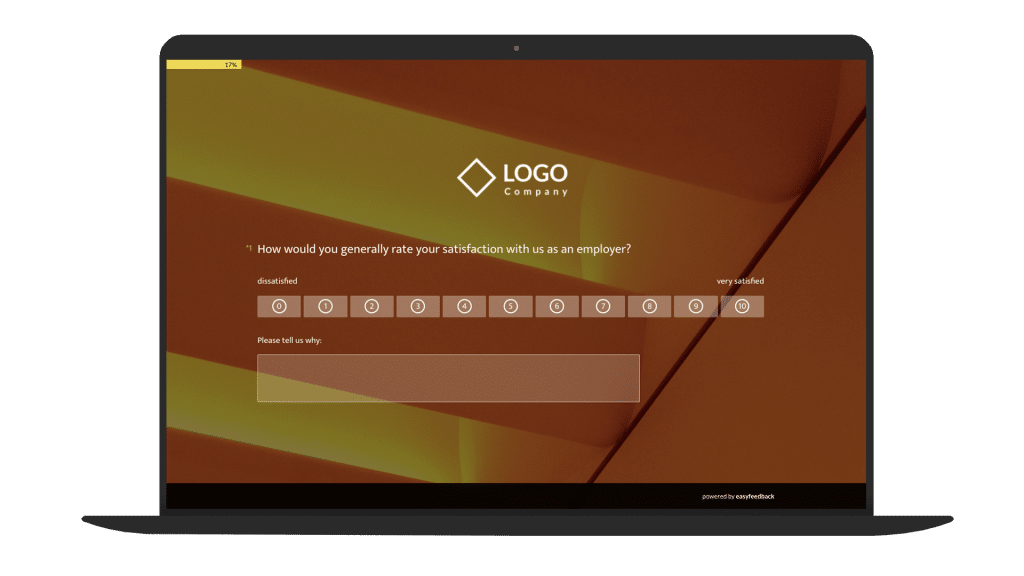
Our ready-made employee satisfaction survey offers you a simple and effective way to measure the current level of satisfaction and identify specific areas for improvement.
Contents of the template:
• Surveys on general employee satisfaction
• Identifying opportunities and providing targeted training
• Transparency of internal communication
• Assessment of management and supervisors
• Demographic data on length of service
Objectives of the survey:
• Increase employee satisfaction and employee motivation
• Identifying weaknesses in communication
• Strengthening team spirit
• Innovation through better collaboration
• Strengthen attractiveness for the talents of the future
Helpful features for the survey:
• Survey options: Anonymous, partially anonymous, personalized
• Invitation options: Link, email, QR code, and more
• Segment analysis based on survey groups or response behavior
• AI analysis of results, including recommendations for action

Data protection „made in Germany“ (GDPR)

Anonymity function for honest feedback
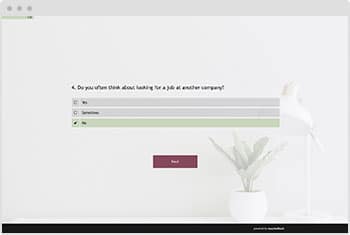
A successful survey should be clearly structured and specifically cover relevant topics. Here is an example of a typical employee satisfaction survey:
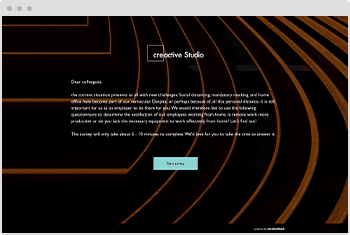
Start your survey with a brief introduction.
Greet your employees and explain the purpose of the survey.
Assure them that participation is optional and anonymous, and that the results will be used, for example, to improve work processes.
Sample text:

"Dear employees, your opinion is important to us!
Together, we want to create a work environment where everyone feels comfortable and can reach their full potential.
That’s why we cordially invite you to participate in our employee satisfaction survey.
Your answers will help us further build on our company’s strengths and make targeted improvements.The survey takes only a few minutes, and your answers will remain anonymous—every voice counts!”
End the survey with a thank-you note and let your participants know how the results will be used. Optionally, you can offer an incentive, such as a discount or entry into a giveaway.
Sample text:

"Thank you very much for taking the time to participate in this survey.
Your feedback is invaluable to us and helps us continuously improve the work environment.
All responses will, of course, be treated anonymously.Thank you for your trust!”
Employee satisfaction refers to an employee’s attitude toward their work and employer, which is influenced by their experiences within the organization.
If employees have predominantly negative experiences during their time with the company, this can lead to increasing dissatisfaction, which affects their motivation, performance, and willingness to leave the organization.
Negative experiences can have various causes, including unclear communication from management, a lack of appreciation, excessive workload, limited development opportunities, or an unfair work environment.
All of these factors can negatively impact an employee’s well-being and satisfaction and ultimately put their commitment to the organization at risk.
Therefore, it is crucial for companies to identify the factors that influence employee satisfaction and take appropriate measures to minimize negative experiences and promote a positive workplace environment.
This can be achieved, for example, through regular employee surveys, feedback discussions, leadership development training, and the implementation of programs that promote work-life balance.
By actively addressing employees’ needs and concerns and fostering a culture of openness, respect, and collaboration, organizations can create an environment where employees enjoy working and are able to reach their full potential.
This not only contributes to employee satisfaction and retention but also strengthens the company’s image as an attractive employer, which supports sustainable business success in the long term.
Pursuing high employee satisfaction is beneficial for organizations for various reasons.
One of the main arguments is that a satisfied employee works with greater engagement and motivation. They are more productive and deliver better results.
This willingness to perform contributes to achieving organizational goals and therefore has a direct impact on the company’s success.
Furthermore, satisfied employees are important ambassadors for a company’s employer brand.
They are more likely to recommend their employer positively to friends, family, and professional contacts.
Another important reason why employee satisfaction matters is retaining existing employees and preventing resignations caused by dissatisfaction.
This helps organizations avoid high employee turnover and reduces costs associated with recruitment and onboarding.
Measuring employee satisfaction is therefore essential to understand the current level of satisfaction among your employees.
Only when you know that employees are dissatisfied with you as an employer, the existing company culture, or their role can you take targeted action to improve the situation.
Negative feedback can therefore become a valuable opportunity in the long term to strengthen your employer brand and support positive organizational development.
By actively responding to employee needs and feedback and implementing appropriate measures to improve working conditions and workplace culture, organizations can create a positive work environment where employees enjoy working and are motivated to perform at their best.
This not only strengthens employee loyalty to the organization but also increases the company’s attractiveness as an employer, creating a long-term competitive advantage in the labor market.
1. Goal: Increasing Employee Motivation
2. Goal: Reducing Employee Turnover
3. Goal: Increasing Employee Engagement
4. Goal: Increasing Productivity
5. Goal: Improving the Workplace Culture
6. Goal: Increasing Innovation Capability
7. Goal: Improving the Employer Brand
8. Goal: Promoting Employee Health
9. Goal: Increasing Customer Loyalty
1. Factor: Work Environment
2. Factor: Leadership and Management
3. Factor: Career Opportunities
4. Factor: Job Content
5. Factor: Work-Life Balance
6. Factor: Company Culture
7. Factor: Compensation and Benefits
8. Factor: Communication
9. Factor: Social Relationships
10. Factor: Rewards and Recognition
11. Factor: Health and Well-Being
12. Factor: Company Stability
To measure and improve employee satisfaction, organizations have a wide range of tools and methods available.
These help identify satisfaction levels, uncover areas for improvement, and implement targeted measures.
Here are some of the most common tools and methods:
1. Method: Employee Surveys
2. Method: 360-Degree Feedback
3. Method: Employee Conversations (One-on-One Meetings)
4. Method: Employee Net Promoter Score (eNPS)
5. Method: Absence and Turnover Analysis
6. Method: Focus Groups and Workshops
7. Method: Employee Interviews
8. Method: Workplace Climate and Culture Measurement
9. Method: Employee Engagement Index
10. Method: Digital Tools and Platforms
11. Method: Anonymous Feedback Channels
In today’s business environment, it is increasingly recognized that employee satisfaction has a direct impact on the success and performance of an organization.
Happy employees are more engaged, productive, and tend to stay with the company longer.
To understand and improve employee satisfaction, it is essential to ask the right questions.
Here you will find 6 key questions that will help you gain a comprehensive understanding of your employees’ satisfaction.
These questions cover various aspects of the work environment, from relationships with managers and workplace culture to work-life balance.
Question 1: eNPS
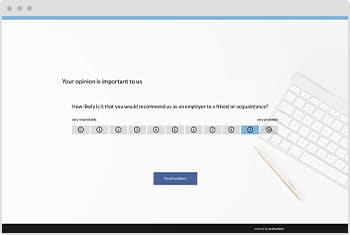
How likely are you to recommend us as an employer to a friend or acquaintance?
Why this question?
The question about the Employee Net Promoter Score (eNPS) is important because it provides a simple and effective way to measure the likelihood that employees would recommend your organization as an employer.
A high eNPS indicates satisfied employees who are willing to actively support and promote the company, while a low eNPS may reveal potential issues or dissatisfaction that need to be addressed.
Question 2: Work Environment and Culture
How do you rate the working atmosphere in your team/department?
Why this question?
The work environment and company culture have a significant impact on employee satisfaction.
A supportive and collaborative team atmosphere is essential for employees’ well-being and productivity.
The question about the workplace climate helps determine whether employees feel respected within their team, whether mutual support exists, and whether there is an open environment for exchanging ideas and collaborating.
This allows potential issues to be identified and targeted measures to be taken to strengthen the work environment and improve employee satisfaction.
Question 3: Development Opportunities
Are there sufficient opportunities for professional development within our organization?
Why this question?
The opportunity for professional growth and personal development is a key factor for many employees when it comes to satisfaction and long-term commitment to the organization.
When employees have the opportunity to develop professionally, learn new skills, and grow personally, they not only increase their satisfaction but also their motivation and engagement.
This helps employees feel valued and enables them to build a successful long-term career within the organization.
Question 4: Communication
How do you rate communication within your organization?
Why this question?
Clear and transparent communication is essential for a positive work environment and contributes significantly to employee satisfaction.
It enables employees to feel heard and informed, promotes collaboration, and helps prevent misunderstandings.
By answering this question, organizations can gain insights into the quality of communication within the company and make improvements where necessary to increase employee satisfaction.
Question 5: Work-Life Balance
How well are you able to balance your work and personal life?
Why this question?
The question about work-life balance is important because the balance between professional and personal life has a significant impact on employee satisfaction.
A healthy balance allows employees to effectively manage their work responsibilities while still having enough time for personal needs, family, and leisure activities.
By answering this question, organizations can understand whether employees feel overworked, whether they have enough time for themselves, and whether measures to promote a healthy work-life balance are needed to improve employee satisfaction and well-being.
Question 6: Relationship with Managers
Do you feel supported and respected by your direct manager?
Why this question?
The relationship with managers can have a significant impact on employee satisfaction.
A respectful and supportive approach promotes employee engagement and satisfaction because employees feel valued and heard.
An open communication relationship between managers and employees allows employees to express their concerns and ideas, which contributes to a sense of involvement and participation.
Furthermore, a positive relationship with managers can help employees feel supported and encouraged to take on challenges and further develop their skills.
A positive relationship with managers therefore creates a foundation for a productive and harmonious work environment where employees can reach their full potential.
Conclusion
The key questions presented here for measuring employee satisfaction are, in our view, important questions that provide fundamental insights into employee satisfaction and well-being.
These questions have been carefully selected to cover the various aspects of the work environment that significantly contribute to employee satisfaction.
They focus on areas such as the work environment, company culture, development opportunities, communication, work-life balance, and relationships with managers.
However, there are also additional questions in other categories that may be relevant.
For further inspiration, take a look at our employee satisfaction survey template or simply create your own survey using the easyfeedback tool.
The best and easiest way to measure employee satisfaction is through an employee survey.
With a questionnaire tailored to your organization, you can ask your employees about their overall satisfaction, working conditions, health, or other important areas.
The following methodological approaches can help you calculate key performance indicators:
1. Key Metric: Employee Net Promoter Score (eNPS)
The eNPS is a metric that allows you to easily determine how loyal and connected employees are to your organization.
It only requires asking employees how likely they are to recommend the company to friends or acquaintances on a scale from 0 to 10.
A distinction is made between so-called promoters, who would recommend the employer, and detractors, who would not.
2. Key Metric: Employee Turnover Rate
The turnover rate is a metric that calculates how many employees have left the organization in relation to the total workforce within a defined period of time.
A distinction is made between voluntary and involuntary turnover.
3. Key Metric: Absence / Sick Leave Rate
Another metric that provides an indication of the current employee experience within your organization is the sick leave rate.
It describes the proportion of employees who are unable to work due to illness.
To a certain extent, it also reflects employee satisfaction.
4. Key Metric: Engagement Score
The engagement score is an important indicator of employee satisfaction and overall employee engagement within an organization.
It measures how emotionally and psychologically connected employees are to their work and the organization.
A high engagement score indicates that employees are motivated, satisfied, and willing to contribute to the success of the organization.
5. Key Metric: Participation in Feedback Processes
This metric measures how many employees participate in surveys, feedback discussions, or 360-degree feedback processes.
A high participation rate indicates strong interest in improving working conditions and higher employee satisfaction.
6. Key Metric: Career Development Rate
This metric measures how many employees within the organization advance professionally or develop their careers within a specific period of time.
A high number indicates that employees value their development opportunities, which is often associated with higher satisfaction.
7. Key Metric: Job Engagement Score
This metric measures how strongly employees identify with their work and the organization.
This is assessed through questions such as: “I am proud to work for this organization” or “I feel that my work is valued.”
1. Point: Work Environment and Infrastructure
[ ] Is the workplace safe and well-equipped?
[ ] Are work tools (computers, software, office supplies) up to date and functional?
[ ] Do we provide sufficient space for individual needs (e.g., quiet areas, ergonomic furniture)?
[ ] Are there sufficient opportunities for remote work or flexible working hours?
2. Point: Job Tasks
[ ] Are tasks clearly defined and aligned with employees’ skills?
[ ] Is there enough variety and challenge in everyday work?
[ ] Can employees organize their way of working independently, or are there too many restrictions?
[ ] Are employees involved in decisions that affect their work?
3. Point: Communication and Feedback
[ ] Is communication regular and transparent (e.g., company goals, changes)?
[ ] Do employees regularly receive feedback on their performance?
[ ] Is there a system for continuous, constructive feedback from both managers and colleagues?
[ ] Can employees openly express their opinions without fearing negative consequences?
4. Point: Recognition and Appreciation
[ ] Are achievements regularly recognized and appreciated (e.g., through praise, bonuses, awards)?
[ ] Are successes publicly celebrated in team or company meetings?
[ ] Are employees’ individual needs and wishes taken into consideration?
5. Point: Career Development
[ ] Do we offer opportunities for training and personal development?
[ ] Are there clear career paths and advancement opportunities within the organization?
[ ] Are employees encouraged to learn new skills and actively shape their careers?
6. Point: Leadership and Management
[ ] Are managers well-trained in communication and employee leadership?
[ ] Do employees feel supported and motivated by their managers?
[ ] Is trust placed in employees’ abilities without excessive micromanagement?
[ ] Are managers approachable and do they take time for employees’ concerns?
7. Point: Work-Life Balance
[ ] Are employees given enough time and flexibility for their personal lives and families?
[ ] Are flexible working hours or remote work options available?
[ ] Are overtime hours avoided or fairly compensated?
[ ] Is mental health taken seriously and actively supported?
8. Point: Compensation and Benefits
[ ] Is compensation competitive compared to the market?
[ ] Are additional benefits available, such as health programs, retirement plans, meal allowances, or fitness programs?
[ ] Are employees compensated fairly and transparently based on performance and responsibilities?
9. Point: Team Environment and Company Culture
[ ] Is the working atmosphere positive and collaborative?
[ ] Are team events or joint activities organized to strengthen team cohesion?
[ ] Do we promote an inclusive, respectful, and diversity-friendly work environment?
[ ] Do employees feel that their values align with those of the organization?
10. Point: Employee Retention
[ ] Are employee surveys conducted regularly to measure satisfaction?
[ ] Are there employee retention programs, such as employee recognition or mentoring?
[ ] Is employee turnover analyzed to identify potential causes of dissatisfaction?
[ ] Do employees feel a long-term connection with the organization?
1. Tip: Provide Regular Feedback and Open Communication
2. Tip: Show Recognition and Appreciation
3. Tip: Support a Healthy Work-Life Balance
4. Tip: Offer Development Opportunities
5. Tip: Create a Positive Company Culture
6. Tip: Promote Health and Well-Being