
Identify physical and psychological risks in the workplace at an early stage

Risk assessment with surveys

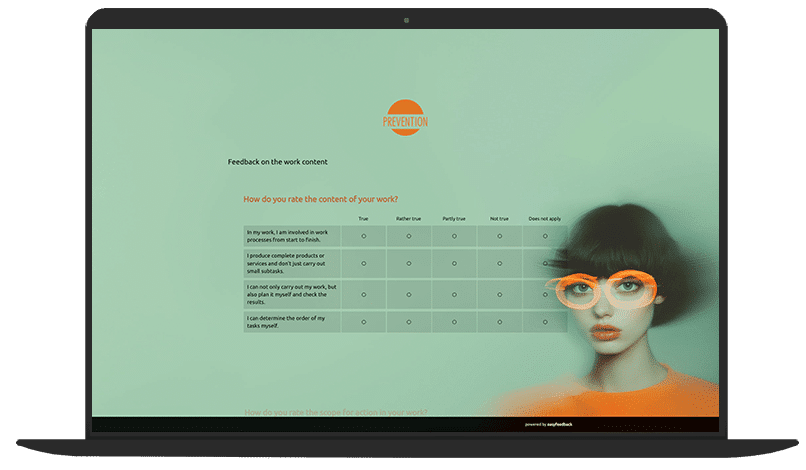
With our survey template, you can identify physical and psychological risks in the workplace at an early stage and derive targeted protective measures — for greater safety and health.

Immobilienscout 24 ist begeisterter easyfeedback Nutzer

“Identifying user needs is at the heart of our business. easyfeedback has been helping us with this task for several years now. We particularly appreciate its intuitive usability and professional support.”

Franziska Becker
Guild Lead User Experience Research
TUI ist begeisterter easyfeedback Nutzer

“We use easyfeedback for internal and external surveys—it’s fast, convenient, and easy! The uncomplicated and friendly support puts a smile on our faces, and we are delighted with the continuous development of the platform.”

Jennifer Fischer
Guest & Competitor Insights Analyst

Why conduct risk assessments in the workplace?

Risk assessments are a key component of occupational health and safety.

They serve to systematically identify and evaluate risks to the safety and health of employees and to derive appropriate protective measures.

This helps to reduce accidents at work, occupational diseases, and health problems. They also contribute to compliance with legal requirements (e.g., occupational health and safety legislation) and help companies avoid potential legal consequences.

A safe workplace not only increases employee well-being, but also their motivation and productivity.

Early risk assessment also helps to minimize costs due to illness-related absences or recourse claims.

Employee surveys support this process by providing direct feedback from employees on stress factors, hazards, and potential for improvement.

This enables companies to derive targeted measures to optimize working conditions and create a safe and healthy environment.

Contents of the template:

  • Feedback on work content
  • Feedback on information flow
  • Questions about responsibility and qualifications
  • Questions about emotional stress
  • Feedback on work organization and time management
  • Questions about social aspects and leadership
  • Feedback on the work environment

Objectives of the survey:

  • Identification of physical and psychological hazards
  • Involvement of employees in the occupational safety process
  • Development of targeted protection and prevention measures
  • Compliance with legal requirements (e.g., Occupational Safety and Health Act)
  • Promotion of health, satisfaction, and productivity
  • Continuous improvement of working conditions

Helpful features for the survey:

  • Survey options: Anonymous, partially anonymous, personalized
  • Invitation options: Link, email, QR code, and more
  • AI analysis of results, including recommendations for action
DSGVO-konforme Online-Umfragen

Data protection „made in Germany“ (GDPR)

Anonyme Teilnahme an Umfragen

Anonymity function for honest feedback

Frequently asked questions about risk assessment

The risk assessment is a systematic and methodically structured process that aims to identify, evaluate, and effectively minimize potential hazards and risks in the workplace at an early stage.

Its primary goal is to sustainably protect the safety and health of employees – because only in a safe working environment can employees fully develop their potential.

Furthermore, conducting a risk assessment is not only a recommendation but also a legal requirement, for example according to Section 5 of the German Occupational Health and Safety Act (ArbSchG).

It therefore forms an important foundation for occupational health and safety management and makes a significant contribution to preventing accidents and occupational diseases.


Objectives of a risk assessment

  • Identifying potential hazards for employees
  • Defining appropriate protective measures
  • Reducing workplace accidents and occupational diseases
  • Ensuring compliance with legal requirements and avoiding liability risks


Typical hazard factors

A risk assessment considers various types of hazards, including:

  • Mechanical hazards (e.g., machines, tools, moving parts)
  • Electrical hazards (e.g., improper wiring, short circuits)
  • Chemical hazards (e.g., hazardous substances, vapors, gases)
  • Biological hazards (e.g., viruses, bacteria)
  • Physical hazards (e.g., noise, radiation, heat)
  • Ergonomic stresses (e.g., heavy loads, forced postures)
  • Psychological stresses (e.g., stress, time pressure, workplace climate)
  • It protects employees from health risks.
  • It helps prevent accidents and downtime.
  • It ensures compliance with legal requirements.


The risk assessment is an essential tool that helps companies actively fulfill their responsibility for protecting their employees.

It not only helps reduce workplace accidents and health-related absences, but also ensures compliance with legal regulations and creates a trusting and safe working environment.

It is important to note that a risk assessment is not a one-time event, but rather a dynamic process.

It must be regularly reviewed, updated, and adapted to changing working conditions – for example, when introducing new technologies, redesigning workplaces, or after a workplace accident.

A risk assessment is a systematic analysis of hazards and risks in the workplace to ensure the safety and health of employees.

It is mandatory in various areas of occupational health and safety and includes several essential elements.

A complete risk assessment should include the following points:

1. Point: Definition of the hazard area

  • Company and work areas: Identification of the workplaces and areas within the company where potential hazards may exist.
  • Work equipment: Machines, devices, tools, and work equipment that may pose a risk.
  • Work organization: Work processes, break times, and shift systems that may involve potential risks.


2. Point: Identification and description of hazards

  • Physical hazards: Noise, vibrations, temperature, lighting, mechanical hazards, risk of electric shock.
  • Chemical hazards: Exposure to toxic, corrosive, or flammable substances, vapors, dusts, or gases.
  • Ergonomic hazards: Inadequate sitting or standing positions, repetitive movements, lifting and carrying loads.
  • Psychosocial hazards: Stress, bullying, excessive workload, team conflicts, insufficient communication.
  • Biological hazards: Bacteria, viruses, and fungi that may pose a health risk.


3. Point: Assessment of hazards

  • Hazard potential: Evaluation of the severity of possible consequences of a hazard (e.g., serious injuries, long-term health problems).
  • Probability of occurrence: Assessment of how likely it is that the hazard will result in an accident or illness.
  • Risk assessment: Combination of hazard potential and probability of occurrence to determine the overall risk. A scale ranging from “low” to “high” is often used.


4. Point: Definition of protective measures

  • Technical measures: Improvements to the workplace (e.g., machine safety systems, ventilation systems, noise protection).
  • Organizational measures: Adjustments to work processes, working time regulations, safety instructions, and training.
  • Personal protective equipment (PPE): Provision of protective clothing, helmets, gloves, hearing protection, respiratory masks, etc.
  • Emergency measures: Emergency plans, first-aid procedures, and evacuation plans.


5. Point: Documentation and communication

  • Documentation: All results of the risk assessment must be recorded, including identified hazards, the conducted risk analysis, and defined protective measures.
  • Employee information: All affected employees must be informed about the risk assessment, especially regarding the defined protective measures and safety rules.
  • Involvement of the works council: The works council must be involved in the assessment process and review the results as well as planned measures.


6. Point: Review and updating

  • Regular review: The risk assessment must be reviewed regularly and updated when necessary, for example, when working conditions, work equipment, or processes change, or after an accident.
  • Evaluation of effectiveness: Verification of whether the implemented protective measures are effective and actually minimize risks.


7. Point: Special hazards

  • For special hazards, such as handling dangerous chemicals, working with machinery, or working in specific environments (e.g., construction sites, laboratories, or near high-voltage systems), the specific hazards must be analyzed in detail and assessed separately.

The risk assessment is a central component of occupational health and safety and serves to systematically identify and evaluate hazards to safety and health in the workplace and to derive appropriate protective measures.

1. Step: Preparation & Planning

  • Define the work area or activity
  • Assign responsibilities (e.g., occupational safety specialist, company physician)
  • Gather relevant regulations & standards


2. Step: Identification of Hazards

  • Analysis of working conditions (e.g., machines, work materials, work processes)
  • Consideration of different types of hazards:
      • Mechanical (e.g., moving parts)
      • Physical (e.g., noise, heat)
      • Chemical (e.g., hazardous substances)
      • Biological (e.g., bacteria, viruses)
      • Psychological (e.g., stress, time pressure)
      • Ergonomic (e.g., incorrect posture, repetitive work)


3. Step: Evaluation of Hazards

  • Assessment of the probability and severity of possible damage
  • Classification into risk categories
  • Prioritization of measures


4. Step: Definition of Protective Measures

  • Technical measures (e.g., safety devices, extraction systems)
  • Organizational measures (e.g., work schedule design, safety instructions)
  • Personal protective measures (e.g., protective equipment such as helmets, gloves)


5. Step: Implementation of Measures

  • Assign responsibilities
  • Carry out and document measures


6. Step: Review of Effectiveness

  • Regular monitoring of measures
  • Adjustment in case of changing working conditions


7. Step: Documentation & Updating

  • Written documentation of the risk assessment
  • Regular revision (in case of new hazards, accidents, or changes within the company)

A risk assessment is a systematic process in which potential hazards in the workplace are identified and evaluated in order to implement appropriate protective measures.

This assessment is an essential part of occupational health and safety and aims to ensure the safety and health of employees.

The works council has several important responsibilities and rights regarding the risk assessment:


1. Participation and Co-determination

The works council has the right to participate in the creation of the risk assessment.

According to the German Occupational Health and Safety Act (ArbSchG), the works council must be involved in all essential aspects of occupational health and safety, particularly in the identification and evaluation of hazards and the definition of measures.


2. Consultation and Monitoring

The works council can make suggestions for improving occupational health and safety and monitor the implementation of measures to prevent hazards.

In addition, the works council can ensure that all relevant hazards are taken into account, including those that may have been overlooked.


3. Access to Information

The works council has the right to request all necessary information related to the risk assessment.

This also includes the results of accident investigations, medical assessments, or risk analyses that are relevant for evaluating workplace hazards.


4. Protection of Employee Interests

The works council represents the interests of employees and can advocate for a comprehensive and realistic risk assessment.

It can also point out deficiencies or inadequate measures and, if necessary, initiate legal steps.


5. Training and Awareness

The works council can also suggest training measures to ensure that all employees are informed about the risk assessment and the protective measures that have been implemented.

1. Point: General Information

  • Work area/Activity: [Description of the work area or activity]
  • Date of assessment: [Date]
  • Responsible person: [Name of the responsible person]
  • Involved persons: [Names of the involved persons]


2. Point: Identification of Hazards

A. Working Environment

  • Are there any tripping, slipping, or falling hazards? [Yes/No] Description: [Details]
  • Are lighting and ventilation adequate? [Yes/No] Description: [Details]
  • Is there any noise exposure? [Yes/No] Measures: [Details]


B. Mechanical Hazards

  • Is there a risk of injury from machines or tools? [Yes/No] Description: [Details]
  • Are machine safety devices available and functioning properly? [Yes/No]
  • Are there any unprotected moving or rotating machine parts? [Yes/No]


C. Electrical Hazards

  • Is there a risk from improper wiring or defective plugs? [Yes/No]
  • Are electrical devices inspected regularly? [Yes/No]


D. Chemical Hazards

  • Are hazardous substances used? [Yes/No] List of hazardous substances: [Details]
  • Are safety data sheets available? [Yes/No]
  • Are suitable protective measures in place (ventilation, personal protective equipment)? [Yes/No]


E. Biological Hazards

  • Is there contact with bacteria, viruses, or mold? [Yes/No]
  • Are hygiene and disinfection measures in place? [Yes/No]


F. Ergonomic Strain

  • Are workplaces ergonomically designed? [Yes/No]
  • Is there one-sided or repetitive strain? [Yes/No]
  • Are lifting aids used? [Yes/No]


G. Psychological Strain

  • Is there high time pressure or stress? [Yes/No]
  • Are break regulations in place? [Yes/No]
  • Are there measures for stress management? [Yes/No]


3. Point: Evaluation of Hazards


4. Point: Measures & Implementation

  • Which protective measures are required? [Description of measures]
  • Who is responsible for implementation? [Name]
  • By when must the measures be implemented? [Date]


5. Point: Review & Documentation

  • Date for reviewing the measures: [Date]
  • Have all measures been effectively implemented? [Yes/No]
  • Are adjustments required? [Yes/No] If yes, which ones? [Description]
  • Date of the last update: [Date]

Hier is an English translation while keeping the HTML structure unchanged:

1. Point: General Information

  • Work area/Activity: ______________
  • Responsible person: ______________
  • Date of assessment: ______________
  • Involved persons (e.g. occupational safety specialist, company doctor): ______________


2. Point: Identification of Hazards


Working Environment

  • Are escape and emergency routes clear and properly marked?
  • Are there any tripping, slipping, or falling hazards?
  • Is the lighting sufficient?
  • Are the climatic conditions acceptable (temperature, humidity, ventilation)?


Mechanical Hazards

  • Is there a risk of injury from machines, tools, or moving parts?
  • Are machine safety devices available and functioning properly?
  • Are there any sharp edges or crushing points?


Electrical Hazards

  • Are electrical systems and devices inspected and in a safe condition?
  • Is there a risk from improper wiring or defective plugs?
  • Is there sufficient protection against short circuits or overloads?


Chemical Hazards

  • Are hazardous substances used (solvents, cleaning agents, gases, etc.)?
  • Are safety data sheets available and followed?
  • Are suitable protective measures in place (ventilation, personal protective equipment)?


Biological Hazards

  • Is there contact with bacteria, viruses, or mold?
  • Are hygiene and disinfection measures in place?
  • Are protective measures (e.g. gloves, masks) followed?


Physical Hazards

  • Are employees exposed to noise, vibrations, or radiation?
  • Are noise protection measures being used?
  • Are there measures in place to protect against extreme heat or cold?


Ergonomic Strain

  • Are workplaces ergonomically designed?
  • Are there monotonous or one-sided physically demanding tasks?
  • Are aids (e.g. lifting equipment) used to reduce physical strain?


Psychological Strain

  • Is there high time pressure or stress?
  • Are there conflicts within the team or unclear work requirements?
  • Are breaks taken and recovery periods considered?


3. Point: Evaluation of Hazards

  • Which hazards pose the greatest risk?
  • Which measures are required?
  • Which priority category does the measure fall into? (high/medium/low)


4. Point: Measures & Implementation

  • Planned protective measures: ______________
  • Responsible person for implementation: ______________
  • Deadline for implementation: ______________
  • Implementation review takes place on: ______________


5. Point: Review & Documentation

  • Have all measures been implemented?
  • Has the hazard been reduced or completely eliminated?
  • Is a new assessment required? (e.g. after an accident or changes within the company)
  • Has the risk assessment documentation been completed and archived?

easyfeedback is a software solution that is mainly used for surveys, feedback, and evaluations.

Although it was not originally developed specifically for risk assessments, it can be a very helpful tool for conducting and managing a risk assessment when used correctly.

Here are some ways easyfeedback can support you with a risk assessment:

1. Option: Creating Surveys and Questionnaires

  • Risk assessment surveys: With easyfeedback, you can create customized surveys or questionnaires to identify workplace hazards. You can ask specific questions that cover all potential risks, such as noise, chemical exposure, ergonomic risks, or psychological stress.


  • Employee anonymity: easyfeedback allows surveys to be conducted anonymously, which can encourage employees to honestly report potential hazards without fearing negative consequences.


2. Option: Collecting and Analyzing Data

  • Collecting feedback:
    You can collect feedback from employees regarding specific hazards and risks. By asking simple, targeted questions, you can quickly gather information about hazards and the affected areas within the company.


  • Data analysis:
    easyfeedback provides functions for evaluating and analyzing collected data. With statistical evaluations, you can easily identify which hazards are mentioned most frequently and which areas of the company require action.


  • Reporting and visualization:
    easyfeedback provides clear reports and visualizations that you can use to document and present the results of the risk assessment. These can then serve as a basis for defining appropriate measures.


3. Option: Feedback on the Effectiveness of Measures

  • Reviewing protective measures:
    After implementing protective measures, you can use easyfeedback to evaluate their effectiveness. A follow-up survey among employees helps determine whether the implemented measures actually make a difference or whether hazards still exist.


  • Continuous improvement:
    With regular feedback, you can continuously adapt and improve the risk assessment to ensure the long-term safety and health of employees.


4. Option: Involving the Works Council and Employees

  • Involving the works council:
    The works council can review surveys and feedback results and actively participate in the risk assessment process. This promotes transparency and employee participation in occupational health and safety processes.


  • Employee participation:
    easyfeedback provides employees with a user-friendly way to express their concerns without feeling pressured by a physical assessment process. This can lead to a more comprehensive and accurate identification of hazards.


5. Option: Automated Reminders and Follow-up
  • Reminder function:
    With easyfeedback, you can send reminders to employees to ensure that the risk assessment is completed and regularly reviewed. This helps prevent important information from being lost and ensures that hazard situations are assessed continuously.


  • Tracking measures:
    You can ensure that implemented measures are consistently carried out by conducting follow-up surveys and reviewing their effectiveness.

More employee survey templates​

Survey Template Job Satisfaction

Job Satisfaction

Survey template details

Survey Template working environment

Workplace Atmosphere

Survey template details

Survey-Template-Pulse-Employee-Questionnaire

Pulse Check

Survey template details

Survey Template: Determine Workload

Workplace Load

Survey template details

Survey template mood barometer

Mood Meter

Survey template details

Explore all survey templates  

You are in professional company

Immoscout 24 Logo
Tui Logo
Porsche Logo
Lufthansa Logo
Jaegermeister Logo

Over 740,000 participants in easyfeedback surveys every month

Result

STUDIO

The performance add-on for your analysis

easyfeedback Result Studio 2