
How strong is your brand's image? Find out by conducting a survey.

Conduct image analysis easily via survey

Use this survey template to analyze the image of your company or brand — by gathering valuable feedback from customers, partners, and the public. This will help you identify strengths, weaknesses, and areas for improvement.

Immobilienscout 24 ist begeisterter easyfeedback Nutzer

“Identifying user needs is at the heart of our business. easyfeedback has been helping us with this task for several years now. We particularly appreciate its intuitive usability and professional support.”

Franziska Becker
Guild Lead User Experience Research
TUI ist begeisterter easyfeedback Nutzer

“We use easyfeedback for internal and external surveys—it’s fast, convenient, and easy! The uncomplicated and friendly support puts a smile on our faces, and we are delighted with the continuous development of the platform.”

Jennifer Fischer
Guest & Competitor Insights Analyst

Why is regular image analysis important?

An image analysis in a corporate or brand context is essential for gaining an in-depth understanding, through market research surveys and other methods, of how customers, partners, and the public perceive the company or brand.

It reveals potential discrepancies between the company’s self-image and its external image, thereby laying the foundation for targeted measures to improve brand perception.

Furthermore, the analysis identifies strengths and weaknesses relative to the competition, enabling more precise market positioning and sustainable competitive advantages.

It also plays a key role in optimizing the communication strategy by highlighting how messages can be conveyed more clearly, authentically, and effectively.

Image analysis and image research also play an important role in crisis prevention, as they identify negative trends early on and allow for proactive countermeasures.

A positive image also strengthens employee motivation and fosters a sense of belonging within the company.

Contents of the template:

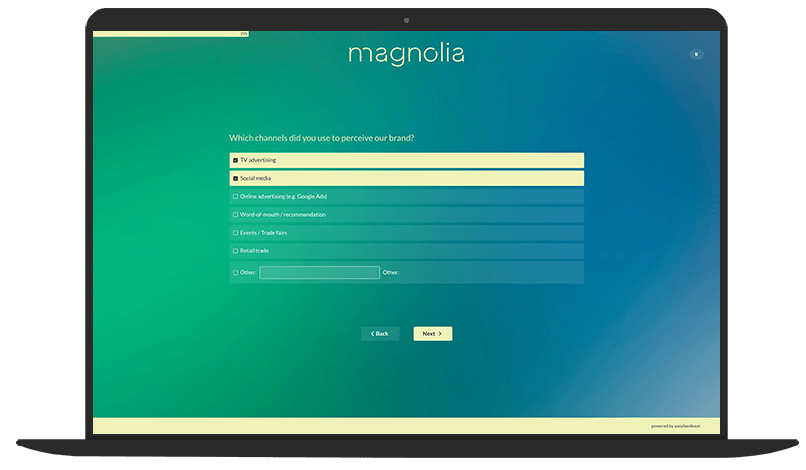
  • Measure brand awareness
  • Gather brand associations
  • Identify brand recognition characteristics
  • Have the brand evaluated
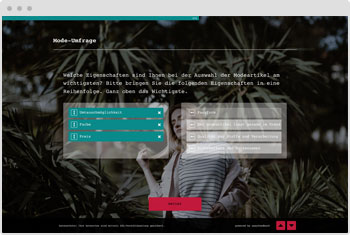
  • Conduct a ranking survey on branding factors
  • Measure the Net Promoter Score (NPS)
  • Collect demographic data

Objectives of the survey:

Helpful features for the survey:

  • Survey options: Anonymous, partially anonymous, personalized
  • Invitation options: Link, email, QR code, and more
  • AI analysis of results, including recommendations for action
DSGVO-konforme Online-Umfragen

Data protection „made in Germany“ (GDPR)

Anonyme Teilnahme an Umfragen

Anonymity function for honest feedback

Frequently asked questions about image analysis

Image analysis refers to the systematic examination and assessment of how a company or brand is perceived by the public, customers, or specific target audiences.

  • Understand how the brand is perceived:
    Find out what image customers and prospects have of the brand and which emotions they associate with it.


  • Identify strengths and weaknesses:
    Discover which aspects of the brand presence work well and where improvement is needed.


  • Derive measures to improve brand image:
    Based on the analysis, develop targeted strategies to maintain or improve the brand image.


  • Competitor comparison:
    Compare your own image with that of competitors to identify and build on unique selling propositions.

Part 1: Perception

This is about how customers and other target audiences actually perceive the brand:

  • Is it seen as trustworthy, innovative, affordable, or high-quality?
  • Which characteristics do people spontaneously associate with the brand?


Part 2: Brand Image Components

Brand perception consists of different levels:

  • Cognitive level: Knowledge about the company, such as its industry, products, and market position
  • Emotional level: Feelings associated with the brand, such as affinity, trust, or pride
  • Behavioral level: Willingness to purchase or recommend the brand


Part 3: Sources of Brand Image Formation

A brand image does not emerge in isolation; it is shaped by various factors:


Part 4: Methods

Various data collection methods are used to gain a comprehensive picture:

  • Surveys and interviews, for example with customers and stakeholders
  • Social media monitoring, including sentiment and comments
  • Media coverage analysis
  • Brand equity studies

Reason 1: Understand How the Brand Is Perceived

One of the most important questions for every company is: What do customers really think about us?

Image analyses help identify the genuine feelings and associations a brand evokes in people.

This reveals how brands are perceived “from the outside”—not just how a company sees itself.


Reason 2: Identify Strengths and Weaknesses

Which aspects of our brand work particularly well?

For example, trust, quality, or service. But also where problems exist — perhaps the brand appears outdated or unappealing.

These insights are the foundation for improvements and targeted measures.


Reason 3: Improve Brand Management

Using the results of an image analysis, strategies can be developed to deliberately manage and improve brand image.

This affects advertising, design, communication, and all other touchpoints with the target audience.

This helps the brand remain relevant and compelling.


Reason 4: Build a Competitive Advantage

A positive brand image results in stronger customer retention and positively influences purchase decisions.

Those who position their brand clearly and attractively stand out from competitors and gain important advantages in the market.


Reason 5: Identify Risks Early

Image analyses help identify negative perceptions early—for example, during online backlash, scandals, or communication failures.

This enables reputation management to respond quickly and limit damage.


Reason 6: Better Understand Target Audiences

Not all target audiences perceive a brand in the same way. Image analyses show which groups have which perceptions or expectations.

Marketing and communication can then be tailored accordingly, for example to reflect age differences or regional characteristics.


Reason 7: Measure Campaign Success

How does a new advertising campaign or design affect brand image?

Before-and-after comparisons make it possible to measure success and assess whether the activities have achieved the desired effect.

Step 1: Define the Objective

Before you begin, clarify:

  • What exactly do you want to find out?
  • Overall brand image?
  • Comparison with competitors?
  • Impact of a campaign?
  • Who is the target audience for the analysis? Customers, employees, the public, or a specific age group?


Example objective: “We want to find out how young adults perceive brand XY compared with competitors.”

Step 2: Select a Method

Depending on the objective, choose one or more methods:

  • Online survey: Measure broad opinion
  • Interviews/focus groups: Gain deeper insights
  • Social media monitoring: Capture spontaneous opinions
  • Benchmarking/competitive analysis: Compare with other brands


Step 3: Develop Questions

Create appropriate questions for your chosen method.

Use a mix of closed questions, such as scales or multiple-choice questions, and open-ended questions.

  • Example (rating-scale question): “How appealing do you find brand XY on a scale of 1 to 5?”
  • Example (open-ended): “What comes to mind spontaneously when you think of brand XY?”


Tip: Use association questions or image cards when exploring more emotional responses.


Step 4: Collect Data

Now conduct your survey or analysis:

  • Online survey, for example with easyfeedback
  • Interviews or focus groups — take recordings or notes
  • Social media analysis using tools, such as Talkwalker, Brandwatch, or manual review


Step 5: Analyze Data

  • Quantitative data: Analyze statistically, using averages and charts.
  • Qualitative data: Sort by topics, opinions, or sentiment, for example through clusters or categories.


Example: 65% of respondents find the brand “appealing,” 20% “neutral,” and 15% “unappealing.”

Step 6: Interpret Results

  • What does the data reveal about the brand image?
  • Are there differences between age groups or regions?
  • What is working well, and what should be improved?


Questions for Interpretation:

  • Which brand image characteristics are most prominent?
  • Do self-perception and external perception align?
  • Are there warning signs, such as declining trust?


Step 7: Derive Actions

  • How can the brand image be improved or maintained deliberately?
  • What needs to change in communication, design, or service?


Example: “The brand is perceived as high-quality but distant. Recommendation: use more emotional communication and strengthen customer engagement.”


Step 8: Documentation & Presentation

Document everything clearly, if necessary in a presentation or report:

  • Objective
  • Method(s)
  • Results, including charts where appropriate
  • Interpretation
  • Recommendations for action

Here are the key methods of image analysis in the field of brands and companies, clearly explained:

1. Method: Surveys (quantitative & qualitative)

Quantitative surveys (e.g. online surveys)

  • Large sample size → measurable data
  • Standardized questions (scales, multiple choice)
  • Goal: Statistical analysis and comparison with competitors


Qualitative interviews or focus groups

  • Small groups or individual interviews
  • Open questions → deeper insights
  • Goal: Understanding attitudes, emotions, and opinions


2. Method: Social Media Monitoring

  • Analysis of posts, comments, and reviews
  • Use of tools (e.g. Brandwatch, Talkwalker, Hootsuite)
  • Analyzes:
      • Sentiment (positive, neutral, negative)
      • Frequently mentioned terms/topics
      • Reach & sentiment trends
  • Advantage: Real-time data and unfiltered opinions


3. Method: Media Coverage Analysis

  • Analysis of press coverage, articles, TV reports, and more
  • Criteria:
      • Sentiment (positive/negative)
      • Key topics (e.g. innovation, scandals)
      • Presence compared to competitors
  • Goal: How is the company portrayed in public?


4. Method: Sentiment Analysis / Text Analysis

  • Automated analysis of texts using AI or algorithms
  • Applicable to social media, forums, reviews, and emails
  • Identifies sentiment, topics, and emotions
  • Example tools: Google Cloud Natural Language, IBM Watson


5. Method: Projective Techniques (e.g. word associations, images)

  • More psychological in nature: the goal is to uncover the subconscious brand image
  • Methods:
      • Association tasks: “What comes to mind spontaneously when you think of Brand XY?”
      • Image selection methods: Participants select images that fit the brand
      • Useful for emotional aspects of brand image


6. Method: Brand Value and Positioning Analyses

  • Combination of image analysis and market analysis
  • Evaluates:
      • Brand strength (e.g. brand awareness, trust)
      • Brand positioning compared to competitors
      • Expected benefits & price perception


7. Method: Tracking Studies / Longitudinal Analyses

  • Repeated image assessments over a longer period of time
  • Goal: Monitor the development of the brand image (e.g. before/after a campaign)

Evaluating an image analysis means systematically analyzing the data collected to determine what the brand image actually looks like and what can be derived from it—for example, for marketing, communication, or strategic decisions.

Step 1: What Data Is Available?

The data typically comes from:

  • Surveys, such as online surveys with rating scales
  • Interviews
  • Association tests
  • Social media monitoring
  • Media analysis


The data can be quantitative (numbers) or qualitative (open-ended answers and opinions).


Step 2: How Is the Data Evaluated?

Quantitative Evaluation (Using Numbers)

Example:

  • Appealing: 4.3 out of 5
  • Trustworthy: 3.9 out of 5
  • Innovative: 2.7 out of 5
  • Successful: 4.5 out of 5


Interpretation: The image is predominantly positive, but innovation is perceived weakly → an opportunity for improvement.

Qualitative Evaluation (e.g., Open-Ended Questions, Comments)

Example statements:

  • “The brand is very down-to-earth, but somehow boring.”
  • “I trust the organization, but it does not seem very modern.”


Interpretation: Trust is strong, while modernity is a weakness. A solid foundation, but improvement is needed.


Step 3: Clustering / Target Audience Analysis

Different target groups may perceive the brand differently.

Example:

  • Younger fans: Image = “cool, creative, digital”
  • Older fans: Image = “down-to-earth, rich in tradition”


Develop tailored communication for each target audience.


Step 4: Compare with the Desired Image

  • What was the desired image?
  • What is the actual image?


Step 5: Recommendations for Action

The analysis may result in, for example:

  • Communication strategies, such as presenting the brand in a more modern way
  • Rebranding, including logo, slogan, and campaigns
  • Measures for fan retention, sponsor acquisition, public relations, etc.

More market research survey templates​

Stakeholder analysis questionnaire template

Stakeholder Analysis

Survey template details

Survey Template Market Analysis

Market Analysis

Survey template details

Survey Template Measure Brand Awareness

Brand Awareness

Survey template details

Survey Template: Test Marketing Campaigns

Marketing Campaign

Survey template details

Consumer Behavior Survey Template

Consumer Behavior

Survey template details

Explore all survey templates  

You are in professional company

Immoscout 24 Logo
Tui Logo
Porsche Logo
Lufthansa Logo
Jaegermeister Logo

Over 740,000 participants in easyfeedback surveys every month

Result

STUDIO

The performance add-on for your analysis

easyfeedback Result Studio 2