

“Identifying user needs is at the heart of our business. easyfeedback has been helping us with this task for several years now. We particularly appreciate its intuitive usability and professional support.”

“We use easyfeedback for internal and external surveys—it’s fast, convenient, and easy! The uncomplicated and friendly support puts a smile on our faces, and we are delighted with the continuous development of the platform.”
Inflation, pandemics, and changing life circumstances are forcing companies to gain a deep understanding of their customers’ evolving purchasing behavior. Only by doing so can they remain successful and adapt to change.
But how can this changing behavior be accurately captured? A survey is an excellent way to measure and analyze the purchasing behavior of your target audience.
Through targeted analysis, companies gain valuable insights and can optimally adapt to consumers’ wishes and needs.
This allows them to identify trends, gauge customers’ willingness to switch, and pinpoint the right target audiences.
Based on this data, tailored marketing campaigns can then be developed and communications effectively targeted.
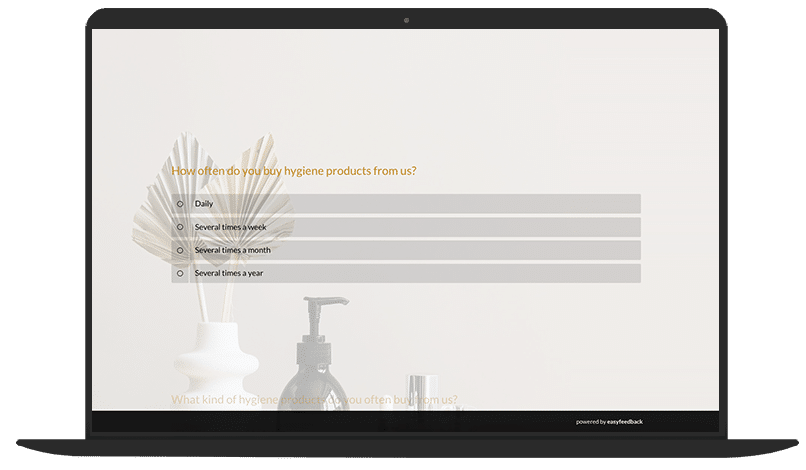
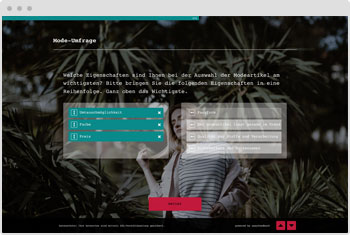
To help you analyze your customers’ purchasing behavior, we’ve created a suitable survey template. Use it and customize it to meet your specific needs.
Contents of the template:
Objectives of the survey:
Helpful features for the survey:

Data protection „made in Germany“ (GDPR)

Anonymity function for honest feedback
Purchasing behavior refers to the way consumers make decisions and act when buying products or services.
It encompasses the entire purchasing process, from recognizing a need through purchase and the post-purchase phase.
Purchasing behavior is influenced by a variety of factors, including personal, psychological, social, and cultural aspects.
Here are the main components of purchasing behavior in detail:
Component 1: Need Recognition
The first step in purchasing behavior is recognizing a need or problem. This can be triggered by internal or external stimuli.
For example, a consumer might notice that their refrigerator is empty (an internal need) or see an advertisement for a new smartphone (an external need).
Component 2: Information Search
After recognizing a need, the consumer begins searching for information to satisfy that need.
This information search can be internal, through memories of previous experiences, or external, through friends, family, advertising, online reviews, and more.
The intensity of the information search often depends on the importance of the purchase and perceived risk.
Component 3: Evaluation of Alternatives
Once sufficient information has been gathered, the consumer evaluates the available alternatives.
This evaluation is based on various criteria, such as price, quality, brand, features, and personal preferences.
The consumer compares the advantages and disadvantages of each option to make the best decision.
Component 4: Purchase Decision
After evaluating the alternatives, the consumer makes a purchase decision.
This decision can be influenced by several factors, including availability, special offers, recommendations, and personal preferences.
It is also possible for the purchasing process to be affected by unexpected influences, such as negative reviews or short-term changes in financial circumstances.
Component 5: Purchase
The actual purchasing process involves the transaction in which the consumer buys the selected product or service.
This can take place in a physical store, online, or through other sales channels.
Factors such as the convenience of the purchasing process, payment options, and customer service can play a role here.
Component 6: Post-Purchase Behavior
Post-purchase behavior refers to the phase after a purchase, when the consumer uses the purchased product and evaluates their satisfaction or dissatisfaction.
Satisfaction can lead to brand loyalty and positive recommendations, whereas dissatisfaction can result in returns, complaints, and negative reviews.
Companies often try to influence this phase through after-sales services and customer support.
Factor 1: Personal Factors
The consumer’s age, gender, occupation, income, lifestyle, and personality.
Factor 2: Psychological Factors
Motivation, perception, learning, beliefs, and attitudes.
Factor 3: Social Factors
Influences from family, friends, social groups, and social roles.
Factor 4: Cultural Factors
Cultural values, norms, subcultures, and social classes.
Factor 5: Economic Factors
Income, price sensitivity, and economic conditions.
Hybrid purchasing behavior refers to the combination and integration of different shopping channels and methods by consumers.
It describes the behavior of consumers who shop both online and offline, taking advantage of the benefits offered by both channels.
Hybrid purchasing behavior includes various aspects and forms that optimize the consumer experience and cater to consumers’ individual needs and preferences.
Here are the key characteristics and examples of hybrid purchasing behavior:
Characteristic 1: Cross-Channel Shopping
Characteristic 2: Multi-Device Use
Characteristic 3: Omnichannel Experience
Examples of Hybrid Purchasing Behavior
Example 1: Online Research and Offline Purchase (ROPO)
Example 2: Offline Research and Online Purchase (Showrooming)
Example 3: Click and Collect
Example 4: Online Purchase and Offline Return
Example 5: Cross-Device Shopping
Identifying trends in purchasing behavior is essential for companies to remain competitive and respond to consumers’ changing needs and wishes.
Here are some methods and tools that can be used to identify purchasing behavior trends:
Method 1: Data Analysis and Big Data
a) Data Sources:
b) Techniques:
Method 2: Market Research
a) Methods:
b) Objective:
Method 3: Social Media and Online Reviews
a) Social Listening:
b) Objective:
Method 4: Competitive Analysis
a) Methods:
b) Objective:
Method 5: Trend Reports and Industry Analysis
a) Sources:
b) Objective:
Method 6: Technological Innovation
a) Methods:
b) Objective:
To identify consumer purchasing behavior, you can ask various questions covering different aspects of the buying process, preferences, and motivations.
Category 1: Demographic Questions
These questions help collect basic information about the target audience.
Category 2: Shopping Habits
These questions aim to understand general purchasing behavior and preferences.
Category 3: Decision-Making
These questions explore how consumers make decisions.
Category 4: Preferences and Satisfaction
These questions help understand how satisfied consumers are with their purchases and what their preferences are.
Category 5: Shopping Platforms and Channels
These questions aim to determine which platforms and channels consumers prefer.
Category 6: Use of Technology
These questions examine how consumers use technology while shopping.
Category 7: Purchase Motivations and Barriers
These questions help understand the reasons and obstacles behind purchases.
Category 8: Post-Purchase Behavior
These questions highlight consumers’ behavior after a purchase.
Consumer behavior refers to the way consumers make decisions regarding the purchase and use of products and services.
It encompasses all activities, processes, and social interactions associated with acquiring, using, and disposing of consumer goods.
Consumer behavior is influenced by a variety of factors, including:
Understanding consumer behavior is crucial for companies and marketers because it enables them to develop products and services that are better aligned with consumer needs and wishes and create more effective marketing strategies.
Consumer behavior is influenced by a variety of factors, including psychological, social, cultural, economic, and personal aspects.
Here are the main factors in detail:
1. Psychological Factors
2. Social Factors
3. Cultural Factors
4. Economic Factors
5. Personal Factors
Here are some examples of consumer behavior that illustrate different aspects and influences:
Example 1: Impulse Purchases
A consumer sees an appealing offer for chocolate at the checkout and buys it spontaneously, even though it was not on their shopping list.
Example 2: Brand Loyalty
A customer repeatedly buys the same smartphone model because they are very satisfied with the brand and have had positive experiences.
Example 3: Price-Conscious Behavior
A consumer compares prices across different online stores before deciding to buy a new television in order to find the best offer.
Example 4: Environmentally Conscious Behavior
A family chooses to buy organic products and avoids plastic packaging to reduce its environmental footprint.
Example 5: Socially Influenced Behavior
A teenager buys clothing from a particular brand because their friends wear it and they want to fit in.
Example 6: Needs-Based Behavior
A consumer buys a new mattress because the old one is worn out and causes back pain.
Example 7: Innovation-Oriented Behavior
A technology enthusiast buys the latest model of a smartwatch to always use the latest features and technologies.
Example 8: Health-Conscious Behavior
A person chooses products with no added sugar and regularly shops at a health food store to support a healthy diet.
Example 9: Convenience-Oriented Behavior
A working parent regularly uses grocery delivery services to save time.
Example 10: Experience-Oriented Behavior
A person spends money on travel and leisure activities because they value new experiences and adventures.