

“Identifying user needs is at the heart of our business. easyfeedback has been helping us with this task for several years now. We particularly appreciate its intuitive usability and professional support.”

“We use easyfeedback for internal and external surveys—it’s fast, convenient, and easy! The uncomplicated and friendly support puts a smile on our faces, and we are delighted with the continuous development of the platform.”
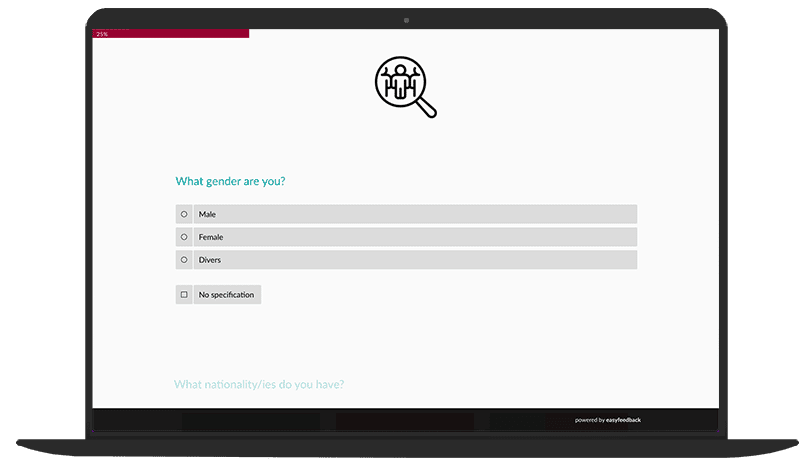
How old are you? Where do you live? What is your employment status? These and similar demographic questions are a standard part of many surveys. But why are they so important?
They allow researchers to categorize participants based on specific characteristics and gain a more accurate picture of their target audience.
Demographic data is essential for understanding survey results in the context of the participant structure. This allows you to identify specific patterns that are crucial for interpreting the responses.
For example, if you’re conducting a survey on product design, demographic data provides valuable insights into how needs and opinions differ by age group or gender.
You can determine whether younger participants have different preferences than older ones, or whether men and women have different expectations of the product.
These insights help you tailor your offerings and better align your marketing strategy with the various target groups.
By taking demographic differences into account, you ensure that your products and services meet the expectations of different customer groups and are thus more successfully positioned in the market.
Contents of the template:
Objectives of the survey:
Helpful features for the survey:

Data protection „made in Germany“ (GDPR)

Anonymity function for honest feedback
Demographic data, also known as sociodemographic data, refers to the collection of general information about a particular group of people, such as age, gender, place of residence, marital status, and more.
This data is usually collected through direct surveys, for example as part of market research.
The aim is to help companies align themselves strategically with a group of people or target audience.
By analyzing this data, companies can better understand who their customers are, what needs and preferences they have, and how products or services can be tailored specifically to the relevant demographic groups.
This enables a more effective, personalized marketing strategy, ultimately leading to higher customer satisfaction and greater business success.
Reason 1: Target Audience Analysis
By collecting demographic data such as age, gender, education level, income, and place of residence, companies and researchers can better understand and segment their target audiences.
This enables targeted engagement and tailored offerings.
Reason 2: Interpret Results
Demographic information helps place survey results in context and interpret them more effectively.
Differences in responses can often be explained by demographic factors, providing valuable insights into the needs and opinions of different groups.
Reason 3: Market Research and Marketing
In market research, demographic data is crucial for identifying market segments and understanding which products or services are especially well received by certain population groups.
This leads to more targeted and effective marketing strategies.
Reason 4: Personalized Marketing
Demographic data enables companies to develop personalized marketing campaigns tailored to the specific characteristics and preferences of different customer groups.
This increases the relevance of messages and improves customer retention.
Reason 5: Product Development
Analyzing demographic data can support the development of new products or services by showing which features and functions are particularly important to specific target groups.
Reason 6: Social Science Research
In social sciences and public policy, demographic data is essential for understanding social trends and planning and evaluating policy measures.
Reason 7: Comparability and Representativeness
Demographic data makes it possible to compare results with other studies or population data and helps ensure that the survey represents a representative sample of the target audience.
Reason 8: Needs Analysis
By analyzing demographic data, companies and organizations can identify groups with specific needs or challenges and respond accordingly.
There are various methods for collecting demographic data, which can be used depending on the objective and context of the study.
Here are some of the most common methods:
Method 1: Questionnaires and Surveys
This is the most common method for collecting demographic data.
Questionnaires, both online and paper-based, include specific questions about age, gender, income, education, and other demographic characteristics.
Online surveys offer the advantage of reaching a large number of participants quickly and cost-effectively.
Method 2: Interviews
In-person or telephone interviews make it possible to collect demographic data directly from participants.
This method has the advantage that complex questions can be clarified and misunderstandings avoided.
Method 3: Observation
In some cases, demographic data can be collected through observation.
This method is often used in social and ethnographic studies to gather information about the behavior and characteristics of groups.
Method 4: Administrative and Registry Data
Government agencies and other organizations often maintain registers and databases containing demographic information.
Examples include census data, birth and death records, voter registers, and social security data.
These sources provide extensive and reliable demographic information.
Method 5: Secondary Data Analysis
Existing studies and datasets created by other researchers or organizations can be analyzed to obtain demographic information.
This method saves time and resources because the data has already been collected.
Method 6: Social Media and Online Platforms
Platforms such as Facebook, Twitter, and LinkedIn collect extensive demographic data about their users.
Researchers and companies can use this data to conduct demographic analysis, although data protection and ethical guidelines must be observed.
Method 7: Experimental Studies
In experimental designs, demographic data can be collected as part of the baseline data to describe the composition of the sample and analyze the results.
Method 8: Panel Studies
Long-term studies in which the same participants are surveyed repeatedly over an extended period enable demographic data to be collected and analyzed over time.
Method 9: Geographic Information Systems (GIS)
GIS technologies can be used to display and analyze demographic data on geographic maps.
This is particularly useful for studying spatial distributions and trends.
Demographic data is statistical information used to describe and analyze specific groups of people.
It forms the basis for many decisions in marketing, politics, social research, product development, and workforce planning.
Through the systematic collection and evaluation of this data, it is possible to create a detailed picture of target audiences, customers, or population groups.
Demographic characteristics usually concern measurable or clearly classifiable attributes of individuals.
They provide objective information that serves as a basis for differentiated target audience analysis or broader social assessments.
Here is an example illustrating the most common demographic data points:
Age
Gender
Education Level
Income
Employment Status
Marital Status
Place of Residence
Ethnic Background
Religion
Housing Situation
Number of Children
This demographic data can be used to create a comprehensive picture of the group being studied.
Such information is especially valuable for market research, service planning, product development, and political and social analysis.
Analyzing demographic data is an important process for gaining insights into the structure and characteristics of a target audience.
Here are the key steps and aspects of the analysis:
Step 1: Data Collection
First, demographic data is collected through surveys, interviews, administrative data, or other methods.
Step 2: Data Cleaning
The collected data is cleaned to remove errors and inconsistencies.
This may include removing duplicates, correcting spelling errors, and filling in missing information.
Step 3: Data Analysis
Demographic data is analyzed using statistical methods.
This may include calculating means, medians, modes, and distributions to identify central tendencies and variability.
Step 4: Segmentation
The target audience is divided into different segments based on demographic data.
For example, age groups, genders, or income brackets can be created to identify specific differences and similarities.
Step 5: Visualization
The results of the analysis are visualized to make them easier to interpret.
Commonly used visualization tools include bar charts, pie charts, histograms, and heat maps.
Step 6: Interpretation
The data is interpreted to draw conclusions and derive recommendations for action.
The findings are considered in the context of the original research question or objective.
Step 7: Reporting
A report is created that summarizes the key results and insights.
This report can be used for both internal purposes and communication with stakeholders.
Example of an Analysis
A report is created that summarizes the key results and insights. This report can be used for both internal purposes and communication with stakeholders.
Assume a survey has collected demographic data on a customer group:
Interpretation:
The data shows that the target audience consists predominantly of young, well-educated women with middle to high incomes.
Recommendations for Action:
Based on this information, a company could adapt its marketing strategies to target this demographic group specifically.
For example, marketing campaigns could be developed to address the interests and needs of young, working women.
Through these steps, demographic data analysis enables a deep understanding of the target audience and supports informed decisions in marketing, product development, and strategic planning.
Personas are fictional but realistic profiles that summarize the typical characteristics of a target audience.
They help companies better understand their customers, refine marketing strategies, and develop products in a targeted way.
They consider not only behaviors and needs, but also specific demographic data.
Here is an example of a persona with detailed demographic information, as is often used in marketing and product development:
Name: Max Mustermann
Age: 32 years
Gender: Male
Education Level: University degree (Master’s in Business Administration)
Income: €55,000 annually
Employment Status: Employed full-time in sales
Marital Status: Married
Place of Residence: Urban; lives in a rented apartment in Berlin
Ethnic Background: German
Religion: No religion
Housing Situation: Rented apartment, three rooms
Number of Children: No children
Leisure Activities: Traveling, reading, cooking
Technology Use:
Media Consumption:
Purchasing Behavior:
Motivation and Goals:
Challenges: