

“Identifying user needs is at the heart of our business. easyfeedback has been helping us with this task for several years now. We particularly appreciate its intuitive usability and professional support.”

“We use easyfeedback for internal and external surveys—it’s fast, convenient, and easy! The uncomplicated and friendly support puts a smile on our faces, and we are delighted with the continuous development of the platform.”
The best ideas often come from employees who are involved in the company’s processes on a daily basis.
Their practical experience enables them to identify potential for improvement and develop innovative solutions.
With a simple employee survey, you can give your employees the opportunity to share valuable feedback and drive internal innovation.
This not only promotes a sense of appreciation and involvement, but also strengthens commitment and identification with the company.
Implement idea management in your company and use our proven template for an effective suggestion scheme. It offers a structured way to collect, evaluate, and implement ideas to achieve continuous improvement.
Perhaps one of your employees already has a brilliant idea that could give your company a competitive advantage.
Contents of the template:
Objectives of the survey:
Helpful features for the survey:

Data protection „made in Germany“ (GDPR)

Anonymity function for honest feedback
An employee suggestion system is a structured improvement process designed to leverage the ideas and creativity of employees throughout an organization. It is an integral part of idea management, which focuses on generating, collecting, evaluating, and implementing innovative ideas.
In practice, this means encouraging employees to submit suggestions for improving products, services, workflows, or business processes.
To maximize its value, employee suggestions are not limited to specific departments. Instead, ideas can relate to any area of the organization.
Suggestions may range from improving the workplace culture and increasing employee satisfaction to reducing costs, conserving resources, improving workplace safety, or optimizing entire business processes.
Submitted ideas are typically reviewed by a dedicated evaluation committee or the company’s management to determine their feasibility, potential benefits, and implementation requirements.
Where employment or labor law issues are involved, employee representatives or works councils may also participate in the evaluation process. If a suggestion is successfully implemented, the employee may, depending on the company’s policies, receive financial rewards or other forms of recognition.
An employee suggestion system gives employees the opportunity to actively contribute to the organization’s success while helping shape and improve their own working environment.
This not only supports continuous improvement but also increases employee motivation, engagement, and employee retention.
As a result, an employee suggestion system is not only an effective innovation management tool but also a valuable instrument for employee engagement and organizational development.
An employee suggestion system is important because it provides a platform where employees can actively contribute to the continuous improvement and development of the organization.
It fosters a culture of openness, collaboration, and innovation, where employees feel heard, valued, and encouraged to share their ideas.
By involving employees in the improvement process, organizations benefit from diverse perspectives and practical insights that can lead to innovative solutions, more efficient workflows, and better business outcomes.
In addition, an employee suggestion system strengthens employee engagement by giving employees the opportunity to influence positive change and make a meaningful contribution to the organization’s success.
Idea management is the systematic process of generating, collecting, evaluating, and selecting ideas with the goal of driving quality improvements, innovation, and operational efficiency within an organization.
It is a strategic approach that aims to harness the creativity and expertise of employees and integrate their ideas into the organization’s continuous improvement process.
Beyond idea generation, idea management promotes a culture of innovation, open communication, and cross-functional collaboration. It encourages employees at all levels to identify opportunities for improvement, think creatively, and contribute to the organization’s long-term success.
A key objective of idea management is to actively involve employees in shaping and improving the organization.
By giving employees the opportunity to submit their own ideas and improvement suggestions, organizations not only increase employee motivation but also strengthen ownership, accountability, and engagement.
At the same time, idea management reinforces employees’ identification with the organization while fostering a sustainable culture of innovation and continuous improvement.
An established component of idea management is the employee suggestion system.
This typically includes standardized and structured processes for submitting, reviewing, rewarding, and implementing employee ideas. It provides a formal framework that ensures suggestions are evaluated transparently and that contributors receive appropriate recognition and feedback.
In contrast, the employee suggestion system represents a specific, structured element of the broader idea management framework.
Together with the continuous improvement process (CIP), it forms a core component of idea management. While employee suggestion systems often focus on individual ideas, CIP emphasizes collaborative teamwork and the ongoing optimization of daily business processes.
Overall, idea management enables organizations to systematically unlock the creative and innovative potential of their workforce, streamline and improve business processes, and strengthen their long-term competitiveness and organizational success.
An employee suggestion system serves several important objectives that help improve an organization’s efficiency, innovation, and long-term competitiveness.
Here are the key objectives:
1. Objective: Foster Innovation
An employee suggestion system enables employees to contribute creative ideas that improve processes, reduce costs, or support the development of new products, services, or business models.
2. Objective: Increase Employee Engagement
By involving employees in decision-making processes and recognizing their contributions, organizations strengthen employee engagement, motivation, and commitment.
3. Objective: Improve Operational Efficiency
An effective suggestion system encourages employees to develop innovative solutions to existing challenges, helping to optimize workflows, increase productivity, and improve operational performance.
4. Objective: Reduce Costs
Another important objective is to identify cost-saving opportunities, such as reducing waste, improving resource utilization, minimizing errors, and optimizing the use of materials and equipment.
5. Objective: Improve Workplace Culture
An employee suggestion system helps create a positive workplace culture by making employees feel heard, valued, and appreciated, while demonstrating that their ideas contribute directly to the organization’s success.
6. Objective: Support Employee Development
Employees who participate in the suggestion process develop valuable skills in problem-solving, creativity, critical thinking, and innovation, supporting both their professional growth and career development.
Advantages of an Employee Suggestion System
1. Advantage: Encourages Innovation
A well-designed employee suggestion system enables employees to contribute creative ideas for improving business processes, developing new products or services, and solving existing challenges.
By encouraging innovation, organizations can remain competitive and respond more quickly to changing market conditions.
Employees who work with processes and systems every day often have valuable insights into what can be improved, and their suggestions can lead to meaningful innovations.
2. Advantage: Increases Employee Engagement
When employees are given the opportunity to participate in the improvement process and see that their ideas are taken seriously, they feel valued, appreciated, and motivated.
This sense of recognition and influence can significantly increase employee engagement and job satisfaction.
It also strengthens employees’ sense of ownership and commitment, as they become active contributors to the organization’s success.
3. Advantage: Cost Savings
Implementing employee suggestions can result in greater operational efficiency, leading to significant cost savings.
For example, process improvements may reduce waste, optimize resource utilization, minimize errors, and shorten production or service delivery times.
These improvements not only lower operating costs but also enhance the organization’s profitability and competitive advantage.
4. Advantage: Strengthens Teamwork
An employee suggestion system promotes collaboration and the exchange of ideas across teams and departments.
Many of the best solutions emerge when employees with different expertise and perspectives work together.
Collaborating on developing and implementing ideas strengthens team spirit, while also improving communication, cooperation, and problem-solving skills.
This fosters trust, knowledge sharing, and a culture of continuous improvement.
Disadvantages of an Employee Suggestion System
1. Disadvantage: Time and Resource Requirements
Managing an effective employee suggestion system requires a considerable investment of time and organizational resources.
Each suggestion must be carefully reviewed, evaluated, and, where appropriate, further developed before implementation.
This process can become particularly demanding when large numbers of suggestions are submitted.
Organizations also need well-defined processes to prioritize ideas and convert them into actionable improvements.
As a result, additional investments in personnel, technology, and administrative support may be required.
2. Disadvantage: Limited Implementation
Not every submitted suggestion is feasible or can be implemented immediately.
Budget constraints, technical limitations, legal requirements, or strategic priorities may prevent even well-considered ideas from moving forward.
This can lead to disappointment and frustration, especially when employees have invested significant time and effort in developing their proposals.
If this occurs repeatedly without clear communication, employees may begin to question the value of participating in the suggestion system.
3. Disadvantage: Reduced Motivation
If employees believe that their ideas are ignored or not taken seriously, their motivation and willingness to participate may decline.
Organizations should therefore establish a transparent feedback process that explains why certain suggestions were accepted or rejected while recognizing every contribution.
A lack of recognition or rewards may discourage employees from participating in future improvement initiatives and reduce overall employee engagement.
4. Disadvantage: Potential Misuse
Another potential challenge is the misuse of the suggestion system.
Employees may use it to promote personal interests, seek recognition without adding value, or intentionally submit impractical or low-quality suggestions that slow down the evaluation process.
In some cases, suggestions may even be used to criticize colleagues or escalate internal conflicts.
Such behavior can undermine trust in the system and contribute to a negative workplace culture characterized by mistrust and unhealthy competition.
There are many effective ways to establish an employee suggestion system within your organization.
Below are five proven methods:
1. Method: Digital Idea Platforms
Digital platforms play a key role in idea management by providing an efficient and flexible way to collect, discuss, and develop employee ideas.
Employees can submit suggestions, collaborate with colleagues, and build upon each other’s ideas through internal online platforms.
These platforms encourage broad employee participation, regardless of location, department, or organizational level.
By using digital tools such as discussion forums, chat features, and collaboration software, ideas can be shared, refined, and evaluated quickly.
Many platforms also include features for transparent voting, evaluation, and prioritization, making the decision-making process more efficient and accelerating the implementation of valuable ideas.
2. Method: Workshops
Employees can participate in workshops to develop ideas and improvement proposals around specific topics or business challenges.
These groups may be formed voluntarily based on employees’ interests and expertise or organized by management to address strategic objectives.
Working collaboratively allows employees to contribute different perspectives and areas of expertise, leading to higher-quality and more innovative solutions.
In addition, workshops strengthen teamwork, collaboration, and cross-functional communication, enabling employees to solve complex problems together.
3. Method: Suggestion Box
Employees can submit ideas continuously through an employee suggestion box.
This can be either a physical suggestion box located within the workplace or a digital suggestion portal integrated into the company’s feedback system.
Anonymous submissions can also be enabled, allowing employees to share ideas openly without fear of criticism or negative consequences.
Providing an anonymous option encourages participation from employees who might otherwise hesitate to contribute, resulting in a wider variety of ideas and perspectives that strengthen the organization’s overall innovation and creativity.
4. Method: Innovation Challenges
Employees are invited to develop and present ideas focused on a predefined business challenge or improvement opportunity.
These idea presentations may take place during innovation challenges, pitch events, workshops, or internal competitions.
Participants are encouraged to present their ideas creatively and persuasively while demonstrating their potential value to the organization.
Following the presentations, a jury or evaluation committee assesses each proposal using predefined evaluation criteria, ensuring transparency and fairness throughout the selection process.
Winning ideas may receive prizes, recognition, or move directly into the implementation phase.
Innovation challenges not only stimulate creativity and innovation but also strengthen collaboration and employee engagement.
5. Method: Employee Surveys
Invite employees to participate in a survey focused on a specific topic where ideas and improvement suggestions are needed.
Through carefully designed survey questions, employees can share and explain their ideas in detail.
An employee suggestion survey can be created quickly and easily using tools such as easyfeedback, without requiring any technical expertise.
The survey can be distributed through various channels, including email invitations or the company’s intranet.
These surveys provide valuable employee feedback on workplace challenges, improvement opportunities, and innovative ideas.
Organizations can then use these insights to implement targeted improvements that enhance daily work processes and increase employee satisfaction.
Implementing an employee suggestion system requires careful planning, clear communication, and ongoing support to ensure long-term success.
Below are the key steps to consider:
1. Step: Assess the Current Situation and Define Objectives
Start by conducting a thorough assessment of your organization’s current processes and challenges.
Identify the problems or improvement opportunities that the employee suggestion system should address.
Define clear objectives, such as improving operational efficiency, reducing costs, increasing innovation, or strengthening employee engagement.
2. Step: Secure Leadership Support
The commitment and support of leadership are essential to the success of an employee suggestion system.
Explain the benefits and objectives of the program to managers and executives, and ensure they actively support and promote employee participation.
Leadership involvement helps build credibility and encourages employees to contribute their ideas.
3. Step: Develop a Structured Concept
Design an employee suggestion system that aligns with your organization’s goals, culture, and business needs.
Define how ideas will be submitted, reviewed, evaluated, prioritized, and implemented.
Be sure to consider legal requirements, data protection regulations, and internal governance policies.
4. Step: Communicate the Program Clearly
Introduce the employee suggestion system through clear and transparent communication across the organization.
Explain how the system works, what types of ideas are encouraged, how the evaluation process operates, and what employees can expect after submitting a suggestion.
Ensure every employee understands how to submit ideas and the value their contributions can bring to both the organization and themselves.
5. Step: Provide Training and Raise Awareness
Train employees on how to use the suggestion system and increase awareness of the importance of innovation and continuous improvement.
Encourage employees to participate actively by demonstrating how their ideas can create meaningful change and improve business performance.
6. Step: Implement the Right Platform
Choose an appropriate digital platform or software solution, such as the easyfeedback survey platform, to support your employee suggestion system.
The platform should be easy to use and include features for submitting, reviewing, evaluating, tracking, and implementing employee suggestions.
A user-friendly system significantly increases participation and administrative efficiency.
7. Step: Monitor and Evaluate Performance
Regularly monitor the effectiveness of the employee suggestion system and evaluate submitted ideas as well as their implementation outcomes.
Analyze which suggestions generated measurable business value and identify opportunities to improve the overall process.
Continuously refine the system to increase participation, transparency, and effectiveness.
8. Step: Establish a Recognition and Reward Program
Implement a recognition and reward system that encourages active employee participation.
Rewards may include financial incentives, public recognition, awards, career development opportunities, or other meaningful benefits that demonstrate employees’ ideas and contributions are valued.
Recognizing contributors helps maintain motivation and reinforces a culture of innovation and continuous improvement.
Involving the works council in the introduction and implementation of an employee suggestion system is important because the works council represents employee interests and plays a key role in employee participation and co-determination within the organization.
Early collaboration creates transparency, increases acceptance of the suggestion system, and ensures that employee rights and legal requirements are properly considered.
The following steps will help you successfully involve the works council:
1. Step: Information Exchange
Inform the works council at an early stage about your plans to introduce an employee suggestion system.
Explain the objectives, benefits, planned procedures, and processes of the suggestion system and demonstrate how it can create value for both the organization and employees.
2. Step: Involvement in Concept Development
Actively involve the works council in the development of the employee suggestion system concept.
Gather feedback and consider suggestions, concerns, legal requirements, and co-determination rights to create a sustainable and accepted solution.
3. Step: Joint Development of the Process
Work together with the works council to define the key elements of the suggestion process.
This includes, for example:
4. Step: Address Questions and Concerns
Provide sufficient time for open discussions with the works council.
Explain how the suggestion system works, how submitted ideas will be handled, and how employee rights and interests will be protected throughout the process.
5. Step: Establish a Works Agreement
Depending on the structure of the suggestion system, it may be beneficial to establish a works agreement with the works council.
This agreement can define important aspects such as:
6. Step: Maintain Regular Communication
Continue involving the works council after the implementation of the suggestion system.
Provide regular updates on the progress, the number of submitted ideas, implemented improvements, and achieved results.
Give the works council the opportunity to provide feedback and suggestions for further improvements.
General guideline:
Design your employee suggestion system questionnaire to be clear, structured, and easy to understand. Use open-ended questions to give employees the opportunity to describe and explain their ideas in detail.
It is also important to properly establish the suggestion system within the organization.
An online questionnaire is one of the easiest ways to implement this effectively, as employees can access the template at any time and submit their ideas whenever they arise.
Collecting ideas only once a year through a general employee survey is usually not very effective.
Ideas often occur spontaneously, for example during a specific task where an employee notices an opportunity for improvement.
In such situations, the appropriate questionnaire should be immediately available. Otherwise, there is a risk that the idea will not be documented and may be forgotten.
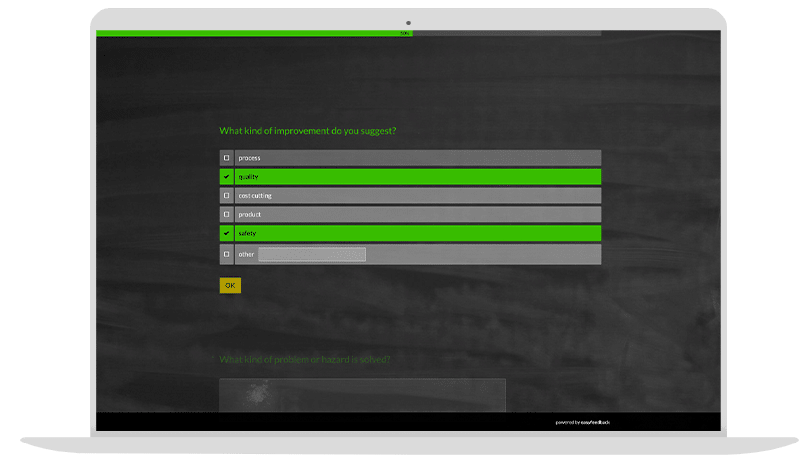
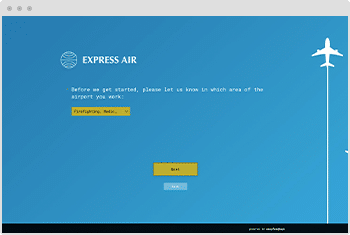
Your questions could, for example, first identify the affected department or area. Afterwards, employees can be guided through open-ended questions that help them develop and describe their specific suggestion.
For a possible reward system, it is also important that submitted ideas can be assigned to the respective employee.
For further ideas and inspiration, we invite you to use our employee suggestion system template or easily create your own questionnaire with our tool.
With easyfeedback, companies can provide a platform where employees can submit their ideas, suggestions, and improvement proposals.
Here are some reasons why easyfeedback is suitable as a tool for an employee suggestion system:
1. Reason: User-Friendliness
easyfeedback provides a user-friendly platform that makes it easy and intuitive to create online surveys and forms, submit suggestions, and actively participate in the improvement process.
The intuitive interface simplifies both the submission of ideas and the evaluation of employee feedback.
2. Reason: Flexible Invitation Options
easyfeedback offers a wide range of options for employees to submit their ideas.
Whether through a simple survey link, a QR code, or seamless integration into the company intranet or website.
With easyfeedback, employees can contribute their creative ideas from anywhere and through different access methods.
3. Reason: Centralized Management
All submitted suggestions are stored centrally on the platform, enabling easy management and analysis.
By analyzing submitted ideas, companies can gain valuable insights that help continuously improve their employee suggestion system.
4. Reason: Automated Analysis
Our tool enables automated (AI-based) analysis of survey results.
You can quickly gain an overview of employee opinions, identify trends, and recognize areas with potential for improvement.
5. Reason: Integration Options
easyfeedback provides a wide range of integration options to seamlessly connect feedback from the employee suggestion system with thousands of apps and optimize existing workflows.
This allows you to make your processes more efficient and improve collaboration between different tools.
6. Reason: Data Protection and Security
easyfeedback ensures data protection and security for all submitted suggestions and provides features such as anonymity and access control to maintain confidentiality.