
Employee survey: Questions, examples & templates
Free Employee Survey Template: Examples, Questions, and Templates for Any Employee Survey.
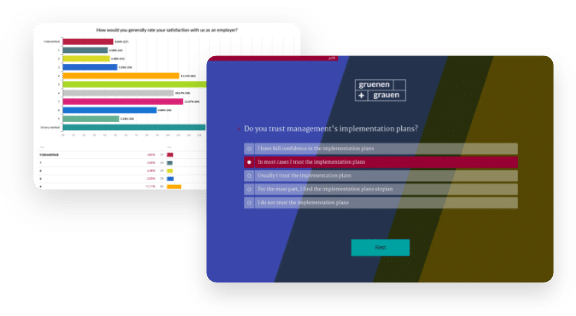

Asking the right questions — and identifying early on what really matters to staff.
Employee surveys do more than just help companies gather feedback. With the right questions, they highlight key issues:
- where motivation is waning
- which teams need support
- where leadership issues are arising
- what pressures employees are facing
- and which developments require early attention.
After all, problems rarely arise out of the blue. They send out warning signs beforehand.
The quality of an employee survey therefore depends crucially on asking the right questions.
On this page, you will find:
- Examples of questions for employees
- Templates for employee surveys
- Sample wording
- Complete questionnaires
- Inspiration for different topics
- Tried-and-tested questions for the early detection of organisational developments
Workforce Signals:
Identifying job satisfaction and motivation
Sample questions for employee surveys on job satisfaction
- How satisfied are you overall with your current work situation?
- Do you feel valued and recognised for your work?
- How motivated are you at the moment in your day-to-day work?
- Do you have sufficient opportunities to utilise your skills?
- Do you feel connected to your team and the company?
- Do you feel that your work makes a positive contribution?
- Would you recommend the company as an employer?
- Which factors currently have the greatest influence on your job satisfaction?
- What particularly motivates you in your work?
- What changes would improve your satisfaction?
These questions help to identify early warning signs of declining motivation, mental disengagement or a lack of staff loyalty.
Leadership Signals:
Assessing leadership and management
Sample questions about managers in employee surveys
- Do you feel sufficiently supported by your manager?
- Are targets and expectations clearly communicated?
- How transparently are decisions explained?
- Do you have confidence in your line manager?
- Do you receive constructive feedback on a regular basis?
- Are problems and conflicts resolved appropriately?
- Do you feel sufficiently involved in decision-making?
- Do managers lead by example when it comes to the company’s values?
- Does your manager support your personal development?
- What improvements would you like to see in leadership behaviour?
Questions on leadership help companies to identify risks within teams at an early stage and to improve the quality of collaboration in the long term.
Collaboration Signals:
Making collaboration and communication visible
Sample questions on teamwork
- How well does your team work together?
- How effective is communication between teams and departments?
- Do you receive all important information in good time?
- Are conflicts resolved constructively?
- How openly is feedback shared within the team?
- Do you feel sufficiently supported by your colleagues?
- How would you rate collaboration with other departments?
- Are there any communication issues that make your work more difficult?
- What improvements would strengthen collaboration?
- Where do you currently see the biggest challenges in internal communication?
These questions help to identify friction, communication issues and organisational weaknesses at an early stage.
Signs of Stress & Burnout:
Recognising stress and work-life balance
Sample questions on workload and work-life balance
- How heavy do you feel your current workload is?
- Are you able to strike a good balance between work and your private life?
- Do you often feel stressed or overworked?
- Do you have enough time to relax?
- Are you able to switch off outside working hours?
- Are your personal needs taken sufficiently into account?
- Do you have enough flexibility regarding your working hours or where you work?
- Which factors are currently causing you the most stress?
- What measures would help reduce your stress levels?
- How does your current work situation affect your well-being?
These questions help organisations to identify signs of stress, burnout and health risks at an early stage.
Culture Signals:
Understanding corporate culture and staff retention
Sample questions on corporate culture
- How would you describe the corporate culture?
- Do you feel connected to the company’s values?
- Are diversity and inclusion actively practised?
- Do you feel respected and valued?
How open is communication within the company? - Does the corporate culture foster collaboration and trust?
- Do you feel you can be yourself at work?
- How transparent do you find management’s decision-making?
- Which aspects of the corporate culture do you particularly value?
- What could be improved about the corporate culture?
Questions about corporate culture help to highlight emotional attachment, trust and identification within the organisation.
Growth Signals:
Promoting development and further training
Sample questions on career development
- How satisfied are you with your opportunities for development?
- Do you have access to suitable training programmes?
- Are your individual strengths sufficiently nurtured?
- Are there clear career and development prospects?
- Do you receive sufficient support for your professional development?
- How often do you receive feedback on your performance?
- Are you able to actively apply new skills in your work?
- Do you have the opportunity to take on responsibility?
- What further training opportunities would you like to see?
- What career goals would you like to achieve in the future?
These questions help organisations identify potential and strengthen long-term employee retention.
Open Signals:
Enabling open employee feedback
Open-ended questions for staff surveys
- Are there any other topics you’d like to raise?
- What suggestions do you have for improving your day-to-day work?
- What is currently going particularly well in your team?
- Where do you currently see the biggest challenges?
- What changes would improve your work?
- What ideas do you have for the company?
- What would you like to see from leaders or management?
- Which processes should be improved?
- Which issues are you particularly concerned about at the moment?
- What should we, as a company, pay more attention to?
Open-ended questions often yield the most valuable insights and help to reveal hidden organisational signals.
Which questions are appropriate for which objective?
The aim of the staff survey
Suggested questions
Measuring staff satisfaction
Motivation, working atmosphere, workload
Identifying staff turnover risks
Identification, leadership, development
Improving leadership
Communication, support, transparency
Analysing corporate culture
Values, collaboration, trust
Making stresses visible
Stress, work-life balance, resources
Improving collaboration
Communication, Conflicts, Teamwork
Boosting motivation
Appreciation, Development, Participation
Do you need a ready-made employee questionnaire to use as a template for your employee survey?
Make use of our free templates and questionnaires for your next staff survey.
Everything you need to know about an employee survey
Gain an early understanding of what is really going on in your business
Create staff surveys, automatically identify critical trends and take action before problems escalate.
We’re here for you
When you create an employee survey using easyfeedback, you’ll have access to the survey tool and all the survey templates it contains.
When you signed up, we set up a demo survey in your account. This already includes a ready-made questionnaire and results.
This allows you to see straight away how the survey tool works and what it has to offer.
If you have any questions, simply visit the help center or get in touch with us.
What sort of questions are suitable for an employee survey?
Suitable questions include those relating to job satisfaction, leadership, communication, corporate culture, stress, motivation and teamwork. It is important that the questions are clearly worded and highlight specific organisational developments.
How many questions should an employee survey contain?
An employee survey should remain as focused as possible. In many cases, 20 to 40 well-formulated questions are sufficient to obtain meaningful results without reducing the response rate.
What open-ended questions can you ask employees?
Open-ended questions are particularly useful for bringing suggestions for improvement, problems or ideas to light. For example:
“What changes would improve your work?”
“What is currently on your mind?”
“Which issues should be given greater consideration?”
What questions are suitable for leadership feedback?
Suitable questions include those relating to:
- Communication
- Support
- Transparency
- Trust
- Decision-making
- Feedback culture
- Opportunities for development
What questions can help to identify problems within teams at an early stage?
Questions on the following topics are particularly helpful:
- Teamwork
- Conflicts with colleagues
- Workplace stress
- Sources of motivation
- Communication within the team
- Appreciation from line managers
- Trust within the team