
Customer survey: Planning, process, and implementation
8 Steps to honest customer feedback, valuable insights, and concrete actions.
- Step 1: Define your goals and target audience
- Step 2: Designing the questionnaire
- Step 3: Structuring the survey
- Step 4: Integrate the corporate design
- Step 5: Invite customers to take the survey
- Step 6: Monitor Participation
- Step 7: Analyze Results and Identify Customer Signals
- Step 8: Derive specific actions from customer feedback
Learn, step by step, how to successfully plan and conduct a professional customer survey and identify key trends in your customer relationships early on.
Step 1: Define your goals and target audience
Every customer survey begins with defining its objectives. Even before you formulate questions or create questionnaires, you should determine:
- Why do you want to survey your customers?
- What insights do you want to gain?
- What trends do you want to identify?
- What decisions should be made later based
- on the results?
Effective customer surveys do more than just collect feedback. They reveal customer signals. Typical goals of a customer survey include:
- Measuring customer satisfaction
- Strengthening customer loyalty
- Identifying churn risks
- Improving products
- Evaluating service quality
- Optimizing the customer experience
- Identifying barriers to purchase
Next, define the target audience:
- Existing customers
- New customers
- Specific customer groups
- Users of certain products
- Customers based on service interactions
The target audience will later influence:
- the invitation
- the questions
- the interpretation of the results
Step 2: Designing the questionnaire
Once the goals have been established, the design of the customer survey begins.
The most important question here is: What customer insights do you want to uncover?
For example, if you want to improve customer satisfaction, you should ask questions about:
- Satisfaction
- Expectations
- Service quality
- Willingness to recommend
- Purchase and usage experience
If you want to gather product feedback, you should specifically ask about:
- Product quality
- Features
- Problems
- Suggestions for improvement
Tip
When developing the questions, don’t start with the questionnaire. Start with the insight you want to gain. Ask yourself:
What statement do you want to be able to make about your customers later on?
Example:
You want to identify which customers are at a higher risk of churn.
A possible statement you could make later would be:
“42% of customers would not currently recommend our product.”
This leads, for example, to the question:
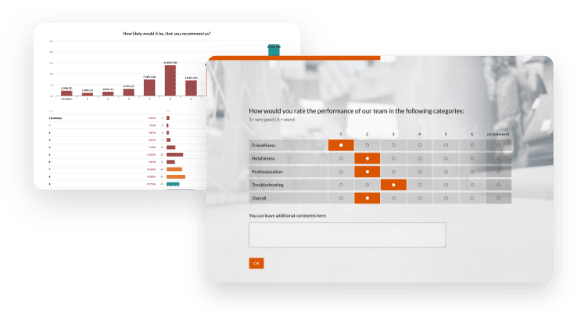
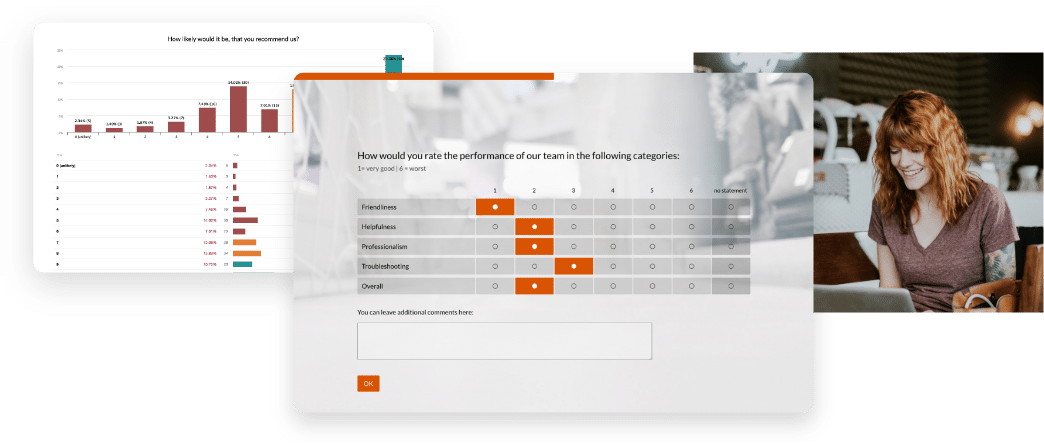
“How likely are you to recommend our company to others?”
Well-formulated questions don’t just provide answers. They reveal customer signals.
Examples, questions, and templates for customer surveys
Discover tried-and-true questions, templates, and examples for customer surveys – from customer satisfaction and NPS to product and service feedback.
Mr Q – easyfeedback’s survey assistant – will also help you design your questionnaire.
Once you’ve created an account, you’ll receive free access to Mr Q and can automatically receive suggestions for appropriate questions, phrasing, and templates.
Step 3: Structuring the survey
Once you have finalised the concept, you can create the actual customer survey. To do this, log in to easyfeedback or create a free account.
You can start with a blank survey or use tried-and-tested templates.
Our templates help you save time, use tried-and-tested questions and avoid common mistakes.
The technical creation of the customer survey should be straightforward. The real added value comes later, during the analysis and interpretation of the results.
Step 4: Integrate the corporate design
Trust also plays a crucial role in customer surveys. Customers are more likely to take part in a survey if they can clearly recognise the sender.
You should therefore use your company logo, corporate colours, fonts and images to present the customer survey in line with your corporate identity.
This will help to strengthen:
- Trust
- Brand recognition
- The response rate and the
- quality of the responses
Step 5: Invite customers to take part in the survey
Once the questionnaire and the design are finalised, the invitation phase begins. Depending on your objectives and the customer group you have selected, you can decide where to reach your customers. easyfeedback offers you a range of options, so that you can invite your customers to take part in the survey using exactly the right method:
- via the email invitation system
- via individual links including a customer
- identifier, such as a customer number
- QR codes on a leaflet
- Via a link on your website
- Via your customer portal
- Via your newsletter
- Or during or after a service interaction
The optimal timing depends on the objective of the customer survey. Typical times are:
- immediately after a purchase
- after a support interaction
- after using a product
- after a project has been completed
The higher the response rate, the more meaningful the customer insights will be.
Step 6: Monitor participation
Once the invitations have been sent out, the first responses usually come in within a short space of time. Initial trends become apparent even whilst the customer survey is still ongoing.
Pay particular attention to:
- the participation rate in relation to the number of invitations sent
- the response rate trend for customer surveys running over a longer period
- initial trends emerging from the first results
- open-ended comments
For ongoing surveys, the response rate indicates whether the survey is positioned correctly within the customer experience. For one-off customer surveys, the highest response rate will occur within the first 3 days. You can therefore send out the first reminder after approximately 5–7 days to encourage further customers to take part.
The higher the response rate, the more meaningful the results. With our sample size calculator, you can easily determine how high the response rate needs to be for the results to be statistically significant.
Step 7: Analyse the results and identify customer signals
Now comes the most exciting part: interpreting the customer feedback.
The real value of a customer survey does not lie in collecting data, but in understanding what customers are trying to tell you.
Start by analysing:
- the overall results
- then individual questions
- and take a look at the open-ended responses
- this will give you an initial overview of the trends in the results
Next, segment the results, for example by:
- customer groups
- products
- regions
- locations
- service areas
It is only through segmentation that differences, risks and potential become apparent.
Typical questions include:
- Where is customer satisfaction falling?
- Which products are causing problems?
- Which customer groups are at risk of leaving?
- Which issues keep cropping up?
- Where is the greatest potential for improvement?
Step 8: Derive specific actions from customer feedback
A customer survey only creates real added value if the results lead to concrete improvements.
With easyfeedback, the signals from customer feedback are automatically analysed and translated into:
- clear insights
- strengths and weaknesses
- risks
- opportunities and
- concrete recommendations for action
The analyses take place in Result STUDIO. There, you can also segment the results by individual customer groups and view the automated analyses for each customer group.
In addition, you can:
- compare customer groups
- analyse trends
- compare results from previous surveys
This provides you with specific analyses and recommendations on individual topics or customer groups within a matter of seconds.
For example:
- which topics influence customer satisfaction
- what lies behind complaints
- what risks of customer churn exist
- which measures promise the greatest impact
easyfeedback helps companies translate customer feedback into concrete guidance and clear decisions – before problems escalate or customer churn affects turnover.
Everything you need to know about a customer survey
1. Planning, organisation & implementation
Understand early on what your customers are trying to tell you
By conducting professional customer surveys, you can automatically identify critical developments and take action before you lose customers.
Thousands of companies already have a better understanding of what really drives their organisation
Better decisions | Problems identified earlier | Improved teams | Reduced staff turnover





4,8


