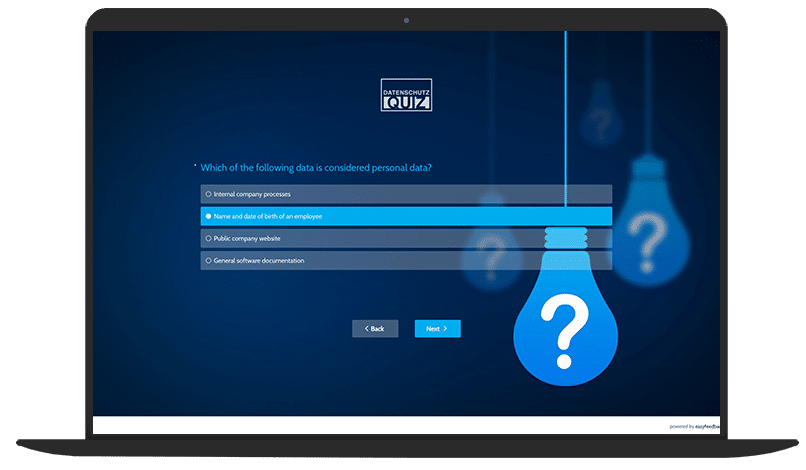

Conduct interactive and engaging data protection training sessions using quizzes

Create a data protection training quiz easily with easyfeedback

With our quiz template, data protection training becomes an interactive learning experience: Employees can test their knowledge in a fun way, receive immediate feedback, and reinforce the material for the long term. This makes data protection training engaging and ensures it is seamlessly integrated into their daily work.

Immobilienscout 24 ist begeisterter easyfeedback Nutzer

“Identifying user needs is at the heart of our business. easyfeedback has been helping us with this task for several years now. We particularly appreciate its intuitive usability and professional support.”

Franziska Becker
Guild Lead User Experience Research
TUI ist begeisterter easyfeedback Nutzer

“We use easyfeedback for internal and external surveys—it’s fast, convenient, and easy! The uncomplicated and friendly support puts a smile on our faces, and we are delighted with the continuous development of the platform.”

Jennifer Fischer
Guest & Competitor Insights Analyst

Why conduct data protection training in the form of a quiz?

A data protection training session in the form of a quiz not only makes the topic more engaging but also more interactive.

Instead of boring lectures, employees are actively involved and can test their knowledge in a fun way.

With a tool like easyfeedback, you can easily create such a quiz, customize it flexibly, and evaluate the results immediately.

Participants receive immediate feedback on their answers, which helps reinforce learning content and allows misconceptions to be corrected right away.

At the same time, companies benefit from straightforward performance tracking and clear evaluations.

This way, data protection is not seen as a dry, mandatory exercise, but as a motivating, practical, and accessible learning experience that leads to greater awareness and secure data handling in the long term.

Contents of the template:

  • Questions about the basics of data protection
  • Questions about security measures
  • Questions about employee obligations
  • Questions about the rights of data subjects

Objectives of the survey:

  • Raising Awareness of Data Protection
  • Assessing the Current Level of Knowledge
  • Reinforcing Content Through Feedback
  • Actively Involving Employees
  • Embedding Data Protection Within the Company

Helpful features for the survey:

  • Survey options: Anonymous, partially anonymous, personalized
  • Invitation options: Link, email, QR code, and more
  • Automatic email notification after completing the quiz
DSGVO-konforme Online-Umfragen

Data protection „made in Germany“ (GDPR)

Anonyme Teilnahme an Umfragen

Anonymity function for honest feedback

Frequently asked questions about data protection training

A data protection training course can be defined as follows:

A data protection training course is a systematic, planned measure in which employees and responsible persons within a company or organization are informed and made aware of the secure handling of personal data, legal requirements—such as the GDPR—and internal data protection policies.

Its aim is to prevent errors, data protection violations, and security risks and protect the rights of data subjects.

  • Providing an understanding of the fundamentals of data protection.
  • Raising awareness of the responsible handling of personal data.
  • Providing practical guidance for everyday work.
  • Required under the GDPR and documented for evidentiary purposes.

Here is a structured overview of the typical content of a data protection training course, suitable for employees in companies or public authorities:

1. Data protection fundamentals

  • Data protection laws: GDPR and national data protection law, such as Germany’s Federal Data Protection Act (BDSG).
  • Key terms: Personal data, processing, consent, and processing on behalf of a controller.
  • Objectives of data protection: Protecting privacy, securing data, and protecting the rights of data subjects.


2. Rights of data subjects

  • Right of access: Who is permitted to view which data?
  • Right to rectification and erasure, also known as the right to be forgotten.
  • Right to object to data processing.
  • Data portability: Transferring personal data to other providers.


3. Employees’ obligations

  • Confidentiality and non-disclosure when handling personal data.
  • Secure processing: Passwords, encryption, and access restrictions.
  • Reporting data protection violations, also known as data breach notification.
  • Documenting data processing activities in accordance with the GDPR.


4. Handling special categories of data

  • Special categories of personal data: Health data, political opinions, and biometric data.
  • Sensitive customer data: Bank details, addresses, and personal information.


5. Technical and organizational measures

  • Access rights and roles: Only authorized individuals may process data.
  • Data backup & backups.
  • Secure email communication, cloud services, and mobile devices.
  • Data protection when working from home and at mobile workplaces.


6. Practical examples and case studies

  • Typical errors in everyday work, such as sending an email to the wrong recipient or leaving documents unsecured.
  • Consequences of data protection violations, such as fines and reputational damage.
  • Role plays or short scenarios for reporting data breaches.


7. Completion and review

  • A short quiz or interactive exercises to reinforce knowledge.
  • References to further information or internal policies.

Yes, data protection training is mandatory in many cases, especially for companies and public authorities that process personal data.

Here is an overview:

  • Legal basis
  • Who must be trained
  • Consequences of not providing training
  • Implementation


1. Legal basis

  • GDPR (General Data Protection Regulation): Article 39 requires the data protection officer to train and raise awareness among employees about data protection requirements.
  • BDSG (Germany’s Federal Data Protection Act): Supplements the GDPR and likewise emphasizes the training obligation.
  • Industry-specific regulations may include additional obligations, for example in healthcare or the financial sector.


2. Who must be trained

  • All employees who process personal data.
  • Managers and responsible persons, to ensure data protection within the organization.
  • New employees directly upon joining.


3. Consequences of not providing training

  • Fines imposed by supervisory authorities—under the GDPR, up to €20 million or 4% of annual turnover.
  • Liability risk for the company in the event of data protection violations.
  • Reputational damage and loss of trust among customers and partners.


4. Implementation

  • Training should be provided at least once per year.
  • Documenting attendance is mandatory, for example for audits or inspections.
  • Practical examples and case studies enhance learning outcomes.
  • Regularly, at least once per year, for all employees.
  • Immediate refresher training when new legal requirements or changes to internal policies arise.
  • For new hires: mandatory training directly at the start of employment.
  • Optional: Short refresher sessions or e-learning modules in between, for example quarterly for particularly high-risk groups.

The works council plays an important role in data protection because it represents employees’ interests and has co-determination rights in certain areas.

Here is an overview of how data protection training and the works council are connected:

Works council co-determination rights

Under the German Works Constitution Act (BetrVG), Section 80 and Section 87 , the works council has co-determination rights regarding:

  • The introduction and use of technical systems that collect employees’ personal data, such as time tracking or email monitoring.
  • Rules governing the collection, processing, and use of data within the company.

The works council must be informed and may refuse consent if data protection rights are violated.

Data protection training for employees

Training is mandatory under the GDPR and is intended to raise awareness of personal data.

The works council should be involved in planning, particularly regarding:

  • The content of the training
  • The choice of training format, such as in-person or online
  • The training schedule and target group of participants


Data protection training for works councils

Works councils themselves often process personal data, such as employee lists, sick notes, and applications.

They must therefore also receive regular data protection training.

Topics may include GDPR fundamentals, employees’ rights, and the handling of sensitive information.

1. Tip: Define clear objectives

      • Define what employees should learn: GDPR fundamentals, handling sensitive data, and reporting obligations in the event of violations.
      • Goal: Raise awareness and provide concrete guidance for action, not just theory.


2. Tip: Choose a training format

      • In-person training: Face-to-face or workshop-based training, well suited to interaction.
      • E-learning / online courses: Flexible, especially for distributed teams.
      • Blended learning: A combination of both—in-person sessions for practical cases and online modules for theory.


3. Tip: Make content practical

      • Use examples from the organization’s own working environment.
      • Present typical errors and their consequences.
      • Include short quizzes or case studies to reinforce learning.


4. Tip: Provide training regularly

      • Repeat at least once per year.
      • Offer refresher training when laws change or new internal policies are introduced.
      • Train new employees immediately upon joining.


5. Tip: Document participation

      • Keep written or digital records of attendance.
      • Document training for audits, certifications, and data protection officers.


6. Tip: Motivation and communication

      • Communicate training not as a mandatory program, but as protection for employees and customers.
      • Use concise, understandable language—without excessive legal detail.


7. Tip: Encourage interactivity

      • Include discussions, group work, or short role plays.
      • Hold a feedback round at the end: What is clear? What remains uncertain?

Here is a selection of questions for a data protection training quiz, divided into topic areas.

1. Category: Data protection fundamentals

What is meant by personal data?

a) Only names and addresses
b) All information relating to an identified or identifiable person
c) Only email addresses

Which of the following data is particularly sensitive, also known as “special category data”?

a) Telephone number
b) Religious affiliation
c) Age

What is the main objective of the GDPR?

a) To give companies more freedom in using data
b) To protect individuals from misuse of their data
c) To reduce data storage


2. Category: Rights of data subjects

A data subject wants to know which data a company has stored about them. Which right can they use?

a) Right to erasure
b) Right of access
c) Right to data portability

How long does a company have to respond to an access request?

a) One week
b) One month
c) Six months

What does the “right to be forgotten” mean?

a) That all data is automatically deleted after one year
b) That personal data must be deleted upon request, provided there are no legal retention obligations
c) That data may never be deleted


3. Category: Employees’ obligations

A colleague asks you to share customer data, although you do not need it for your work. What should you do?

a) Share the data immediately
b) Refuse and, if necessary, inform the data protection officer
c) Share only half of the data

What is particularly important when handling passwords?

a) Write them down to avoid forgetting them
b) Use strong passwords and change them regularly
c) Share passwords with colleagues to make work easier

Which principle states that only the data necessary for the relevant purpose may be processed?

a) Storage limitation
b) Data minimization
c) Purpose limitation

4. Category: Security measures

A USB drive containing customer data is lost. Which measure is mandatory?

a) Do nothing because the data is encrypted
b) Report the loss to the data protection officer immediately
c) Look for the USB drive later

Which of the following measures increases data security in the workplace?

a) Lock the screen when leaving the workstation
b) Send data unencrypted by email
c) Write passwords on Post-it notes attached to the monitor

What is meant by “Privacy by Design”?

a) Data protection is considered only at the end of a project
b) Data protection is integrated into products and processes from the outset
c) It refers to designing privacy policies


More quiz templates​

Easyfeedback Logo

Customer acquisition

Survey template details

Quiz Template: Agility-Check

Agility Check Quiz

Survey template details

Quiz Template: Burnout Test

Burnout Quiz

Survey template details

Quiz Template: City Quiz

City Quiz

Survey template details

Quiz Template: Digital Marketing Trends

Digital Marketing Trends Quiz

Survey template details

Explore all survey templates  

You are in professional company

Immoscout 24 Logo
Tui Logo
Porsche Logo
Lufthansa Logo
Jaegermeister Logo

Over 740,000 participants in easyfeedback surveys every month

Result

STUDIO

The performance add-on for your analysis

easyfeedback Result Studio 2