
360-degree feedback: Questions, examples & templates
Identify the key indicators by asking the right questions.
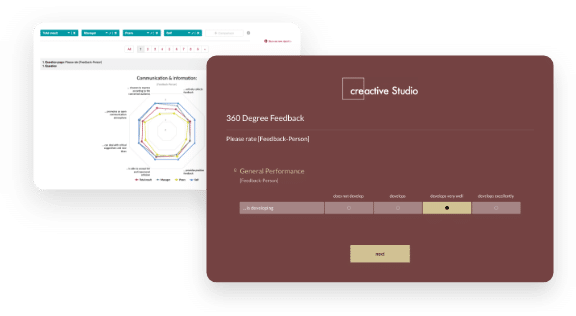
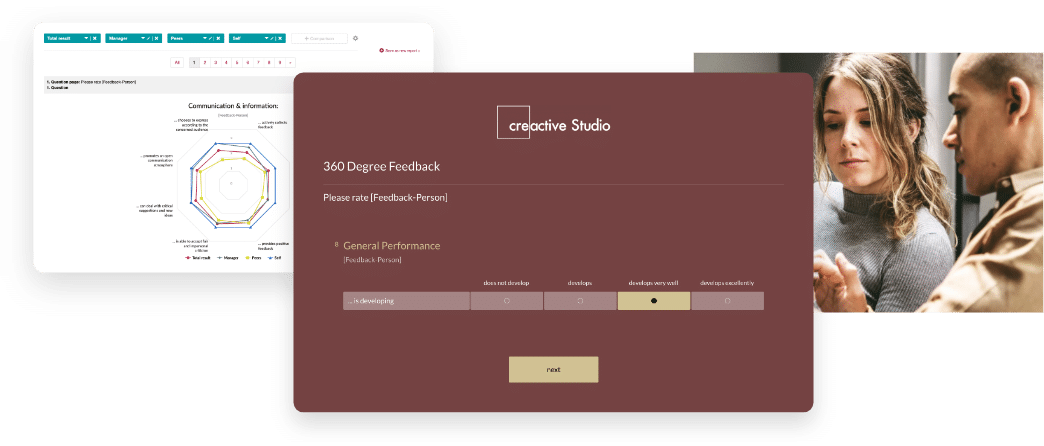
Asking the right questions and bringing leadership into focus from all perspectives
360-degree feedback is one of the most effective methods of leadership development.
By combining their self-perception with others’ perceptions, leaders gain valuable insights into the impact they have on staff, colleagues and line managers.
The quality of 360-degree feedback depends crucially on asking the right questions.
On this page you will find:
- 360-degree feedback questions
- Examples of leadership assessments
- Sample wording for competency models
- Tried-and-tested question sets
- Inspiration for bespoke 360-degree feedback processes
Communication skills:
360-degree feedback questions on communication
Communication is one of the most important leadership tasks. Managers must convey objectives, communicate information clearly and, at the same time, create an open environment for feedback.
Sample questions
- Does the manager communicate clearly and comprehensibly?
- Is important information passed on in good time?
- Does the manager set out expectations in a clear and understandable way?
- Does the manager listen actively?
- Are differing opinions respected?
- Does the manager give constructive feedback?
- Are conflicts addressed openly?
- Does the manager encourage open communication within the team?
- Is communication transparent?
- Are decisions explained in a way that is easy to understand?
The aim of this area of expertise
These questions help to identify how a manager’s communication skills are perceived and whether information is being conveyed effectively within the team.
Leadership:
360-degree feedback questions on leadership
A good manager supports staff in their day-to-day work and creates the conditions for successful collaboration.
Sample questions
- Does the manager provide sufficient support for their staff?
- Does it support the development of its staff?
- Does she delegate tasks effectively?
- Does she build trust within the team?
- Does she recognise good performance?
- Does it cater for individual needs?
- Does she involve staff in decision-making?
- Does it encourage personal responsibility?
- Is she approachable to staff?
- Does she create a positive working environment?
The aim of this area of expertise
The questions reveal how the quality of leadership is perceived and which leadership strengths or areas for development exist.
Decision-making behaviour:
360-degree feedback questions on decision-making behaviour
Every day, managers make decisions that affect teams, projects and business units.
Sample questions
- Does the manager make decisions in good time?
- Are decisions justified in a way that is easy to understand?
- Is relevant information being taken into account?
- Does the manager act decisively even in difficult situations?
- Are risks assessed appropriately?
- Does the manager take responsibility for decisions?
- Does she involve the relevant people in decisions?
- Are decisions implemented consistently?
- Does the manager provide guidance?
- Are priorities clearly set?
The aim of this area of expertise
These questions help to understand how a manager’s decision-making ability and reliability are perceived.
Collaboration:
360-degree feedback questions on collaboration
Successful leadership is based on trust, cooperation and constructive collaboration with different groups of people.
Sample questions
- Does the manager encourage teamwork?
- Does it support cross-departmental collaboration?
- Does she treat others with respect?
- Does she inspire confidence?
- Does it encourage a constructive approach to conflict?
- Does it support the achievement of shared goals?
- Does it work in partnership with other departments?
- Does it promote the exchange of knowledge?
- Is she a reliable person to turn to?
- Does it contribute to a positive working atmosphere?
The aim of this area of expertise
The questions reveal how the manager is perceived within teams and in their interactions with other departments.
Trust & Integrity:
360-degree feedback questions on trust and credibility
Trust is one of the most important foundations of successful leadership.
Sample questions
- Does the manager act credibly?
- Does she keep her promises?
- Does she treat her staff fairly?
- Does she handle information responsibly?
- Are decisions made in a way that is transparent?
- Does it foster trust within the team?
- Is she perceived as authentic?
- Does she act in accordance with the company’s values?
- Is her behaviour consistent?
- Does it provide a sense of security and direction?
The aim of this area of expertise
These questions highlight how credible and trustworthy the manager is perceived to be from different perspectives.
Strategic thinking:
360-degree feedback questions on strategic thinking
Managers should not only oversee operational tasks, but also keep an eye on long-term developments.
Sample questions
- Does the manager think long-term?
- Does it identify relevant developments at an early stage?
- Does it set out a clear direction?
- Does she understand the company’s objectives?
- Does she make decisions with a view to their long-term implications?
- Does she recognise opportunities and risks?
- Does it encourage innovation?
- Does it provide guidance for future developments?
- Does it effectively link operational and strategic objectives?
- Does she actively support change?
The aim of this area of expertise
These questions help to understand the extent to which the manager thinks strategically and takes future issues into account.
Adaptability:
360-degree feedback questions on change and transformation
Change is now part of everyday life for many organisations. Managers play a key role in this.
Sample questions
- Does the manager actively support change?
- Does she communicate changes clearly?
- Does she deal openly with her insecurities?
- Does it build trust in change processes?
- Does it encourage new ideas?
- Does it support innovation?
- Does she deal with resistance in a constructive way?
- Does it encourage a willingness to learn?
- Does she adapt her leadership style flexibly?
- Does it provide guidance during times of change?
The aim of this area of expertise
These questions help organisations assess their managers’ ability to adapt to change and their future-readiness.
Which questions are appropriate for which objective?
The aim of 360-degree feedback
Recommended areas of expertise
Developing managers
Leadership, communication, trust
Improving leadership culture
Collaboration, integrity, communication
Supporting follow-up programmes
Strategic thinking, decision-making behaviour
Supporting change processes
Adaptability, communication
Assessing managers
All areas of expertise
Preparing for executive coaching
Self-image vs. external perception across all areas
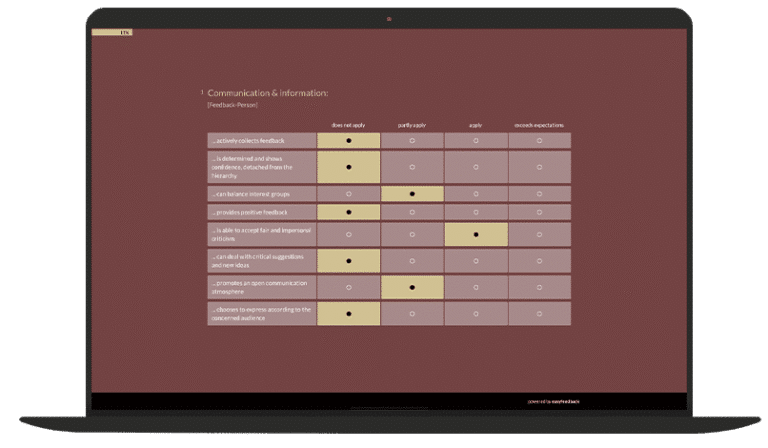
Free template for 360-degree feedback
Make use of tried-and-tested surveys and sample wording for your next management appraisal.
Use easyfeedback to create your 360-degree feedback.
Which questions are appropriate for which objective?
Understand how leadership is perceived within your organisation
Make use of tried-and-tested questions, examples and templates for 360-degree feedback to develop managers in a targeted manner and gain valuable insights.
We’re here for you
When you create a 360-degree feedback survey with easyfeedback, you’ll have access to the survey tool and all the survey templates it contains.
Upon registration, we’ve set up a demo survey in your account. This already includes a ready-made surveys and results.
This allows you to see straight away how the survey tool works and what it has to offer.
If you have any questions, simply visit the help center or get in touch with us.
How many questions should a 360-degree feedback exercise include?
In practice, 30 to 60 questions have proved effective. It is important to cover the relevant areas of competence without overwhelming the participants.
Which competencies should be assessed in a 360-degree feedback exercise?
Typical areas include communication, leadership, collaboration, decision-making, trust, strategic thinking and the ability to adapt to change.
What makes for good 360-degree feedback questions?
Good questions describe observable behaviour and avoid interpretations. This leads to more objective assessments and more meaningful results.
Should every manager be asked the same questions?
Not necessarily. Many organisations use bespoke competency models and tailor their 360-degree feedback questions to management levels, roles or development programmes.