


Why customer surveys are relevant under data protection law
The GDPR applies as soon as personal data is processed.
This also applies to seemingly harmless surveys.
Personal data can include:
- Name or email address
- Customer numbers
- IP addresses
- Free-text responses containing identifiable information
- Combinations of responses that allow conclusions to be drawn about individuals
Even an anonymous survey can quickly become personal — often without companies realizing it.
Key GDPR principles for customer surveys
Establishing a Clear Legal Basis
Two legal bases are typically applicable to customer surveys:
- Consent of the participants
- Legitimate interest of the company
In practice, transparency is crucial: Participants must know why their data is being collected and what happens to it.
Transparent Information (Duty to Inform)
Participants must be informed before the survey begins about:
- Purpose of the survey
- Responsible company
- Data retention period
- Method of analysis
- Rights to withdraw consent
- Contact information for the data protection officer
This information must be clearly visible in the survey or invitation.
Observe data minimization
The GDPR follows the principle: Only as much data as necessary.
Ask yourself with every question:
Do I really need this information to improve my offering?
Optional fields instead of required fields also help ensure data protection compliance.
Prefer anonymization

Anonymous surveys significantly reduce risks.
If identification isn’t necessary, personal data shouldn’t be collected in the first place.
A common mistake: collecting feedback while simultaneously storing unnecessary tracking data.
Ensuring Secure Data Processing
Companies must ensure that:
- Data is transmitted in encrypted form
- Server locations are GDPR-compliant
- Access is restricted
- Data processing agreements (DPAs) are in place
This is precisely where unintended violations often occur due to the use of unsuitable survey tools.
Common GDPR Mistakes in Customer Surveys
Many companies don’t act improperly on purpose — they do so out of habit.
Common issues include:
- Using tools that don’t meet EU data protection standards
- Lack of consent for email invitations
- Automatic storage of IP addresses
- Unclear privacy notices
- Unlimited data retention
The risk: complaints, warnings, or loss of customer trust.
The Solution: GDPR-Compliant surveys from the start
Instead of trying to “fix” data protection issues after the fact, it’s worth using a tool that already incorporates GDPR requirements.
That’s where easyfeedback comes in.
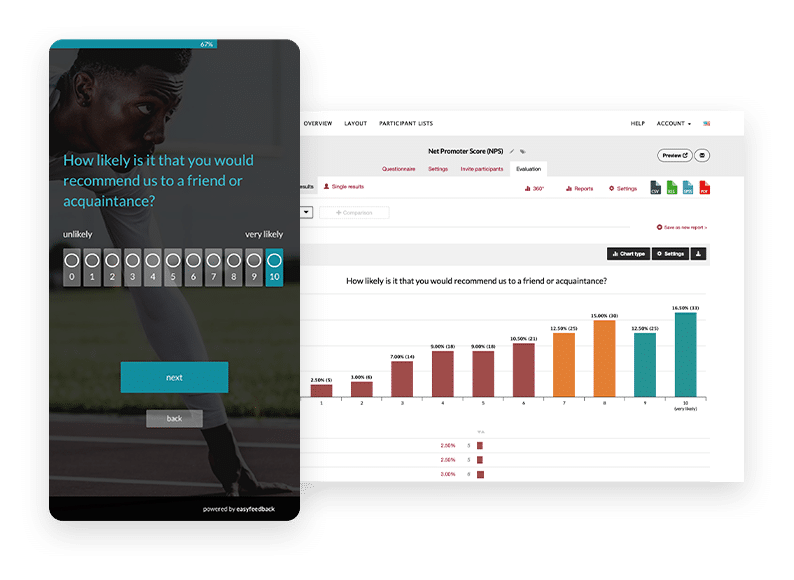
The platform was developed specifically for professional customer surveys and helps companies collect feedback in a structured and privacy-compliant manner.
Key Benefits
- GDPR-compliant data collection
- TISAX- and ISO 27001-certified
- Servers located in Germany
- Anonymous surveys available
- Flexible privacy notices can be integrated
- Role and permission management
- Easy creation of professional surveys
This ensures that data protection is not an obstacle, but an integral part of the customer experience.

Using Data Protection as a Trust-Building Tool
The GDPR is often perceived as a restriction.
In reality, however, it presents an opportunity: Companies that handle data transparently actively strengthen their customers’ trust.
A properly conducted customer survey sends a clear message:
- We listen.
- We respect your data.
- We act responsibly.
And it is precisely this trust that is more valuable in the long run than any single survey response.
Conclusion
Customer surveys remain an indispensable tool for growth and customer-centricity — provided they are conducted in compliance with the GDPR.
By providing clear information, minimizing data collection, and relying on secure tools like easyfeedback, you can gather feedback without incurring legal risks.
After all, good feedback starts not only with the right questions — but also with responsible data protection.
More about customer survey
- 8 practical methods to collect customer feedback
- 7 tips for evaluating your customer survey
- Tips, tricks & methods for creating a customer survey
- 12 questions for your customer survey to detect customer needs
- Customer opinions: Listening as a strategy for success
- How much does a customer survey cost?