


Defining the Objective – The Most Important Step Before Asking the First Question
Before you formulate questions, you need clarity.
Many surveys fail because they are created without a clear objective.
So ask yourself the following questions:
- What specific decision should the results support?
- What hypothesis do I want to test?
- What metrics do I really need?
- What information is “nice to have” – but not necessary?
A common problem: People want to know “everything possible.”
This leads to long, unclear surveys and vague results.
Practical tip:
Write down your goal in a single, precise sentence.
For example:
“I want to measure our customers’ satisfaction with our ordering process over the past quarter and identify areas for improvement.”
The clearer your goal, the more focused your questions will be.
Define the target audience – Who will be filling out the questionnaire?

A questionnaire only works well if it’s tailored to the target audience.
The language, length, complexity, and tone must be appropriate.
Consider the following:
- Who are the respondents?
- What prior knowledge do they have?
- How much time can or are they willing to invest?
- In what context will they be answering the survey (on a mobile device, in the office, on the go)?
An internal employee survey may contain technical terms. A customer survey should be worded clearly and in plain language.
The appropriate form of address (informal/formal) should remain consistent and align with your organization’s communication style.

Layout and Structure – The Common Thread Is Key
A questionnaire is like a journey.
If it’s disorganized, participants quickly lose their bearings.
The Introduction – Building Motivation and Transparency
The introduction is often underestimated.
Yet it plays a key role in determining whether people are willing to participate.
A good introduction includes:
- The purpose of the survey
- The approximate duration
- Information on data protection
- Notes on anonymity (if applicable)
- A respectful tone
Example:
“Your opinion is important to us. The survey takes about 5 minutes and is anonymous. Your feedback helps us improve our service in a targeted way.”
Transparency builds trust, and trust increases the completion rate.
Getting Started – Easy Questions First
Start with simple, harmless questions.
This allows participants to “settle in.”
Good choices include:
- General assessments
- Frequency questions
- Usage questions
Avoid the following at the beginning:
- Complex matrix questions
- Very personal questions
- Critical or emotional topics
The introduction should be smooth and straightforward.
The Main Body – From the General to the Specific

The main section provides a more in-depth exploration of the content.
Make sure the structure is clearly organized by topic.
Organize questions:
- By topic blocks
- Logically building on one another
- From general to specific
Example for a customer satisfaction survey:
- Overall satisfaction
- Evaluation of individual service areas
- Detailed questions about specific processes
- Suggestions for improvement
Avoid jumping between topics.
A structured flow looks professional and increases concentration.
The Conclusion – Room for Open-Ended Thoughts
At the end, it’s a good idea to ask an open-ended question, such as:
“Is there anything else you’d like to share with us?”
This often yields valuable qualitative insights that don’t come to light with closed-ended questions.
Don’t forget to say thank you at the end.
Asking Good Questions – Clarity Over Complexity

A poorly worded question skews results.
That’s why precision trumps creativity.
Avoid common mistakes
- Double questions:
“How satisfied are you with price and quality?”
→ Ask about price and quality separately. - Leading questions:
“How much does our excellent service impress you?”
→ Formulate the question neutrally. - Vague terms:
“regularly,” “often,” “reasonable”
→ Be specific. - Sentences that are too long:
Complex sentence structures make understanding difficult.
Use Consistent Scales
If you use rating scales, be consistent.
Example:
- 1 = very dissatisfied
- 5 = very satisfied
Constantly switching scales (sometimes 1–5, sometimes 1–10) confuses participants and makes it harder to analyze the results.

Choosing the right question types
The choice of question type affects the quality of the data.
Closed-ended questions
- Quick to answer
- Easy to compare
- Simple to analyze
Rating-scale questions
- Ideal for measuring attitudes
- Enable trend analysis and benchmarking
Matrix questions
- Efficient when dealing with multiple similar statements
- Use sparingly (otherwise, respondents may become fatigued)
Open-ended questions
- Provide qualitative depth
- Require more effort to analyze
A balanced combination is usually ideal.
Length and User-Friendliness
A common mistake: too many questions.
The longer the questionnaire, the higher the dropout rate.
Focus on the essentials.
Critically evaluate each question:
- Does it provide real value?
- Does it support my goal?
- Can I analyze the data?
Technical aspects also play a role:
- Mobile optimization
- Clear navigation
- Progress indicator
User-friendliness affects data quality.

Pretest – Quality Assurance Before Launch
Before the questionnaire is published:
- Have test participants fill it out
- Watch for comprehension issues
- Check the completion time
- Verify logic and filters
A pretest often uncovers unclear wording or technical errors that would otherwise lead to skewed results.
Analysis Requires Structure – A Long-Term Perspective for Better Analysis
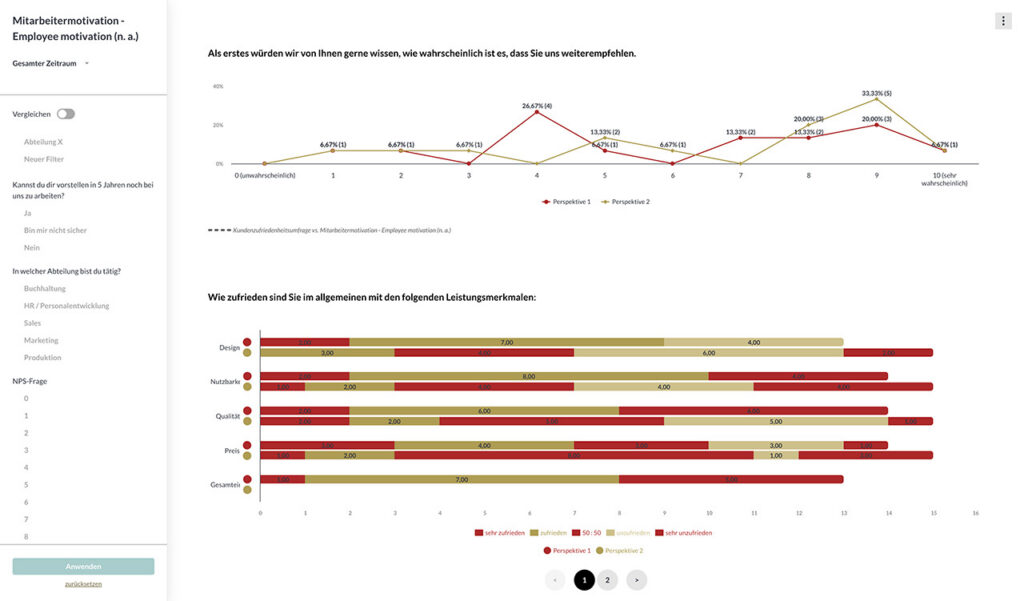
Even as you’re setting it up, you should ask yourself:
- Which metrics do I want to calculate?
- Do I want to compare target groups?
- Do I need filter options?
A clear structure will save you a lot of time later on during analysis.
Data is only valuable if it can be interpreted.
easyfeedback – Professional Survey Tool for Implementation
When it comes to the practical implementation of a questionnaire, specialized software can make all the difference.
easyfeedback is an online platform for creating, conducting, and analyzing surveys.
Our software offers, among other things:
- An intuitive questionnaire editor
- Various question types and scales
- Filter and logic functions
- Automatic (AI-based) evaluations and charts
- GDPR-compliant data collection (ISO 27001 and TISAX)
- Custom design options
- Report export functions
Especially for recurring surveys, employee surveys, or customer satisfaction analyses, easyfeedback enables structured, efficient, and professional implementation.

Final Thoughts
A good questionnaire is more than just a list of questions. It is a strategic tool for decision-making.
Those who clearly define their goals, take a structured approach, phrase questions precisely, and keep the analysis in mind will not only receive answers — but also actionable insights.
And that is precisely where the true strength of a good survey lies.
More tips & tricks for surveys
- Evaluating surveys with easyfeedback: Effectively collect and analyze feedback
- Survey or questionnaire? Find out the decisive difference!
- 8 tips for building your questionnaire
- Tips for increasing participation rates in employee and customer surveys
- 10 tips to increase the response rate of your survey
- Tips & tricks to motivate more participants to take part in the survey
- Why you shouldn’t ask as many questions as you like in your survey
- Negative feedback after a survey: how to best deal with it!
- 7 proven practical tips for creating your next questionnaire
- Formulating texts and questions when creating your questionnaire
- Planning a survey – systematically gaining insights
- Should I include a “Don’t know” option in surveys?
- When is a survey truly representative?