


Objectives and significance of industry analysis
The main objective of industry analysis is to systematically record the economic conditions, competitive structures, and development trends of a particular industry.

It provides answers to questions such as:
- How big is the market?
- Who are the main competitors?
- What barriers to entry are there?
- What trends and innovations are shaping the industry?
- What is the customer structure like?
These insights enable companies to better assess their position in the market, minimize risks, and develop growth strategies.
Preparing the analysis
Before starting the actual analysis, the scope of the investigation should be clearly defined:
- Narrow down the industry: Which sub-areas or segments should be considered?
- Determine the target audience: Who is the analysis intended for (e.g., investors, management, marketing)?
- Select data sources: Internal data (e.g., sales figures), external sources (e.g., market studies), and primary data from surveys should be combined.
Important analysis tools
1st tool: Porter’s Five Forces Model
This model analyzes five key competitive forces in an industry:
- Threat of new competitors
- Bargaining power of suppliers
- Bargaining power of customers
- Threat of substitute products
- Rivalry among existing competitors
It provides an overview of the structure and attractiveness of an industry.
2nd tool: PESTEL analysis
PESTEL analysis is used to evaluate external influencing factors:
- Political
- Economic
- Social
- Technological
- Environmental
- Legal
These factors provide information about trends and potential disruptions in the market environment.
3rd tool: SWOT analysis
A SWOT analysis complements the industry analysis by relating a company’s internal strengths and weaknesses to external opportunities and risks.
4th tool: Surveys in industry analysis
Surveys are a particularly effective tool that can be used specifically to gather current opinions, attitudes, and expectations within the industry.
They are suitable for various target groups:
- Customer surveys: Provide insights into satisfaction, purchasing behavior, needs, and trends.
- Competitor surveys: Enable an assessment of the market position and strategic orientation of competitors.
- Expert interviews: Provide qualitative information about industry trends, technological developments, and regulatory changes.
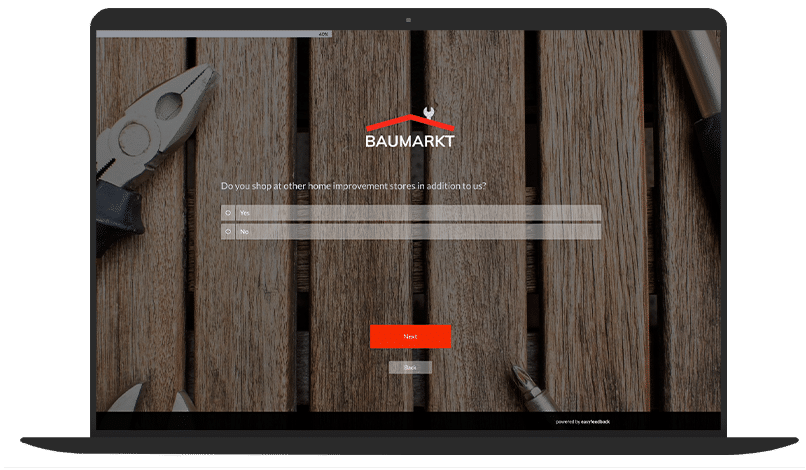
Important points when conducting surveys:
- Clear objectives and precise questions
- Representative sample
- Choice of the right tool (e.g., online platforms such as easyfeedback)
- Statistical evaluation and interpretation of the results
Data collection and evaluation
Information gathering is a central component of the analysis.
A mixture of quantitative and qualitative data is ideal.

The most important sources include:
- Industry associations and specialist literature
- Public statistics (e.g., Destatis, Eurostat)
- Market studies (e.g., by Statista, PwC, Deloitte)
- Own surveys and interviews
- Observations and empirical values from the corporate environment
Derive recommendations for action
The industry analysis concludes with concrete strategic implications.

The insights gained can be used to derive measures such as:
- Market entry or expansion into specific segments
- Adjustment of the marketing mix
- Product innovations based on customer preferences from surveys
- Risk management strategies to protect against external threats
Conclusion
Industry analysis is an essential tool for strategic planning and corporate development.
Those who know the structures, trends, and players in their industry can make informed decisions and secure long-term competitive advantages.
The integration of surveys makes the analysis even more meaningful, as it is based not only on existing data, but also on current and directly collected market opinion.
Companies that regularly and methodically conduct industry analyses — including surveys — are better equipped for the challenges of tomorrow.