

“Identifying user needs is at the heart of our business. easyfeedback has been helping us with this task for several years now. We particularly appreciate its intuitive usability and professional support.”

“We use easyfeedback for internal and external surveys—it’s fast, convenient, and easy! The uncomplicated and friendly support puts a smile on our faces, and we are delighted with the continuous development of the platform.”
If you want to measure customer satisfaction, you have not just one option but several metrics at your disposal.
Each metric — whether it’s the Net Promoter Score, the Customer Effort Score, the customer churn rate, or another — has its own way of determining and interpreting customer satisfaction.
The Customer Satisfaction Score (CSAT) provides you with another metric you can use to measure customer satisfaction.
Through a standardized questionnaire, your customers can provide feedback and express their satisfaction with a specific aspect of your company, product, or service at regular intervals — for example, regarding your ordering process, your website, complaint handling, support, and more.
This gives you the opportunity to address potential issues and subsequently review the measures taken.
It is important to remember that the CSAT is not just another way to measure customer satisfaction, but also a way to interpret and analyze satisfaction in a different manner.
Combining various indicators to determine customer satisfaction is the key to success.
Contents of the template:
Objectives of the survey:
Helpful features for the survey:

Data protection „made in Germany“ (GDPR)

Anonymity function for honest feedback
CSAT stands for “Customer Satisfaction Score” and is a metric that measures customer satisfaction with a product, service, or interaction.
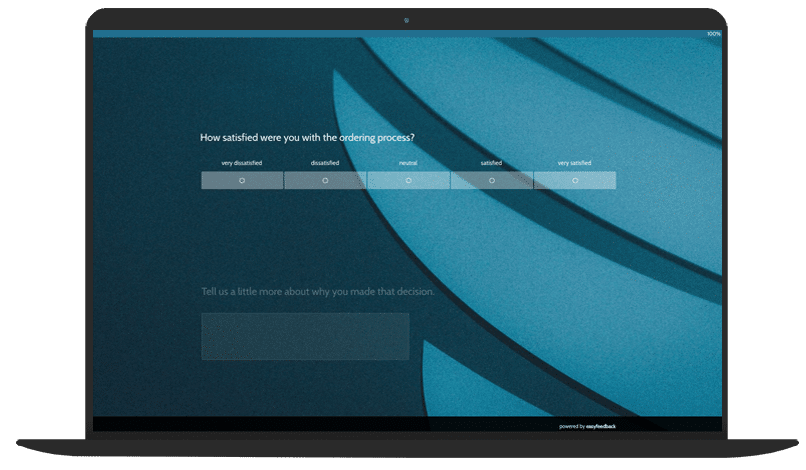
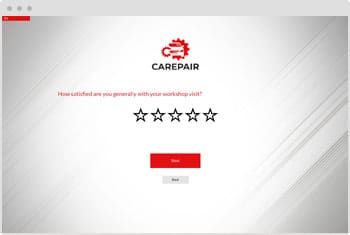
It is typically measured by asking customers a direct question, such as:
“How satisfied are you with our product/service?”
Customers usually respond on a scale ranging from very dissatisfied to very satisfied. These responses are then converted into a percentage to calculate the CSAT score.
A high CSAT score indicates that the majority of customers are satisfied, while a low score indicates dissatisfaction.
CSAT (Customer Satisfaction Score) and NPS (Net Promoter Score) are both metrics for measuring customer satisfaction, but they have different focuses and methodologies:
Customer Satisfaction Score (CSAT)
Net Promoter Score (NPS)
Customer Effort Score (CES)
Key Differences
1. Goal and Focus:
2. Question and Response Scale:
3. Calculation:
All three metrics are valuable tools for evaluating customer satisfaction and loyalty, but they provide different insights and should ideally be used together.
The formula for calculating the Customer Satisfaction Score (CSAT) is relatively simple.
It is typically expressed as a percentage and measures the proportion of customers who are satisfied with a product, service, or interaction.
Here is the formula for calculating the CSAT:
CSAT = (Number of positive responses / Total number of responses) × 100
Step-by-step explanation:
Step 1: Collect the data
Ask your customers how satisfied they are with a specific product, service, or interaction.
This is usually done through a survey using a scale (e.g., from 1 to 5 or from 1 to 7), with higher values indicating greater satisfaction.
Step 2: Define positive responses
Determine which values on the scale are considered positive responses. For example, on a 5-point scale, values 4 and 5 could be considered positive.
Step 3: Count the responses
Step 4: Calculate the CSAT
Example:
Suppose you conducted a survey with the question:
“How satisfied are you with our service?”
using a scale from 1 to 5 (where 5 means very satisfied and 1 means very dissatisfied).
CSAT = (80/100) x 100 = 80%
In this example, the CSAT score is 80%, which means that 80% of the surveyed customers are satisfied with the service.
There are several methods for measuring the Customer Satisfaction Score (CSAT), which can be selected depending on your goals and business context.
Here are some common methods:
1. Method: Direct surveys
2. Method: In-app/website feedback forms
3. Method: Social media monitoring
4. Method: Customer feedback tools
5. Method: NPS (Net Promoter Score) as a complementary method
Example of a complete CSAT survey:
Question 1: “How satisfied are you with our customer service?”
Question 2 (optional): “Do you have any suggestions for improving our service?”
[Free text field]
Thank-you message:
“Thank you for your feedback! Your opinion is very important to us and helps us improve our service.”
Suppose you conducted a survey to measure your customers’ satisfaction with your customer service.
The survey question is:
“How satisfied are you with our customer service?”
Responses are given on a scale from 1 to 5, where:
Collected data:
Number of responses with a rating of 1: 5
Number of responses with a rating of 2: 5
Number of responses with a rating of 3: 10
Number of responses with a rating of 4: 50
Number of responses with a rating of 5: 30
Step 1: Determine the positive responses
Let’s assume that responses with a rating of 4 (Satisfied) and 5 (Very satisfied) are considered positive.
Positive responses (4 + 5): 50 + 30 = 80
Step 2: Determine the total number of responses
Total number of responses: 5 + 5 + 10 + 50 + 30 = 100
Step 3: Calculate the CSAT
CSAT = (Number of positive responses / Total number of responses) × 100
CSAT = (80/100) x 100 = 80%
4. Calculate the CSAT
Result:
The CSAT score is 80%. This means that 80% of the surveyed customers are satisfied or very satisfied with your customer service.
To measure the Customer Satisfaction Score (CSAT), you should ask questions that focus on specific aspects of your products, services, or interactions.
Here are some examples of CSAT questions you can use:
General CSAT questions
More specific CSAT questions
Response scales
The response scale can vary, typically ranging from 1 to 5 or 1 to 7, with higher values indicating greater satisfaction.
Example of a survey:
Question: “How satisfied are you with our customer service?”
Other possible questions in the same survey:
These questions can be adapted depending on the context and the specific goals of your CSAT survey.
The responses collected help you better understand your customer satisfaction and identify areas for improvement.
A good CSAT survey should be clear, concise, and user-friendly in order to collect useful and reliable data on customer satisfaction.
Here are the key factors that make a good CSAT survey:
1. Factor: Simple and precise question
The question should directly address the customer’s satisfaction with a specific aspect of the interaction, product, or service.
Examples of questions:
2. Factor: Clearly defined scale
Use an easy-to-understand scale to measure the level of satisfaction. A common scale ranges from 1 to 5 or from 1 to 7.
Example of a 5-point scale:
3. Factor: Simple and short survey
Keep the survey short and to the point to ensure a high response rate. Ideally, include 1 to 3 questions that can be answered quickly.
Example of a short survey:
4. Factor: Optional comments
Give customers the opportunity to leave additional comments or feedback. This can provide valuable qualitative insights.
Example of an open-ended question:
“Do you have any suggestions for improving our service?”
5. Factor: Easy participation
Make sure the survey is easy to complete. Avoid lengthy questionnaires or complicated response formats.
6. Factor: Timing and relevance
Send the survey shortly after the interaction or purchase, while the experience is still fresh. Make sure the survey is relevant to the customer.
7. Factor: Thank-you message
Thank participants for their feedback. This shows appreciation and can increase their willingness to participate in future surveys.
Example of a thank-you message:
“Thank you for your feedback! Your satisfaction is important to us and helps us continuously improve our service.”
8. Factor: Data protection and anonymity
Inform participants about how their data will be used and ensure anonymity whenever possible. This builds trust and can increase willingness to participate.
A good Customer Satisfaction Score (CSAT) varies depending on the industry, company size, and market segment, but in general, there are some benchmarks that can serve as indicators of high customer satisfaction:
General Benchmarks for a Good CSAT
Factors That Influence a “Good” CSAT
1. Factor: Industry and Market Segment
CSAT scores can vary depending on the industry.
For example, industries such as retail and hospitality often have higher CSAT scores than the telecommunications or financial services industries.
2. Factor: Company Size
Small businesses or start-ups may have different benchmarks than large, established companies.
3. Factor: Regional Differences
Regional and cultural differences can also influence CSAT.
For example, customers in one region may have higher or lower expectations than customers in another region.
The CSAT (Customer Satisfaction Score) benchmark is a reference value that helps you understand how your CSAT scores compare with those of other companies or industry standards.
Benchmarks provide context for your results and help you evaluate your company’s performance and develop strategies for improvement.
How to Find the Right CSAT Benchmark:
1. Industry Benchmarks
Different industries have different standards for customer service and satisfaction. It is therefore helpful to use benchmarks that are specific to your industry. For example, e-commerce benchmarks may differ from those in the healthcare sector.
2. Market Research Reports
Consult market research institutes and studies from research companies such as Forrester, Gartner, or Nielsen, which provide industry averages and CSAT benchmarks.
3. Competitor Analysis
Try to find out the CSAT scores of your competitors to understand where you stand compared to them. This can be done through industry reports or publicly available customer reviews.
4. Online Databases and Forums
Use public forums, industry websites, or company reports that provide benchmark data.
General CSAT Benchmarks
Example Benchmarks by Industry
Tips for Using Benchmarks
Benchmarks are useful for gaining a better understanding of your customer satisfaction in the context of your industry and for planning targeted improvement measures.