
“Identifying user needs is at the heart of our business. easyfeedback has been helping us with this task for several years now. We particularly appreciate its intuitive usability and professional support.”

“We use easyfeedback for internal and external surveys—it’s fast, convenient, and easy! The uncomplicated and friendly support puts a smile on our faces, and we are delighted with the continuous development of the platform.”
Regular student feedback is essential because it allows teachers to view their lessons from the students’ perspective.
Strengths can be identified and weaknesses addressed in a targeted manner.
Feedback promotes open communication, builds trust, and motivates students to actively participate.
To implement this effectively, teachers should use surveys to gather student feedback in a structured way.
This allows for the continuous improvement of teaching methods and content, enables individualized support, and sustainably increases learning success.
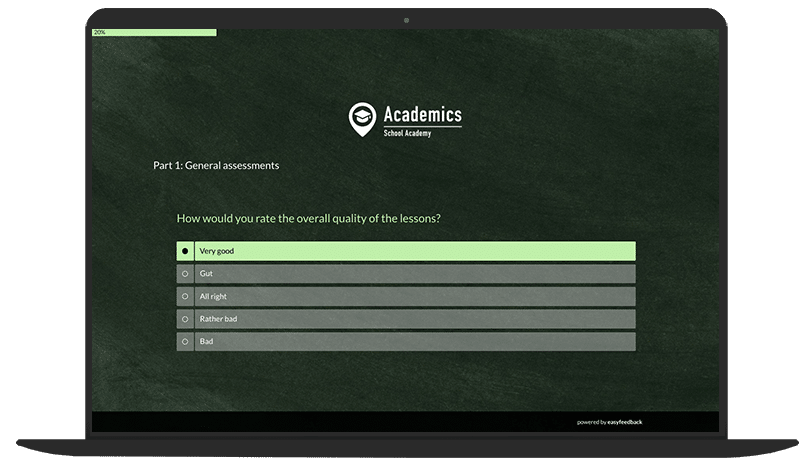
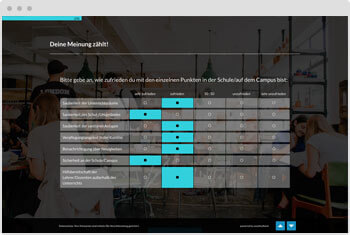
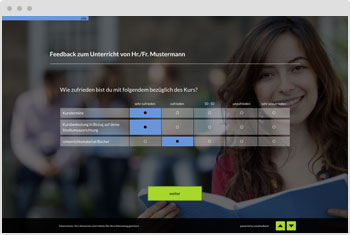
Contents of the template:
Objectives of the survey:
Helpful features for the survey:

Data protection „made in Germany“ (GDPR)

Anonymity function for honest feedback
Student feedback refers to the feedback that students provide about lessons, teaching methods, the learning environment, or the teacher’s behavior.
It is used to reflect on and improve teaching from the learners’ perspective.
Student feedback is important because it offers a wide range of benefits for teaching, teachers, and learners.
Here are the key reasons:
1. Reason: Include the learners’ perspective
Students are the main participants in lessons. Their feedback shows how they perceive teaching and where improvements are needed.
2. Reason: Improve teaching quality
Feedback helps teachers adapt their methods, materials, and interactions with the class in order to teach more effectively.
3. Reason: Promote participation
When students can express their opinions, they feel valued and taken seriously, which strengthens their motivation and participation.
4. Reason: Build better relationships
Feedback creates an open and trusting atmosphere between teachers and learners.
5. Reason: Reflection for teachers
Feedback enables teachers to reflect on their own work and try new approaches.
6. Reason: Support learning outcomes
When teaching is better tailored to students’ needs, their learning outcomes also improve.
The advantages and disadvantages of student feedback can help to better understand the effectiveness and challenges of this tool:
Advantages of student feedback
Disadvantages of student feedback:
There are various methods for collecting student feedback.
The choice of method depends on the age group, the purpose of the feedback, and the available resources.
Here are some proven approaches:
1. Method: Written
2. Method: Digital
3. Method: Verbal
4. Method: Playful
5. Method: Creative
Tips for implementation
Step 1: Define objectives
Clarify why feedback is being collected:
Step 2: Select a method
Decide how the feedback will be collected:
Step 3: Prepare questions
Formulate clear and understandable questions:
Step 4: Set the framework
Plan the process:
Step 5: Conduct the feedback activity
Step 6: Evaluate feedback
Step 7: Communicate the results
Step 8: Take action
Step 9: Follow up
Reflect on how the process went:
Step 10: Establish regular feedback
1. Tip: Ensure anonymity
The anonymity of responses is essential so that students can provide open and honest feedback.
Assure students that their opinions will be treated confidentially.
2. Tip: Collect data systematically
Organize feedback into categories such as teaching methods, classroom climate, materials, or individual support.
This makes it possible to analyze individual areas in a targeted way.
3. Tip: Identify patterns and trends
Pay attention to recurring statements or topics.
Individual opinions are valuable, but broader trends show where action is genuinely needed.
4. Tip: Emphasize strengths
Start the evaluation with the positive aspects of the feedback.
This motivates you to maintain what is working well and strengthens the relationship with students.
5. Tip: Deal with criticism constructively
Do not take criticism personally; view it as an opportunity for development.
Try to understand students’ perspectives in order to better recognize their needs.
6. Tip: Set priorities
Not all feedback can be implemented immediately.
Identify the most urgent issues that will have a significant impact on teaching.
7. Tip: Engage in dialogue with students
Share the key feedback findings with students.
Ask for specific suggestions and develop possible solutions together.
8. Tip: Develop transparent measures
Show students that their feedback is taken seriously by taking concrete steps.
Clearly communicate which measures will be implemented and why.
9. Tip: Think long term
Feedback should not be viewed as a one-time activity.
Conduct surveys regularly and compare the results to measure progress and ensure long-term improvements.
10. Tip: Involve colleagues
If possible, discuss the feedback with colleagues.
They can offer new perspectives and support the implementation of measures.
11. Tip: Follow up and review
Conduct another survey after a few weeks or months to check whether the measures have had the desired effect.
Ask students directly whether they notice the improvements.
12. Tip: Show appreciation
Thank students for their honest feedback and for actively contributing to the improvement of teaching.
This strengthens their motivation to contribute in the future as well.
Student feedback plays a central role in the continuous development of teaching.
By including learners’ perspectives, teachers can address the strengths and weaknesses of their lessons in a targeted way and sustainably improve teaching quality.
Importance of student feedback for teaching development
Objectives of student feedback in teaching development
Areas of application for student feedback
Practical implementation
Challenges and how to address them