


What is 360-degree feedback?
360-degree feedback is a comprehensive assessment tool in which employees receive feedback not only from their supervisors, but also from colleagues, team members, and, if necessary, customers.
The aim is to obtain a holistic picture of a person’s strengths, development potential, and communication skills.
The art of creating the right questionnaire
The success of 360-degree feedback depends largely on asking the right questions.
A structured questionnaire covers various areas of competence, e.g.:
- Professional competence: How confidently and efficiently does the person perform their tasks?
- Social competence: How well do they work in a team?
- Leadership skills: How clearly and motivatingly do they communicate?
- Personal development: In which areas is there potential for improvement?
A questionnaire that is too general or poorly worded can easily lead to superficial answers — or worse, frustration among participants.
Examples of questions in 360-degree feedback
A well-designed questionnaire should cover different perspectives.
Typical questions might include:
Professional competence
- How confidently and efficiently does the person perform their tasks?
- Do they demonstrate good problem-solving skills?
- How good is their knowledge in their field?
- Do they use resources and tools effectively?
- How well do they manage to set priorities?
- Do they respond flexibly to new requirements?
Social skills
How constructively does she work in a team?
Does she treat colleagues with respect?
Does she actively support others when they face challenges?
Can she resolve conflicts appropriately?
Does she listen actively and take different perspectives into account?
Does she contribute to a positive working atmosphere?
Leadership qualities
- Does she communicate clear goals and expectations?
- Does she motivate the team effectively?
- Does she handle feedback fairly and transparently?
- Does she delegate tasks appropriately and clearly?
- Does she promote the personal development of her employees?
- Does she make well-founded and comprehensible decisions?
Personal development
- How open is the person to feedback and new ideas?
- Which strengths should they continue to develop?
- In which areas do you see potential for development?
- How well do they reflect on their own behavior and decisions?
- Do they actively set goals for their own development?
- How do they deal with mistakes and setbacks?
Communication & Collaboration
- Do they convey information clearly and comprehensively?
- Are they good at explaining complex content?
- Do they adapt their communication style to different conversation partners?
- Do they share relevant information in a timely manner?
- Do they promote exchange between departments or teams?
Innovation & Initiative
- Does she actively contribute new ideas?
- Does she implement suggestions constructively?
- Does she show initiative in projects or problem solving?
- Does she proactively address opportunities and risks?
These questions can be flexibly adapted to the respective position, industry, or company structure.
easyfeedback as a smart solution
This is where easyfeedback comes in.
Our online survey tool not only makes it easier to create and distribute the questionnaire, but also ensures anonymous and structured evaluation.
Employees receive quick feedback, managers identify patterns and areas for development, and HR departments save valuable time.

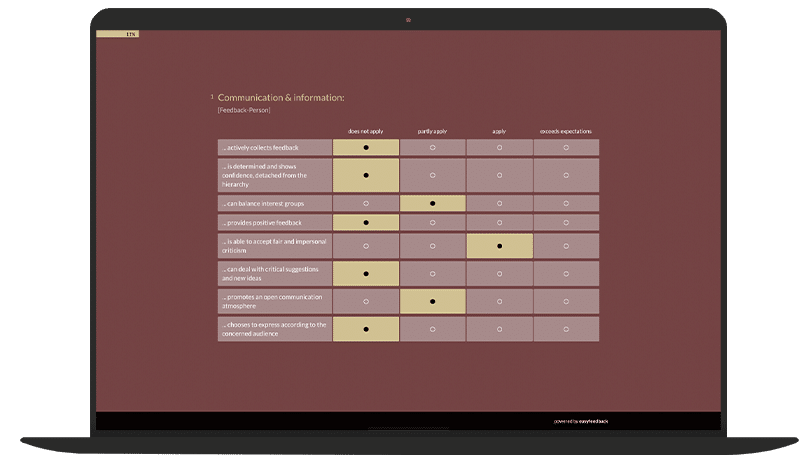
Our template – ready to use
To make it easier to get started, we have developed a ready-made 360-degree feedback template.
This template is flexible, practical, and covers all relevant areas of competence.
It can be integrated directly into easyfeedback – so teams can start a professional feedback culture in no time.
Conclusion
A well-thought-out questionnaire is at the heart of successful 360-degree feedback.
Combined with an intelligent solution such as easyfeedback, feedback can be designed to be efficient, structured, and appreciative.
And those who use our template not only save time, but also ensure that no relevant aspects are overlooked.
More on 360 Degree Feedback
- How to: Conduct 360-degree feedback with easyfeedback
- 360 degree feedback: definition, process, information & tips for implementation
- 270-degree feedback: A valuable perspective for personal development
- The most frequently asked questions about 360-degree feedback
- 360-degree feedback: A key tool for modern leadership development
- 360-degree feedback in the context of personnel development
- 3 tips to avoid pillorying managers
- Survey Template: 360 Degree Feedback
- Survey Template: 90 Degree Feedback
- Survey Template: 270 Degree Feedback