


What is 360-degree feedback?
360-degree feedback is a structured feedback process in which a person — usually an employee or manager—is assessed not only by their direct supervisor, but also by colleagues, employees, customers, and often by themselves.
This provides a more comprehensive and objective picture of their behavior, performance, and skills.
What is 360-degree feedback used for?
360-degree feedback is primarily used for personnel development — to improve leadership, social, and management skills.
It helps to identify blind spots in one’s own behavior, promote strengths, and address areas for development in a targeted manner.
Who is 360-degree feedback suitable for?

It is particularly useful for managers, project managers, and employees who interact with many other people.
In small teams or for purely operational activities without external contacts, the benefits are more limited.
How does 360-degree feedback work?
Typical process:
- Clarification of objectives & selection of roles: Which skills should be evaluated?
- Selection of feedback providers: Colleagues, supervisors, employees, etc.
- Conducting the survey (usually anonymously via questionnaire).
- Evaluation & report: Analysis of the results, usually structured according to perspectives.
- Results discussion & development plan: Joint discussion of the results and definition of measures.
What is included in the questionnaire?
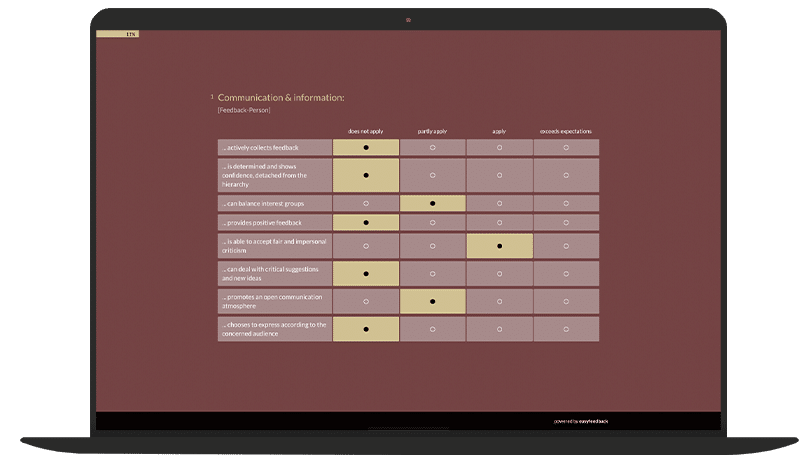
Questions typically focus on observable behavior in areas such as communication, collaboration, leadership, decision-making, reliability, and development.
Good questionnaires usually contain a mix of scale questions and open-ended questions to allow for both quantitative and qualitative feedback.
What are good feedback questions for supervisors?
Good questions relate to specific observable behavior.
For example:
- Does the manager communicate clearly and comprehensibly?
- Do they provide regular and constructive feedback?
- Do they make understandable decisions?
- Do they promote employee development?
- Do they create a trusting working atmosphere?
Such questions provide tangible and helpful feedback.
How many questions should a 360-degree feedback questionnaire have?
We often recommend 20 – 30 questions so that the feedback is comprehensive but not overwhelming.
Less than 10 questions only capture rough impressions, while more than 50 can be tiring.
Is the feedback anonymous?
Yes — in professional 360-degree feedback processes, the feedback is usually evaluated anonymously so that no conclusions can be drawn about individual feedback providers.
This increases the honesty and quality of the feedback.
How often should 360-degree feedback be conducted?
Many experts recommend annual feedback so that developments become visible and there is time to implement changes.
Depending on the corporate culture, the frequency can also be 12 – 24 months.
What are the advantages of 360-degree feedback?
The key advantages include:
- More realistic assessment through multiple perspectives
- Promotion of self-reflection and development
- More objective results than with individual assessments
- Strengthening of the feedback and learning culture within the company
What are the disadvantages or risks?
Possible disadvantages:
- Time-consuming and resource-intensive (more participants → more effort)
- Without good communication, there may be fears or resistance.
- Incorrect or subjective feedback (e.g., resulting from conflicts) can distort the results.
- Without targeted follow-up, the effect quickly fizzles out.
What competencies are measured in 360-degree feedback?
Typical areas of competence are:
- Communication
- Leadership behavior
- Teamwork & cooperation
- Sense of responsibility
- Decision-making ability
- Results and goal orientation
- Conflict management skills
- Customer or service orientation
The selection depends on the company’s goals.
How does 360-degree feedback differ from traditional performance reviews?
While traditional reviews are usually conducted by managers alone and focus more on goal achievement, 360-degree feedback provides multidimensional insights into behavior and competencies and is primarily used for development purposes.
What is the difference between 180, 270, and 360-degree feedback?

The difference lies in the number of perspectives:
- 180 degrees → Self + supervisors
- 270 degrees → Self + supervisors + colleagues
- 360 degrees → All (external) groups including employees (all-round view)
The more perspectives are included, the more differentiated the feedback is.
What are the four perspectives in 360-degree feedback?
The classic 360-degree survey consists of four perspectives:
- Self-assessment – How do I see myself?
- Supervisors – How does my manager evaluate me?
- Colleagues – How do I experience working in a team?
- Employees – How do I come across as a manager or contact person?
This combination ensures a balanced and realistic overall picture.
How do I write an introduction for a 360-degree survey?
A good introduction should:
- Explain the purpose and benefits
- Emphasize anonymity
- Encourage honest participation
- Be short and easy to understand
Example:
“This survey helps us identify strengths and reveal areas for development. Your answers are anonymous and make an important contribution to an open feedback culture.”
What happens after the 360-degree feedback?
The survey is typically followed by:
- Evaluation of the results
- Personal feedback meeting
- Reflection on strengths and areas for development
- Concrete measures or goals
- Coaching or training, if necessary
Only these steps make the feedback truly effective.
Is coaching necessary after feedback?

Ideally, yes — the impact of 360-degree feedback increases significantly when the results are reviewed together with a neutral person (coach, HR professional).
This helps to use the insights constructively.
How many people should provide feedback?
The minimum is usually 4 – 10 feedback providers to ensure anonymity and diversity of perspectives.
More feedback providers generally increase the significance of the results.
Why do many 360-degree feedback processes fail?
Common reasons are:
- Lack of or questionable anonymity
- Unclear objectives
- Questionnaires that are too long or poorly designed
- No evaluation discussions
- No concrete measures taken afterwards
Without implementation, feedback remains ineffective.

More on 360 Degree Feedback
- 360 degree feedback: definition, process, information & tips for implementation
- Don’t pillory leaders during 360-degree feedback (with video)
- How to: Conduct 360-degree feedback with easyfeedback
- 360-degree feedback: Achieving success with the right set of questions
- 360-degree feedback: A key tool for modern leadership development
- 270-degree feedback: A valuable perspective for personal development
- 360-degree feedback: Process, benefits, and success factors
- Survey Template: 360 Degree Feedback
- Survey Template: 90 Degree Feedback
- Survey Template: 270 Degree Feedback