


Step 1: Setting goals and planning
The first step is to ask yourself what you want to achieve with 360-degree feedback.
Perhaps you want to strengthen your leadership skills, improve your teamwork, or gain a better understanding of your career development opportunities.
Successful planning also requires:
- a clearly defined time frame,
- the selection of feedback providers,
- good internal communication,
- and consideration of data protection and anonymity.
Transparent planning ensures that you and everyone else involved have confidence in the process.
Step 2: Selecting feedback providers
The broader the perspectives, the more valuable the result.

That’s why we involve different groups of people who know you from different perspectives:
- your supervisors
- colleagues
- employees, if you are a manager
- customers (optional)
- as well as your own self-assessment
This combination provides a realistic picture of your behavioral and competency areas.
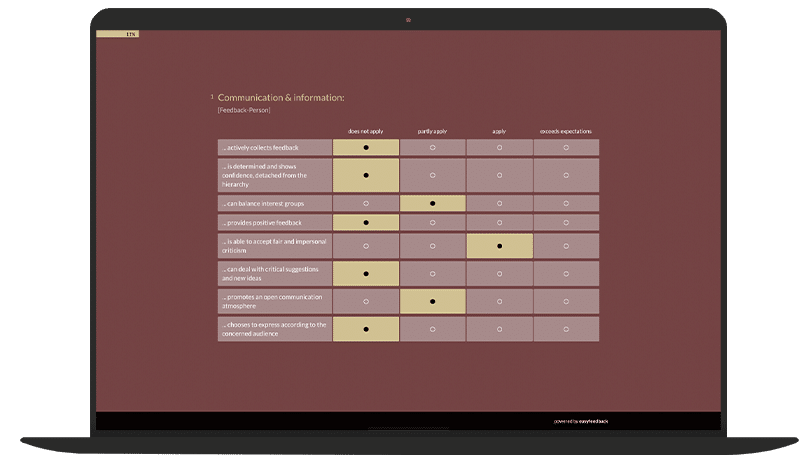
Step 3: Creating or selecting the questionnaire
The 360-degree questionnaire is the core of the feedback process.
It contains clear, precise questions on key areas of competence such as:
- Communication
- Conflict and problem-solving skills
- Leadership skills
- Teamwork
- Self-organization
Many companies use professional tools such as easyfeedback, while others develop their own customized questionnaires.
It is important that the questions are relevant and easily measurable.
Step 4: Conducting the survey
The survey is usually conducted online and is anonymous so that all participants can answer openly and honestly.
To ensure that the process runs smoothly, it is important to provide:
- clear information about the procedure,
- a tool that is easy to use,
- and sufficient time for everyone to enter their answers.
Step 5: Evaluation and report
Once the survey is complete, all data is evaluated anonymously.
The results report shows you:
- Average values from all perspectives,
- graphical representations of your strengths and areas for development,
- differences between self-image and external image,
- as well as specific recommendations for action.
This report forms the basis for the subsequent discussion and your personal development.
Tip: With easyfeedback, the results from the 360-degree feedback can be evaluated quickly and easily using AI – saving time and manual effort.
Step 6: Feedback discussion
In the next step, you discuss the results with a coach, your HR department, or your manager.
This involves more than just data — it’s about understanding, context, and personal reflection.

The focus is on:
- your strongest skills,
- important areas for development,
- possible reasons for differing feedback,
- and looking ahead—how you can use the insights gained.
The conversation helps you to accept the feedback in a positive and constructive way.
Step 7: Creating a development plan
To ensure that the feedback is put into practice, you develop an individual action plan.
This can include:
- Training courses or workshops
- Coaching or mentoring
- New working methods or behavioral strategies
- Specific goals and measurable KPIs
The development plan should be realistic, individually tailored, and clearly defined in terms of time.
Step 8: Follow-up and review
To measure your progress, you should review what has changed after a few months.
Many companies use a shortened re-feedback process for this after 6–12 months.
This allows you to identify:
- which measures have been effective,
- where you can continue to grow,
- and how your impact on the team has changed.
Conclusion
360-degree feedback is a powerful tool that helps you better understand yourself, identify blind spots, and advance your professional and personal development in a targeted manner.
For the process to be truly successful, it requires clear goals, careful planning, professional support, and an open, appreciative approach to the results.
When these factors come together, not only do you benefit personally, but the entire corporate culture is strengthened in the long term.
More on 360 Degree Feedback
- Everything you need to know about 360 degree feedback: process, info and tips
- How to: Conduct 360-degree feedback with easyfeedback
- 270-degree feedback: A valuable perspective for personal development
- 360-degree feedback: A key tool for modern leadership development
- The most frequently asked questions about 360-degree feedback
- 360-degree feedback in the context of personnel development
- 360-degree feedback: Achieving success with the right set of questions
- 3 tips to avoid pillorying managers
- Survey Template: 360 Degree Feedback
- Survey Template: 90 Degree Feedback
- Survey Template: 270 Degree Feedback