

“Identifying user needs is at the heart of our business. easyfeedback has been helping us with this task for several years now. We particularly appreciate its intuitive usability and professional support.”

“We use easyfeedback for internal and external surveys—it’s fast, convenient, and easy! The uncomplicated and friendly support puts a smile on our faces, and we are delighted with the continuous development of the platform.”
Employee evaluations are more than just a formality — they serve as a compass for growth.
They highlight what’s going well, identify untapped potential, and create space for honest feedback and clear goals.
When used effectively, they boost motivation, build trust, and help foster targeted talent development.
When you supplement this with anonymous surveys, you get a glimpse behind the scenes: How do teams really feel? What motivates them, and what holds them back? Where are there hidden challenges that often go unspoken in conversations?
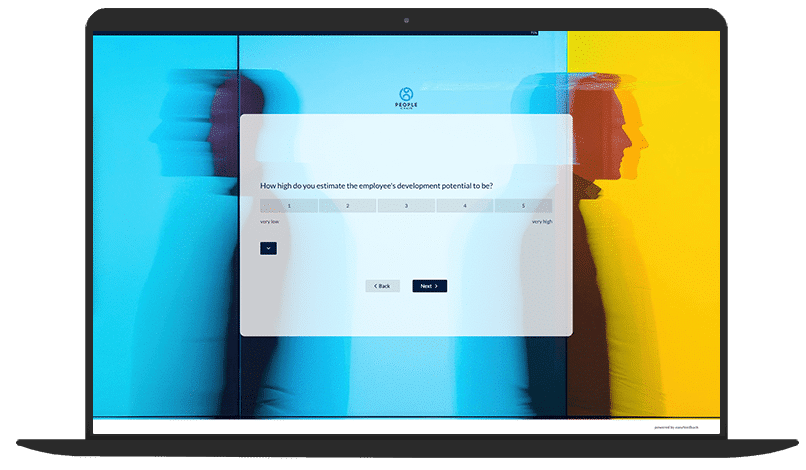
With our survey template, you can gather exactly this kind of honest employee feedback — structured, anonymous, and easy to analyze.
This creates a genuine picture of the mood that helps managers provide targeted support and effectively drive change.
Together — appraisals and surveys—they breathe new life into teamwork and ensure that everyone feels seen, heard, and supported.
Contents of the template:
Objectives of the survey:
Helpful features for the survey:

Data protection „made in Germany“ (GDPR)

Anonymity function for honest feedback
Employee performance evaluation (also known as employee assessment or personnel appraisal) is a tool for personnel management and employee development.
It refers to the systematic process in which managers evaluate employees’ performance, behavior, competencies and potential.
1. Goal: Performance Evaluation
The systematic and objective assessment of work performance is a key instrument for identifying individual strengths and weaknesses.
It provides a reliable foundation for personnel decisions such as salary adjustments, promotions, or transfers.
At the same time, it enables continuous monitoring of performance, allowing development potential to be identified early and specifically supported.
2. Goal: Supporting Employee Development
Performance evaluations make it possible to accurately identify training and qualification needs.
This allows for the targeted planning of individual development measures and the strategic management of career paths.
Especially in the areas of talent management and succession planning, performance evaluations play an important role in ensuring that the right employees are supported and developed at the right time.
3. Goal: Feedback and Communication
Regular feedback as part of performance evaluations promotes an open feedback culture between managers and employees.
It creates transparency regarding expectations, enables appreciative recognition and constructive criticism, and contributes to employee motivation and development.
A good communication culture strengthens trust and improves collaboration within the team.
4. Goal: Goal Orientation and Management
Performance evaluations help align individual contributions with the company’s overall objectives.
They assess the level of goal achievement, identify deviations, and provide the foundation for defining future goal agreements.
This promotes a goal-oriented, measurable, and responsible way of working.
5. Goal: Documentation
The written documentation of performance, development progress, and discussion content ensures transparency and protects both employers and employees.
It serves as a reliable foundation for future decisions and provides legal protection in the event of disputes.
Furthermore, it promotes the traceability of individual development over a longer period of time.
6. Goal: Improving Working Relationships
A fair, transparent, and comprehensible performance evaluation significantly contributes to the quality of working relationships.
It strengthens mutual trust, creates clarity regarding expectations, and reduces potential conflicts through open communication.
As a result, not only is the work environment improved, but also team dynamics and long-term employee retention are strengthened.
Advantages of Employee Evaluation
1. Clear Performance Assessment
2. Promoting Communication
3. Employee Development
4. Basis for Decision-Making
5. Increasing Motivation
Disadvantages of Employee Evaluation
1. Subjectivity and Bias
2. Stress and Anxiety Among Employees
3. Time and Resource Requirements
4. Risk of Demotivation
5. Potential Conflicts
Reasons for Employee Performance Appraisal
The reasons for conducting employee performance appraisals are diverse and affect both the interests of the company and the development of employees.
Here are the most important reasons:
1. Reason: Performance Evaluation
2. Reason: Goal Tracking and Review
3. Reason: Employee Development
4. Reason: Feedback and Communication
5. Reason: Management Tool
6. Reason: Documentation and Traceability
7. Reason: Strategic Workforce Planning
These criteria can be adapted or weighted depending on the company, position, and performance evaluation system.
Often, rating scales (e.g., from 1–5 or school grades) are also used to standardize evaluations and improve comparability.
1. Phase: Preparation
Preparation is crucial for a successful and fair performance appraisal. This phase establishes the foundation:
2. Phase: Creating the Assessment
In this phase, the manager systematically evaluates the collected information:
3. Phase: Performance Review Meeting
The personal meeting is the core element of the employee appraisal:
4. Phase: Follow-up
5. Phase: Evaluation
Ensuring the quality of the appraisal process also includes regular review and adjustment:
1. Criterion: Professional Competence
Professional competence forms the foundation of occupational qualification and describes the extent to which an employee has the necessary knowledge and skills to perform their tasks.
Key aspects include:
Managers additionally require strong management competencies to combine professional challenges with strategic thinking.
2. Criterion: Work Approach
The quality of an employee’s work approach is a key factor for productive and goal-oriented work. Evaluation includes:
3. Criterion: Work Performance
Actual performance is evaluated based on quantitative and qualitative characteristics:
4. Criterion: Social Behavior
Social behavior influences teamwork and the external image of an organization.
Evaluation aspects include:
5. Criterion: Commitment and Motivation
Engaged employees make a significant contribution to the success of a company.
This criterion assesses:
A high level of commitment strengthens employee retention and has a motivating effect on the surrounding work environment.
6. Criterion: Leadership Behavior (for Managers)
For employees in leadership positions, evaluating leadership qualities is essential:
7. Criterion: Goal Achievement
Achieving measurable results is an objective criterion for performance:
These criteria can be adapted or weighted depending on the company, position, and appraisal system.
Rating scales (e.g., from 1–5 or school grades) are often used to standardize evaluations and make them comparable.
1. Method: Rating Scales (Rating Methods)
2. Method: Checklist Method
3. Method: Narrative Evaluation
4. Method: 360-Degree Feedback
5. Method: Self-Assessment
6. Method: Goal-Setting Discussions
7. Method: Behaviorally Anchored Rating Scales (BARS)
8. Method: Critical Incident Method
Ziel agreements are often a central component of employee performance evaluations.
In this process, managers and employees agree at the beginning of a specific period (e.g. one year) on concrete, measurable goals that should be achieved.
Step 1: Goal Definition
Step 2: Progress Review and Support
Step 3: Evaluation of Goal Achievement
Step 4: Feedback and Development
Advantages of the Combination
When it comes to data protection in employee performance evaluations, there are important aspects that companies must consider to ensure that employees’ personal data is protected and legal requirements are met.
1. Aspect: Legal Basis and Purpose Limitation
2. Aspect: Data Minimization
3. Aspect: Confidentiality and Access Rights
4. Aspect: Transparency and Employee Information
5. Aspect: Retention Periods
6. Aspect: Employees’ Rights
easyfeedback can support employee performance evaluations in various ways by serving as a practical survey tool that simplifies and professionalizes the feedback process.
Here are some specific advantages and possible applications:
1. Advantage: Data Collection
2. Advantage: Structured and Standardized Evaluation
3. Advantage: Anonymity and Openness
4. Advantage: Transparency and Traceability
5. Advantage: Saving Time and Resources
6. Advantage: Integration of Goal Agreements