
Prepare for performance reviews effectively with a survey

Prepare for Performance Reviews Effectively with a Survey

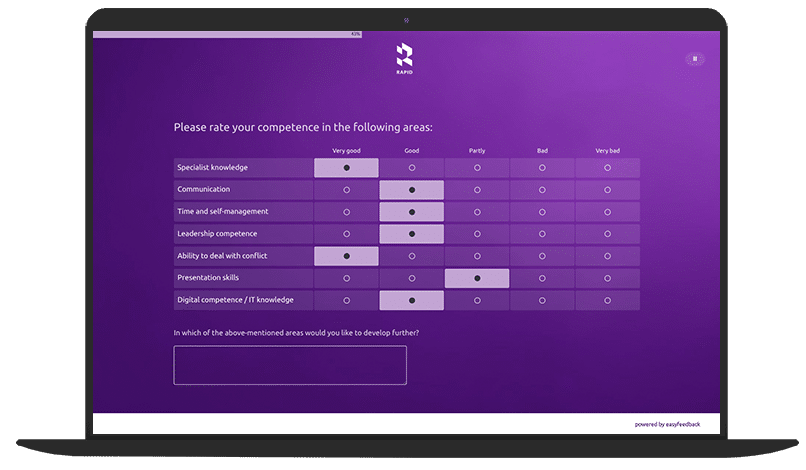
Our survey template helps managers and employees prepare for performance reviews in an effective, structured, and focused manner. It provides clarity, saves time, and keeps the focus on the issues that really matter.

Immobilienscout 24 ist begeisterter easyfeedback Nutzer

“Identifying user needs is at the heart of our business. easyfeedback has been helping us with this task for several years now. We particularly appreciate its intuitive usability and professional support.”

Franziska Becker
Guild Lead User Experience Research
TUI ist begeisterter easyfeedback Nutzer

“We use easyfeedback for internal and external surveys—it’s fast, convenient, and easy! The uncomplicated and friendly support puts a smile on our faces, and we are delighted with the continuous development of the platform.”

Jennifer Fischer
Guest & Competitor Insights Analyst

Why prepare performance reviews using surveys?

Preparing for performance reviews using a survey is a simple and effective way to make the conversation more pleasant and productive for both parties.

Employees have the opportunity to reflect on their responsibilities, goals, aspirations, or challenges at their own pace and articulate them clearly.

At the same time, managers gain an early overview of key topics and can prepare specifically for the meeting.

This makes the discussion more personal, structured, and focused on what really matters.

A standardized questionnaire also ensures that nothing is overlooked and saves time during the conversation.

It also demonstrates that employees’ opinions are valued.

Typical topics include reviews of goals, feedback on collaboration, or ideas for further development.

Overall, the questionnaire helps make development discussions more honest, effective, and valuable for both parties.

Contents of the template:

  • Questions about self-assessment
  • Questions about development and goals
  • Skills assessment
  • Survey on job satisfaction
  • Questions about professional development and career advancement

Objectives of the survey:

  • Structured preparation for the performance review
  • Reflection on one’s own performance and development
  • Identification of training and support needs
  • Recognition of strengths, potential, and areas for development
  • Promotion of employee accountability
  • Clarification of expectations and career goals
  • Open discussion about satisfaction, teamwork, and leadership

Helpful features for the survey:

  • Survey options: Anonymous, partially anonymous, personalized
  • Invitation options: Link, email, QR code, and more
  • AI analysis of results, including recommendations for action
DSGVO-konforme Online-Umfragen

Data protection „made in Germany“ (GDPR)

Anonyme Teilnahme an Umfragen

Anonymity function for honest feedback

Frequently asked questions about performance reviews

An development discussion is a structured and trust-based conversation between a manager (e.g., supervisor or team leader) and an employee.

It is designed to specifically support professional and personal development – with a focus on the future rather than looking back.

The conversation is not only about performance, but primarily about potential, personal goals, perspectives, and concrete development opportunities.


Difference from other types of conversations:

A development discussion is not simply a performance review like a traditional annual appraisal.

It is also more than just feedback: The focus is on the future, on potential, and on how employees can actively shape their role and career path.

It is a joint assessment of the current situation with a clear focus on future growth and development.

Development discussions are more than just a formal requirement – they are valuable opportunities to jointly promote growth, motivation, and employee satisfaction.

Both companies and employees benefit when these conversations are well prepared and conducted with clear objectives.


Goals for the company / the manager:

  • Identify and develop potential:
    Recognize talents in order to invest specifically in training, development,
    or new responsibilities.


  • Develop succession planning and career paths:
    Identify employees early who may be suitable for future roles and responsibilities.


  • Create individual development plans:
    Define concrete measures such as training, mentoring, or project responsibility.


  • Improve performance and align goals:
    Establish shared expectations and connect individual goals with company objectives.


Goals for employees:

  • Recognize personal strengths and development potential:
    Receive feedback on performance, skills, and areas for improvement.


  • Discuss career goals:
    Express personal professional aspirations and future career visions.


  • Identify development opportunities:
    Gain transparency about career opportunities, advancement options, or possible role changes within the company.


  • Clarify training needs:
    Agree on suitable training courses, workshops, coaching, or further education opportunities.


  • Experience appreciation and personal guidance:
    Feel that individual contributions are recognized, valued, and taken seriously.

A development discussion thrives on openness, reflection, and a forward-looking perspective.

To make the dialogue structured and goal-oriented for both managers and employees, the following topic areas have proven effective:


1. Area: Review of Personal Development

  • What went well during the last year / period?
  • What progress has been made?
  • What were significant achievements or challenges?


2. Area: Strengths & Development Areas

  • Which professional and personal strengths are visible?
  • Where is there potential for improvement?
  • Feedback from both the manager and the employee


3. Area: Career Goals and Personal Perspectives

  • What goals does the employee have in the short, medium, and long term?
  • Which roles or responsibilities are of future interest?
  • Wishes for change, such as moving to another department or taking on leadership responsibilities


4. Area: Qualification & Further Development

  • Which training programs or courses are useful?
  • Is there a need for coaching, mentoring, or project-based learning?
  • Language courses, soft skills, technical skills, and other competencies


5. Area: Concrete Actions & Development Plan

  • Which next steps will be agreed upon together?
  • What support can the company provide?
  • Timeline, responsibilities, and measurement of success


6. Area: Collaboration & Leadership

  • How is the collaboration with colleagues and managers experienced?
  • Are there suggestions for improvement or specific wishes?
  • How does the employee feel within the team?


7. Area: Motivation & Job Satisfaction

  • What currently motivates the employee – and what reduces motivation?
  • Which working conditions support strong performance?
  • Wishes regarding work methods, task distribution, or work-life balance

Here is a structured preparation guide for a development discussion – both for employees and managers.

It can be used to prepare effectively and get the most value out of the conversation.


Preparation for a Development Discussion – Employees

1. Review of the Past Period

  • What have I achieved during the last period (e.g., 6–12 months)?
  • Which projects, tasks, or challenges have I successfully completed?
  • What went particularly well – what am I proud of?
  • What could have gone better?


2. Personal Strengths & Development Areas

  • Which strengths do I contribute (professional, social, methodological)?
  • Where do I see opportunities for further development?
  • Where would I like to receive feedback?


3. Goals & Career Aspirations

  • What professional goals do I have (short- and medium-term)?
  • Which tasks, roles, or projects are of interest to me?
  • Would I like to take on more responsibility (e.g., leadership,
    specialization)?


4. Training & Development

  • Which courses, training programs, or coaching sessions could support my growth?
  • Would I like to develop new skills (e.g., soft skills, IT, languages)?
  • Where do I see a specific need for learning and improvement?


5. Questions & Expectations

  • Which questions do I have for my manager?
  • What kind of support would I like to receive?
  • What would improve my motivation or job satisfaction?


Preparation for a Development Discussion – Manager


1. Analysis of the Employee

  • Which strengths, achievements, and successes are visible?
  • Where do I see opportunities for development?
  • How has the employee developed since the last discussion?


2. Role & Potential

  • Does the current role match the employee’s skills and interests?
  • Is there potential for new tasks, additional responsibilities, or career
    development?
  • How can I support and challenge the employee effectively?


3. Development Opportunities & Measures

  • Which training programs or development opportunities are suitable?
  • Are there current projects where the employee can develop further?
  • Which resources (time, budget) are available?


4. Preparing Feedback

  • What would I like to address openly – both positively and critically?
  • How can I communicate development opportunities in a constructive and
    motivating way?

Here is a checklist & guide for a development discussion – ideal for preparation by managers or employees:


Preparation (Both Sides)

  • Review: Reflect on personal achievements, successes, and challenges
  • Identify and write down personal strengths and development areas
  • Consider possible career goals and future aspirations
  • Prepare questions, wishes, and suggestions
  • Review previous development goals (if available)


Conversation Structure / Guide


1. Opening & Clarifying the Framework

  • Briefly explain the purpose and structure of the conversation
  • Create an open and trusting atmosphere


2. Review & Performance

  • What has gone well recently?
  • Which challenges have occurred?
  • What has been learned or achieved?


3. Strengths & Development Areas


4. Professional Goals & Perspectives

  • Where does the person see themselves in 1–3 years?
  • Is there interest in new roles, projects, or additional responsibilities?
  • What provides long-term motivation?


5. Training & Development

  • Identify needs for training, courses, or coaching
  • Explore opportunities to deepen or expand knowledge
  • Develop soft skills (e.g., communication, self-organization)


6. Collaboration & Work Environment

  • How is collaboration within the team?
  • What could be improved?
  • What is experienced as supportive or challenging?


7. Agreements & Actions

  • Define concrete development goals (SMART)
  • Plan actions: What needs to be done? Who is responsible? By when?
  • Clarify required support (e.g., budget, time, resources)
  • Schedule the next discussion (e.g., in 6 months)


Follow-up

  • Document the conversation in writing (e.g., meeting notes, development plan)
  • Initiate agreed actions and schedule relevant appointments
  • Provide regular interim feedback

Here is a suggested questionnaire for a development discussion – ideal for preparing or supporting the conversation.

It can be used both by employees and managers.


Part 1: Review

  • Which tasks or projects have had the greatest impact on you during the last period?
  • What went well? Where do you see your personal achievements?
  • Which challenges occurred – and how were they overcome?
  • What would you have liked to do differently or receive better support with?


Part 2: Self-Assessment & External Perspective

  • Which strengths do you bring to your work?
  • Where do you personally see potential for development?
  • How would your colleagues describe your way of working?
  • What kind of feedback would you like to receive from your manager?


Part 3: Motivation & Satisfaction

  • What motivates you most in your daily work?
  • What currently limits your motivation or productivity?
  • How satisfied are you with your current role and distribution of tasks?
  • How do you experience collaboration within the team?


Part 4: Development & Future

  • In which areas would you like to develop further?
  • Which professional or personal goals are you pursuing for the next year?
  • Are you interested in new roles, tasks, or taking on more responsibility?
  • Which further training, courses, or development measures would you like?


Part 5: Working Conditions & Collaboration

  • What support from your manager would help your development?
  • Are there aspects of the work environment that should be improved?
  • From your perspective, what works well in collaboration – and what works less well?


Part 6: Open Questions / Additional Topics

  • Are there any other topics you would like to discuss during the development conversation?


Guidelines for Use

  • The questionnaire can be completed in writing before the conversation or used as a guide during the discussion.
  • Questions can be adapted or shortened depending on the target group (specialists, managers, apprentices, etc.).
  • Digital versions (e.g., online forms or PDF documents) are also suitable.

Here are practical tips for a successful development discussion – for both managers and employees – to ensure the conversation is constructive, open, and goal-oriented:


1. Tip: Communicate Openly and Honestly

  • Talk clearly and respectfully about wishes, goals, and challenges.
  • Give and receive constructive feedback – without becoming defensive.


2. Tip: Think Future-Oriented

  • The focus is not on evaluation, but on personal and professional development.
  • Think together: Where should the journey go?


3. Tip: Prepare Thoroughly for the Conversation

  • Reflect on achievements, current responsibilities, and personal goals.
  • Consider possible training needs or new interests.


4. Tip: Schedule Enough Time and Create a Calm Environment

  • Avoid interruptions (turn off phones, no checking emails during the conversation).
  • A conversation duration of 60–90 minutes is ideal.


For Employees:

  • Know your strengths:
    What do I contribute to the team? What am I valued for?
  • Define goals:
    Consider short- and medium-term professional goals.
  • Identify development areas:
    Where do I want to improve? What interests me?
  • Discuss training needs:
    Which courses, coaching sessions, or new areas of responsibility could help me grow?
  • Take an active role:
    Development is a shared responsibility – contribute your own ideas.


For Managers:

  • Listen, don’t just talk:
    Take employees seriously and give them space to share their thoughts.
  • Understand and support individual goals:
    Not every career path looks the same.
  • Prepare observations:
    Bring specific examples of performance and behavior.
  • Agree on concrete actions:
    Define SMART development goals.
  • Ensure follow-up:
    Create commitment through scheduled check-ins and agreements.


Extra Tip: Document the Conversation

Record important points and agreements in writing (e.g., a development plan).

This ensures that progress can be tracked and commitments are followed through.

More employee survey templates

Survey template 270 degree feedback

270 Degree Feedback

Survey template details

90 Degree Feedback Questionnaire Template

90 Degree Feedback

Survey template details

Survey template: feedback employee onboarding

Employee Onboarding Feedback

Survey template details

Survey Template Offboarding

Offboarding

Survey template details

Survey template mood barometer

Mood Meter

Survey template details

Explore all survey templates  

You are in professional company

Immoscout 24 Logo
Tui Logo
Porsche Logo
Lufthansa Logo
Jaegermeister Logo

Over 740,000 participants in easyfeedback surveys every month

Result

STUDIO

The performance add-on for your analysis

easyfeedback Result Studio 2