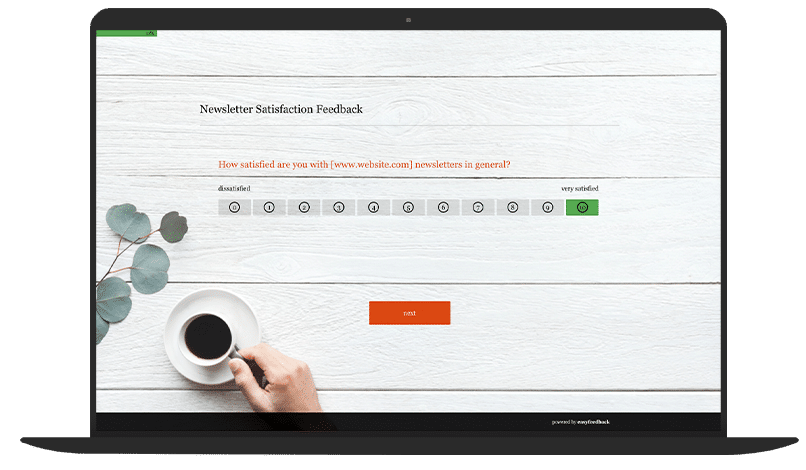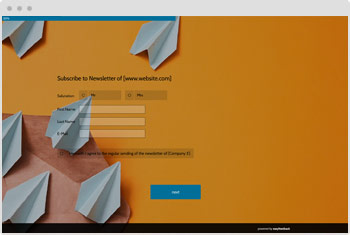

Improve your newsletter with feedback from your readers

Receive-feedback-on-newsletter-with-a-survey

With this ready-made survey template, you can improve the quality of your newsletter, strengthen customer loyalty, and attract new customers at the same time.

Immobilienscout 24 ist begeisterter easyfeedback Nutzer

“Identifying user needs is at the heart of our business. easyfeedback has been helping us with this task for several years now. We particularly appreciate its intuitive usability and professional support.”

Franziska Becker
Guild Lead User Experience Research
TUI ist begeisterter easyfeedback Nutzer

“We use easyfeedback for internal and external surveys—it’s fast, convenient, and easy! The uncomplicated and friendly support puts a smile on our faces, and we are delighted with the continuous development of the platform.”

Jennifer Fischer
Guest & Competitor Insights Analyst

Why is feedback on the newsletter important?

Feedback on your newsletter is extremely important because it provides valuable insights into what your subscribers really want.

When you understand which topics spark their interest and what they value most, you can tailor your newsletter content specifically to the needs of your target audience.

This not only improves the quality of your communication but also increases the relevance and appeal of your content for your readers.

Customer feedback also helps you identify and address errors or weaknesses, making your marketing strategies more effective.

By listening continuously, you can build a deeper connection with your subscribers, increase their satisfaction, and drive long-term revenue.

This way, both you and your customers benefit from a continuously improved newsletter experience.

Contents of the template:

  • How often does the customer want to receive a newsletter?
  • What does the customer read?
  • What bothers the customer?
  • General feedback

Objectives of the survey:

  • Create effective newsletters
  • Boost sales
  • Build customer loyalty
  • Strengthen your brand
  • Use newsletters as a communication tool
  • Optimize your newsletter marketing

Helpful features for the survey:

  • Survey options: Anonymous, partially anonymous, personalized
  • Invitation options: Link, email, QR code, and more
  • AI analysis of results, including recommendations for action
DSGVO-konforme Online-Umfragen

Data protection „made in Germany“ (GDPR)

Anonyme Teilnahme an Umfragen

Anonymity function for honest feedback

Frequently asked questions about the newsletter

A newsletter is a regularly published circular that is usually distributed via email to a specific audience.

For example, a newsletter may be aimed at a company’s customers or employees and sent at regular intervals, such as weekly or monthly, covering a specific topic or range of topics.

Since a newsletter is a flexible communication tool, it can be used in different ways depending on the objective:

For example, information about news and updates such as discount promotions, new product launches, or upcoming events can be targeted and distributed to customers.

However, it can also be used to communicate important company information to employees.

For example, internal company news or information about a planned employee survey can be communicated this way.

There are various types of newsletters, which can be categorized according to their purpose and content.

Here are some of the most common types:

1. Type: Regular newsletter

  • Company newsletter: Provides information about a company’s news, developments, and events.
  • Industry-specific newsletter: Focuses on news and trends in a specific industry.
  • Personal newsletter: Created by individuals, often bloggers or influencers, to communicate with their community.


2. Type: Promotional and sales newsletter

  • Promotional newsletter: Presents special offers, discounts, and promotions.
  • Product newsletter: Provides information about new products or services.


3. Type: Content-based newsletter

  • Blog or article newsletter: Contains summaries or links to new blog posts or articles.
  • Curated content newsletter: Collects and shares interesting content from the web on a specific topic.


4. Type: Event newsletter

  • Event newsletter: Provides information about upcoming events, webinars, conferences, or workshops.
  • Event recap: Reports on past events and provides recaps, photos, and videos.


5. Type: Internal newsletter

  • Employee newsletter: Is aimed at a company’s employees and provides information about internal news, changes, and achievements.


6. Type: Educational and training newsletter

  • Learning newsletter: Provides educational materials, tutorials, tips, and tricks on a specific topic or skill.
  • Training newsletter: Provides information about courses, seminars, and professional development opportunities.


7. Type: Customer support newsletter

  • Support updates: Informs customers about new support options, FAQs, guides, and solutions to common problems.


8. Type: Community newsletter

  • Community updates: Keeps community members informed about news, discussions, and activities within the group.


9. Type: Personalized newsletter

  • Individualized content: Based on the recipient’s interests and behavior to provide tailored content.


10. Type: Transactional newsletter

  • E-commerce updates: Sends order confirmations, shipping information, and other transaction-related information.

A newsletter is a flexible and cost-effective marketing tool that can be used very effectively for customer retention, as well as for acquiring new customers.

Due to its digital nature, a newsletter is not only a cost-effective method for distributing information to many people in a short period of time, but can also be sent without wastage to exactly those people who have subscribed to your newsletter.

Furthermore, the success of a newsletter can be measured very easily.

Key figures such as click-through rate, open rate, or unsubscribe rate tell you how successful your newsletter is.

When implemented correctly and filled with content that meets expectations, it can generate traffic to all important company pages and can therefore also contribute to increased sales.

By regularly providing your subscribers with high-quality information and drawing their attention to your products or services, you strengthen customer loyalty and increase the likelihood that they will become paying customers.

We have listed the other benefits of a newsletter below:

1. Advantage: Direct communication

  • Targeted messages: You can send specific messages directly to an interested target audience.
  • Personalization: Personalized content and offers tailored to the needs and interests of recipients.


2. Advantage: Cost efficiency

  • Low costs: Compared to traditional marketing methods such as print or TV advertising, email newsletters are more cost-effective.
  • High profitability: Due to their low costs and broad reach, newsletters can generate a high return on investment.


3. Advantage: Measurability

  • Analytics: Detailed analyses and reports allow you to measure the effectiveness of your campaigns (open rates, click-through rates, conversion rates, etc.).
  • Optimization: Based on the data, you can continuously improve your strategies and content.


4. Advantage: Increased customer retention

  • Regular interaction: Regular contact helps strengthen your relationship with customers and build their connection to your brand.
  • Building loyalty: Exclusive offers and relevant content promote customer loyalty.


5. Advantage: Expanding reach

  • Viral distribution: Subscribers can easily forward interesting content, which can lead to increased reach.
  • Lead generation: New prospects can be acquired through registration forms and recommendations.


6. Advantage: Flexibility

  • Versatility: Newsletters can contain a wide variety of content, from text and images to videos and links.
  • Scheduling: You can choose the delivery time to best suit your target audience.


7. Advantage: Building trust and authority

  • Expert status: By sharing valuable and informative content, you can position yourself as an expert in your industry.
  • Transparency: Regular updates and open communication help build trust in your company.


8. Advantage: Interactive opportunities

  • Engagement: Interactive elements such as surveys, feedback forms, or call-to-action buttons encourage reader engagement.
  • Community building: Engage readers by encouraging them to participate in discussions or events.


9. Advantage: Increased sales

  • Promotions and offers: Direct promotion of products and services can lead to increased sales.
  • Campaigns: Targeted marketing campaigns can highlight specific products or services and boost sales.


10. Advantage: Environmentally friendly

  • Digital distribution: Reduces the need for paper and physical shipping, making it more environmentally friendly.

This depends entirely on which marketing strategy you are pursuing and what function the newsletter is intended to serve.

Accordingly, the structure, content, and visual design of the newsletter should be aligned with its specific objective.

For example, if your goal is to strengthen customer loyalty and retain your customers over the long term, you can communicate not only information about promotions, offers, and discounts, but also inspiring and helpful content about the products and services you offer.

From time to time, you can also ask about your customers’ needs or satisfaction, for example by integrating a survey into the newsletter.

Another objective for using a newsletter could be the acquisition of new customers.

For example, if people have subscribed to your newsletter through other marketing activities but are not yet customers, you can use the newsletter to encourage them to make a purchase through attractive offers or compelling information and content.

Furthermore, a newsletter does not always have to pursue a monetary objective. It can also be used to increase brand awareness.

To achieve this, you can make the newsletter particularly interesting for your subscribers by providing valuable tips and tricks on a specific day of the week, for example tips on how to use the products you offer.

You can also use the newsletter for the strategic development of a brand or to enhance its reputation, for example by communicating insights into a company’s social responsibility.

As you can see, a newsletter can be used in many different ways and can therefore achieve a wide range of objectives.

At the beginning, ask yourself what role the newsletter should play in your marketing campaign, what the strategy should look like, and what specific goal the newsletter should contribute to achieving.

This is how you can make it successful.

Below, we have listed all the objectives of a newsletter:

1. Objective: Providing information

  • Updates and news: Regular information about new products, services, or developments within the company.
  • Industry news: Sharing relevant industry information and trends.


2. Objective: Customer retention

  • Engagement: Keep your target audience engaged and interested by providing valuable and interesting content.
  • Loyalty programs: Promote customer loyalty through exclusive offers, discounts, or invitations to events.


3. Objective: Marketing and promotion

  • Sales promotion: Promote special offers, new products, or services.
  • Brand awareness: Strengthen brand identity and perception through consistent communication and branding.


4. Objective: Education and training

  • Knowledge transfer: Provide educational content such as tutorials, guides, or webinars to further educate your target audience.
  • User enablement: Provide assistance and tips for using products or services more effectively.


5. Objective: Interaction and feedback

  • Two-way communication: Invite subscribers to participate in surveys or feedback sessions to better understand customer opinions and preferences.
  • Community building: Build a community by encouraging your subscribers to interact with one another and share their experiences.


6. Objective: Lead generation and nurturing

  • New customer acquisition: Attract new customers through targeted content and offers.
  • Lead nurturing: Nurture prospects by continuously providing relevant and useful information to gradually convert them into customers.


7. Objective: Building trust

  • Transparency and authenticity: Foster trust through transparent communication and authenticity.
  • Expert status: Establish yourself as an expert by sharing specialist knowledge and expertise in relevant areas.


8. Objective: Increasing sales

  • Cross-selling and upselling: Encourage additional sales through recommendations and personalized offers.
  • Campaign optimization: Analyze newsletter performance data to optimize future marketing campaigns and make them more targeted.

Here are some examples and ideas for newsletter content that can appeal to different goals and target audiences:

1. Idea: Company news

  • Current developments: Report on new partnerships, expansions, or internal milestones.
  • Employee introductions: Introduce new team members or highlight outstanding employee achievements.
  • Behind the scenes: Give insights into what goes on behind the scenes at your company.


2. Idea: Product updates

  • New product launches: Inform your subscribers about new products or services.
  • Product features: Detailed descriptions and benefits of new or updated products.
  • User reports: Customer testimonials or success stories.


3. Idea: Educational content

  • Guides and tutorials: Step-by-step guides or video tutorials for your products.
  • Industry knowledge: Articles or white papers on relevant topics in your industry.
  • Webinars and workshops: Announcements and invitations to educational webinars or workshops.


4. Idea: Exclusive offers

  • Discounts and vouchers: Exclusive discount codes or special offers for newsletter subscribers.
  • Pre-sale access: Early access to new products or events.
  • Contests: Participation in exclusive contests or prize draws.


5. Idea: Customer engagement

  • Surveys and feedback: Invite subscribers to participate in surveys to collect feedback on products or services.
  • Reader contributions: Share stories or images submitted by your subscribers.
  • Community news: Information about upcoming community events or projects.


6. Idea: Inspirational content

  • Success stories: Inspiring stories of customers who have successfully used your products.
  • Tips and tricks: Useful tips that improve or simplify your subscribers’ everyday lives.
  • Inspirational quotes: Share inspiring quotes or stories to motivate your readers.


7. Idea: Market research

  • Trend analysis: Reports on current trends in your industry and their impact.
  • Case studies: Detailed case studies on successful projects or products.
  • Expert interviews: Interviews with industry experts or thought leaders.


8. Idea: Interactive content

  • Quizzes and surveys: Interactive elements such as quizzes or short surveys.
  • Feedback forms: Easy-to-complete forms for collecting readers’ opinions.
  • Social media integration: Include social media links and encourage readers to share content.


9. Idea: Events and activities

  • Event announcements: Information about upcoming events, trade shows, or webinars.
  • Event recaps: Recaps and summaries of past events.
  • Virtual meetings: Invitations to online meetings or live streams.


10. Idea: Seasonal topics

  • Holiday greetings: Special newsletters for holidays or special occasions.
  • Seasonal tips: Seasonal tips and tricks, such as gardening tips in spring or health tips in winter.
  • Year-in-review: Summaries and highlights from the past year.


11. Idea: Multimedia content

  • Videos and podcasts: Embed videos or links to podcasts covering relevant topics.
  • Infographics: Visual representations of data or processes.
  • Photo galleries: Image galleries of events, products, or customer projects.

Every newsletter should always be tailored to the respective company and the goal you want to achieve with the newsletter.

Incorporate your corporate design and your company’s individual style, and use the newsletter to show who you are and what values you stand for.

Nevertheless, there are a few general aspects that you can use as a guide when structuring your newsletter.

We have summarized them for you below:

Sender and subject line

What do you see first when you receive an email?

That’s right, the sender and the subject line.

If the subject line sparks your interest, you open the email. This shows how significant an impact the subject line can have on the success or failure of your newsletter.

Accordingly, you should pay close attention to this component of the newsletter. Keep the subject line short and concise and spark your readers’ interest.

Also pay attention to your choice of words. Certain words can raise suspicions that the email contains fraudulent or dangerous content, causing it to automatically end up in the recipient’s spam folder.

The sender also plays an important role. An email with a personal sender or a clearly recognizable purpose ([newsletter@example.com](mailto:newsletter@example.com)) is more likely to be opened than a general address ([info@example.com](mailto:info@example.com)) or a less trustworthy-looking email address ([xyz34@example.com](mailto:xyz34@example.com)).

Personal greeting

A personal greeting contributes to strengthening customer loyalty.

It also makes the reader feel directly addressed and more inclined to continue reading.

Depending on the company culture, a casual greeting (Hey Tim) or a formal greeting (Dear Mr. Weber) may be appropriate.

The Why?

Now we come to the core of the newsletter and, therefore, the question of why it is being sent in the first place.

What do you want to achieve by sending the newsletter?

For example, your goal could be to generate more traffic to your website or increase your sales.

An incentive, such as a discount code, can help spark your readers’ interest and encourage them to continue reading.

Body text

The purpose of the body text is to positively influence the reader in order to achieve the aforementioned why.

Make sure that your text is not only visually appealing but, above all, engaging in terms of content. Meaningful headlines can help you structure your text.

Even if a newsletter consists of a series of emails, each email should be unique.

Therefore, avoid repetition and add variety.

For example, tell a personal story, give your readers an exclusive tip, or surprise them with added value, such as offering a free e-book download on a specific topic.

Call-to-action button

And now we come to the centerpiece of the newsletter: the call-to-action button.

Because what good is a great newsletter if it is read but the reader does not take any further action afterward?

Therefore, make sure that it is clearly visible and directs the reader where you want them to go.

Sign-off

Who is actually writing this?

End your newsletter with a friendly sign-off and your name.

A photo of yourself helps create a personal connection. This way, your readers have a visual impression of you and know who they can contact.

Footer

There are several legal aspects to consider in the footer. Among other things, you are required to provide a link to your legal notice or provide your address and appropriate contact details.

You must also give recipients the option to unsubscribe from the newsletter easily.

In addition, you need to provide a link to your privacy policy.

The footer can also include your company logo or a link to your homepage.

Newsletter marketing is an effective way to stay in touch with a target audience, promote customer engagement, and achieve business goals.

Here are some strategies and best practices for successful newsletter marketing:

1. Strategy: Goal Setting and Strategy Development


2. Strategy: Creating Valuable Content

  • Relevant information: Provide content that is useful and interesting to your target audience, such as industry news, tips, and guides.
  • Varied formats: Use different formats such as articles, videos, infographics, and interactive elements to keep readers engaged.
  • Personalization: Tailor content to the individual interests and behaviors of recipients.


3. Strategy: Design and User Experience

  • Visual appeal: An appealing design and clear structure improve readability and engagement.
  • Mobile-friendliness: Make sure your newsletter is easy to read on mobile devices, as many users open emails on their smartphones.
  • Easy navigation: Use clear calls to action (CTAs) and an intuitive layout structure.


4. Strategy: Sign-Up Process and List Management

  • Simple sign-up process: Make signing up for your newsletter easy and straightforward.
  • Double opt-in: Use a double opt-in process to ensure that recipients are genuinely interested and have subscribed voluntarily.
  • Create segments: Divide your subscribers into different segments to send more targeted and relevant content.


5. Strategy: Sending and Timing

  • Regular distribution: Establish a consistent sending frequency, e.g. weekly or monthly.
  • Optimal timing: Test different sending times to find out when your target audience is most likely to open and read your emails.


6. Strategy: Analysis and Optimization

  • Monitor key performance indicators: Track important metrics such as open rates, click-through rates, and conversion rates.
  • A/B testing: Conduct A/B tests to determine which subject lines, content, and designs perform best.
  • Collect reader feedback: Use surveys or direct feedback options to gather opinions and suggestions from your subscribers.


7. Strategy: Legal Aspects

  • Data protection: Make sure you comply with data protection laws (e.g. GDPR) by handling subscriber data transparently.
  • Unsubscribe option: Provide an easy way to unsubscribe from the newsletter and respect this decision.


8. Strategy: Integration with Other Marketing Channels

  • Cross-promotion: Promote your newsletter on your website, social media, and through other marketing channels.
  • Content recycling: Repurpose newsletter content in other formats, e.g. as blog posts or social media updates.


Examples of Successful Newsletter Marketing Strategies:

  • Welcome series:
    Send a series of emails to new subscribers to welcome them, introduce your company, and provide them with useful information.


  • Exclusive content:
    Offer your subscribers exclusive content that is only available through the newsletter, such as special offers or insider tips.


  • Event-based emails:
    Send emails based on specific events, such as birthday offers, anniversaries, or abandoned cart reminders.


  • Storytelling:
    Use storytelling to build emotional connections with your readers and make your brand more relatable.

Good question!

What works is what resonates with your readers.

What works for one company may not necessarily work for another.

The content should reach your readers, inspire them, and make them look forward to more.

How can you achieve this?

Put yourself in your readers’ shoes.

What is interesting to them, and how can you support them? What topics or problems are they dealing with?

In addition to the content, you should also pay attention to external factors when designing your newsletter, such as correct spelling and an appealing visual design.

Text with little spacing between lines can quickly appear cramped and overloaded. Make sure not to use too much text and focus on the essentials.

Colors and images can have a strong impact and can even convey moods.

But technical aspects should also be taken into account.

The newsletter should display properly on both PCs and mobile devices.

All links should work and lead readers to the intended destination.

Characteristics of a Successful Newsletter

1. Characteristic: Relevant and Valuable Content

  • User-focused content: Make sure the information is relevant and useful to your target audience.
  • Varied topics: Offer a mix of news, tips, guides, and entertaining content.


2. Characteristic: Appealing Design

  • Visual appeal: Use a clear, appealing design with sufficient white space to improve readability.
  • Brand consistency: Use your brand colors, fonts, and logos to increase brand recognition.
  • Responsive design: Make sure the newsletter is easy to read on all devices, especially mobile devices.


3. Characteristic: Clear Layout and Structure

  • Clarity: Use clear headings, paragraphs, and bullet points to structure the text.
  • Short sections: Keep texts short and concise to maintain readers’ attention.


4. Characteristic: Personalization

  • Personalized approach: Use the recipient’s name and tailor the content to their interests.
  • Segmentation: Divide your subscribers into different groups to send more targeted and relevant content.


5. Characteristic: Engaging Calls to Action (CTAs)

  • Clear calls to action: Use eye-catching and clear CTAs that encourage the reader to take a specific action.
  • Provide added value: Make sure the CTA offers a clear benefit to the reader, such as exclusive offers or additional information.


6. Characteristic: Regular Distribution

  • Consistent frequency: Send the newsletter at regular intervals to ensure continuous communication.
  • Optimal timing: Find the best time to send the newsletter based on the habits of your target audience.


7. Characteristic: Interactive Elements

  • Encourage engagement: Integrate interactive elements such as surveys, quizzes, or social media links to engage readers.
  • Collect feedback: Provide simple ways for readers to give feedback or participate in discussions.


8. Characteristic: Valuable Incentives

  • Exclusive content: Offer your subscribers exclusive information, discounts, or early access to new products.
  • Personalized offers: Use your subscribers’ data to create personalized and relevant offers.


9. Characteristic: Transparency and Authenticity

  • Honest communication: Be transparent and authentic in your communication to build trust.
  • Clear unsubscribe option: Provide an easy way to unsubscribe from the newsletter and respect this decision.


10. Characteristic: Analysis and Optimization

  • Monitor key performance indicators: Track important metrics such as open rates, click-through rates, and conversion rates.
  • Continuous improvement: Use the data collected to continuously optimize your newsletter and adapt it to your readers’ needs.


What Makes a Newsletter Successful?

A newsletter should encourage interaction with the reader.

A newsletter is considered “successful” when it motivates the reader to take action.

We have outlined three potential goals below:

1. Goal: The Email Is Opened

The first important measure of newsletter success is that the email is actually opened.

If you achieve this, you are already halfway there.

2. Goal: The Newsletter Is Read

Another important factor is that the content interests the reader and they read the newsletter rather than immediately unsubscribing.

Ideally, the reader gains something valuable from it and remains receptive to future emails.

3. Goal: The Reader Clicks the Call-to-Action Button

You have achieved your goal.

The reader takes action and follows the path you have provided, for example, to a blog article on your website or to an offer in your online store.

The effectiveness of newsletters depends on several factors, including the quality of the content, the way the target audience is addressed, the design, and the frequency of distribution.

Here are some reasons why newsletters are considered effective, as well as some metrics for evaluating their effectiveness:

1. Reason: Targeted Communication

  • Personalization: By using personalization techniques, newsletters can deliver tailored content that is adapted to the individual interests and needs of recipients.
  • Segmentation: Target audience segmentation makes it possible to address specific groups with relevant content, increasing relevance and engagement.


2. Reason: High Reach and Engagement

  • Direct communication: Newsletters are delivered directly to recipients’ inboxes, increasing the likelihood of visibility and interaction.
  • Interactive content: Newsletters can contain interactive elements such as surveys, videos, and call-to-actions that encourage engagement.


3. Reason: Measurable Results

  • Tracking and analytics: Using analytics tools, open rates, click-through rates, and conversion rates can be measured to evaluate and optimize effectiveness.
  • A/B testing: By testing different versions of a newsletter, the most effective content and designs can be identified.


4. Reason: Cost Efficiency

  • Low costs: Compared to other marketing channels such as print advertising or TV advertising, newsletters are cost-effective and offer a good cost-benefit ratio.
  • High ROI: Well-executed newsletter campaigns can generate a high return on investment, particularly when they lead to direct sales or lead generation.


Metrics for Evaluating Effectiveness

1. Metric: Open Rate

The open rate indicates how many recipients have opened the newsletter.

A high open rate indicates interest in and relevance of the newsletter.

2. Metric: Click-Through Rate (CTR)

The click-through rate measures how many recipients have clicked on links in the newsletter.

A high click-through rate shows that the content is appealing and motivates recipients to take action.

3. Metric: Conversion Rate

The conversion rate shows how many recipients have completed a desired action, such as making a purchase or filling out a form.

It is a direct indicator of the newsletter’s success in relation to the defined goals.

4. Metric: Unsubscribe Rate

The unsubscribe rate shows how many recipients have unsubscribed from the newsletter.

A low unsubscribe rate indicates that the newsletter is relevant and useful to most recipients.

5. Metric: Bounce Rate

The bounce rate measures how many newsletters could not be delivered.

A low bounce rate indicates that the recipient list is up to date and well maintained.

An appealing and effective newsletter design is crucial for capturing and maintaining your readers’ attention.

Here are some tips for creating a successful newsletter design:

1. Tip: Clear and Simple Layout

  • Clarity: Use a clean and well-organized layout that structures the content effectively.
  • Highlighting: Visually emphasize important information such as headings and call-to-actions (CTAs).


2. Tip: Responsive Design

  • Mobile-friendly: Make sure your newsletter is easy to read on all devices, especially mobile devices.
  • Flexible layout: Use flexible layouts and images that adapt to different screen sizes.


3. Tip: Visual Hierarchy

  • Prioritization: Use a visual hierarchy to highlight the most important information.
  • Sizes and colors: Use different font sizes and colors to direct attention.


4. Tip: Consistent Branding

  • Brand consistency: Use your brand colors, fonts, and logos to increase brand recognition.
  • Style consistency: Make sure the newsletter follows your company’s corporate design.


5. Tip: Appealing Graphics and Images

  • Quality: Use high-resolution images and graphics that match the content.
  • Use images thoughtfully: Place images strategically to break up the text and create visual appeal.


6. Tip: Readable Typography

  • Font and size: Choose easy-to-read fonts and an appropriate font size.
  • Contrast: Ensure sufficient contrast between the text and background to guarantee readability.


7. Tip: Clear Call-to-Actions (CTAs)

  • Clarity: Make CTAs eye-catching and unambiguous so readers know what action to take.
  • Positioning: Place CTAs in prominent locations, e.g. at the end of a section or in the header.


8. Tip: Short and Concise Texts

  • Short content: Keep your text brief and get to the point quickly.
  • Paragraphs and lists: Use paragraphs, bullet points, and subheadings to structure the text.


9. Tip: Interactive Elements

  • Links and buttons: Add clickable links and buttons to encourage readers to interact.
  • Multimedia: Integrate videos, GIFs, or social media links to make the newsletter more engaging.


10. Tip: Test and Optimize

  • A/B testing: Experiment with different designs and content to find out what works best.
  • Feedback: Regularly collect feedback from your readers and adjust the design accordingly.


Examples of Effective Newsletter Design:

1. Minimalist Design:
Use plenty of white space to present content clearly and with focus.

2. Image-Focused Design:
Use large images and visual storytelling techniques to evoke emotions.

3. Modular Layout:
Design the newsletter using clearly defined modules or sections that are easy to scan.


More customer survey templates

Newsletter Registration Form Survey Template

Newsletter Subscription

Survey template details

Survey-Template-Measure Customer Satisfaction

Customer Satisfaction

Survey template details

Survey Template: Needs Analysis

Customer Needs Analysis

Survey template details

Readership Questionnaire Template

Readership Satisfaction

Survey template details

Survey Template Member Questionnaire

Member Satisfaction

Survey template details

Explore all survey templates  

You are in professional company

Immoscout 24 Logo
Tui Logo
Porsche Logo
Lufthansa Logo
Jaegermeister Logo

Over 740,000 participants in easyfeedback surveys every month

Result

STUDIO

The performance add-on for your analysis

easyfeedback Result Studio 2