
Assess your suppliers' suitability in advance with a survey

Evaluate the suitability of your suppliers in advance with a survey

Use our survey template to comprehensively evaluate potential or existing suppliers. Assess key criteria such as quality, reliability, and customer service to make informed decisions and build long-term partnerships with the best suppliers.

Immobilienscout 24 ist begeisterter easyfeedback Nutzer

“Identifying user needs is at the heart of our business. easyfeedback has been helping us with this task for several years now. We particularly appreciate its intuitive usability and professional support.”

Franziska Becker
Guild Lead User Experience Research
TUI ist begeisterter easyfeedback Nutzer

“We use easyfeedback for internal and external surveys—it’s fast, convenient, and easy! The uncomplicated and friendly support puts a smile on our faces, and we are delighted with the continuous development of the platform.”

Jennifer Fischer
Guest & Competitor Insights Analyst

Why conduct a supplier self-assessment?

Conducting a supplier self-assessment enables companies to gather valuable information about their potential or existing suppliers.

This information is crucial for evaluating the quality and reliability of suppliers and identifying risks early on.

It ensures that suppliers comply with internal and legal requirements.

At the same time, companies can gather data on key aspects such as financial stability, delivery times, quality management, sustainability, and ethical business practices.

This information enables well-informed decisions that ensure a stable and efficient supply chain.

Furthermore, vulnerabilities and potential risks can be proactively addressed, thereby preventing disruptions in the supply process.

In addition, the self-disclosure enhances transparency in the partnership and fosters a trusting business relationship.

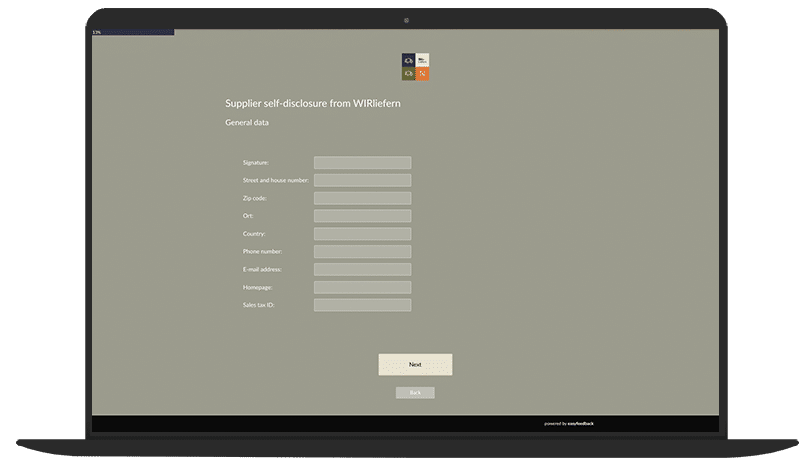
Contents of the template:

  • Request general information
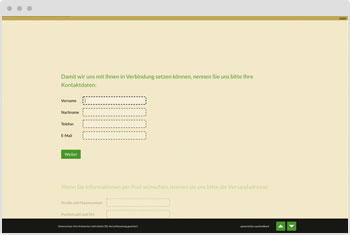
  • Request contact information for the responsible representative
  • Questions about the company and product
  • Information on policies, code of conduct, and certifications

Objectives of the survey:

  • Ensuring supplier quality standards
  • Identifying and assessing potential risks
  • Gathering information to support decision-making
  • Assessing delivery capacity in terms of quantity and timing
  • Evaluating environmental and social responsibility
  • Building long-term, trusting partnerships

Helpful features for the survey:

  • Survey options: Anonymous, partially anonymous, personalized
  • Invitation options: Link, email, QR code, and more
  • AI analysis of results, including recommendations for action
DSGVO-konforme Online-Umfragen

Data protection „made in Germany“ (GDPR)

Anonyme Teilnahme an Umfragen

Anonymity function for honest feedback

Frequently asked questions about supplier self-disclosure

A supplier self-assessment is a key tool in supplier management and strategic procurement.

It is a standardized document or structured questionnaire that suppliers complete to provide a company with detailed information about themselves.

The aim is to create transparency regarding the supplier’s capabilities, standards, and operating conditions.

This self-assessment often forms the basis for the initial evaluation of a potential partner—both during supplier selection and in regular requalification processes for existing supplier relationships.

A supplier self-assessment serves several important purposes for companies that work with suppliers.

Here are the main reasons why such a self-assessment is conducted:


1. Reason: Quality assurance

A supplier self-assessment enables companies to ensure that their suppliers comply with the required quality standards.

This includes reviewing certifications, quality management systems, and quality assurance procedures.

This helps ensure that the products or services supplied meet expectations and requirements.


2. Reason: Risk mitigation

The self-assessment helps identify and assess potential risks that may be associated with working with a supplier.

These include financial risks, such as the supplier’s creditworthiness, as well as operational and logistical risks.

By identifying such risks at an early stage, companies can take measures to minimize or avoid them.


3. Reason: Compliance and legal requirements

The self-assessment ensures that suppliers meet legal and regulatory requirements.

This includes compliance with environmental regulations, labor laws, and other relevant requirements.

It helps companies prevent legal issues and potential penalties while ensuring ethically sound procurement.


4. Reason: Transparency and trust

By collecting detailed information, the self-assessment creates transparency in the supplier relationship.

This promotes trust between companies and suppliers and enables open and honest collaboration.

Transparency is particularly important for long-term business relationships and for ensuring reliability and integrity.


5. Reason: Increased efficiency

A well-structured self-assessment can make the supplier selection and evaluation process more efficient.

By systematically collecting relevant information, companies can make informed decisions and select the best suppliers.

This contributes to optimizing the supply chain and improving overall performance.


6. Reason: Sustainability and social responsibility

The self-assessment enables companies to evaluate their suppliers’ sustainable practices and social responsibilities.

This is particularly important for companies that value environmentally friendly and ethically responsible business practices.

By considering sustainability and social criteria, companies can ensure that their suppliers align with their values and policies.

A supplier self-assessment is an important tool that companies use to obtain the most comprehensive and transparent picture possible of their potential or existing suppliers.

By systematically collecting relevant data, it enables a well-founded assessment of the supplier’s performance, reliability, and trustworthiness—an indispensable basis for sustainable business relationships.

Here are the typical contents of a supplier self-assessment:

General company information

  • Company name and legal form
  • Address and contact information
  • Year of establishment and company history
  • Corporate structure and subsidiaries
  • Contact persons and contact details


Financial data

  • Annual financial statements from recent years
  • Proof of creditworthiness and credit checks
  • Information on financial stability and liquidity


Quality management

  • Certifications, such as ISO 9001
  • Quality assurance processes and procedures
  • Documentation and traceability of quality measures
  • Sustainability and social responsibility
  • Environmental certifications, such as ISO 14001


Sustainability initiatives and practices

  • Compliance with environmental laws and regulations
  • Social responsibility and labor standards
  • Code of ethics and anti-corruption policies


Supply chain and logistics

  • Production capacities and locations
  • Delivery times and reliability
  • Logistics processes and transport methods
  • Warehouse capacities and inventory management


Risk management

  • Risk assessment and management strategies
  • Emergency and business continuity plans
  • Proof of insurance


References and experience

  • List of key customers and business partners
  • Industry experience and successfully completed projects
  • Customer satisfaction reports and reference letters


Legal and regulatory information

  • Compliance with legal and regulatory requirements
  • Patents and intellectual property
  • Legal disputes or pending proceedings


Technological capabilities

  • Innovation and research & development
  • Technical equipment and capabilities
  • Software and IT infrastructure


Other specific requirements

  • Industry- or company-specific requirements
  • Additional information or documents requested by the client

The requirement to conduct a supplier self-assessment arises from various legal, regulatory, and business requirements.

These requirements ensure that companies work with suppliers that meet the necessary standards and that risks are minimized.

Here are the main reasons why a supplier self-assessment may be mandatory or advisable:

1. Reason: Legal and regulatory requirements

In many industries and countries, there are legal requirements and regulations that oblige companies to obtain information about their suppliers.

These requirements may relate to aspects such as:

  • Compliance: Ensuring compliance with laws and regulations, such as labor law, environmental laws, or anti-corruption laws.
  • Safety and quality: Compliance with specific standards and requirements that ensure product safety and quality.


2. Reason: Risk management

A supplier self-assessment helps identify and assess potential risks before entering into a business relationship.

Risks that can be addressed through a self-assessment include:

  • Quality risks: Avoiding problems caused by insufficient quality controls or quality management practices.
  • Supply chain risks: Identifying weaknesses in the supply chain that could lead to delivery shortages or disruptions.


3. Reason: Contractual obligations

Companies may have contractual obligations that require suppliers to provide a self-assessment.

These obligations may arise from:

  • Contracts and agreements: Requirements in contracts or agreements that mandate transparency and the review of supplier performance.
  • Customer requirements: Requirements from customers or partners that require companies to ensure their suppliers meet certain standards.


4. Reason: Quality and environmental management

For companies that have implemented quality management systems, such as ISO 9001, or environmental management systems, such as ISO 14001, supplier assessment is an important part of:

  • Maintaining certifications: Ensuring that all parts of the supply chain comply with established quality and environmental standards.
  • Continuous improvement: Continuously improving the quality and sustainability of products or services.


5. Reason: Ethics and social responsibility

Many companies place great importance on ethical business practices and social responsibility.

A self-assessment can help ensure that:

  • Ethical standards: Suppliers comply with ethical standards, for example regarding working conditions or environmental responsibility.
  • Social responsibility: The company fulfills its social and ethical obligations by working with responsible suppliers.


6. Reason: Competitiveness

A comprehensive understanding of suppliers through self-assessments can also help companies remain competitive by enabling them to:

  • Optimize costs: Optimize processes and select the best suppliers to reduce costs.
  • Strengthen market position: Ensure supplier quality in order to maintain a good reputation and a strong market position.

A sustainability-focused supplier self-assessment helps companies ensure that their suppliers follow environmentally friendly and socially responsible practices.

Here are the key aspects that should be covered in such a self-assessment:

1. Aspect: Environmental management

  • Certificates and standards: Questions about existing environmental certifications, such as ISO 14001 or EMAS, that demonstrate compliance with environmental standards.
  • Waste management: Information on waste separation, recycling strategies, and waste minimization.
  • Energy consumption: Data on energy consumption, the use of renewable energy, and energy efficiency measures.
  • Resource use: Approaches to reducing the use of raw materials and water, as well as promoting sustainable materials.


2. Aspect: Ethical labor practices

  • Working conditions: Information on working hours, compensation, and workplace safety.
  • Workers’ rights: Compliance with international labor standards and laws, including the avoidance of child labor and forced labor.
  • Diversity and inclusion: Practices that promote diversity and equal opportunities in the workplace.


3. Aspect: Supply chain and sourcing

  • Sustainable sourcing: Policies and procedures for sourcing raw materials from sustainable sources.
  • Supplier evaluation: Reviewing whether the supplier’s own suppliers also comply with environmental and ethical standards.
  • Transparency: Disclosure of the supply chain and the origin of materials.


4. Aspect: Product lifecycle

  • Product design: Measures for developing products that are more environmentally friendly or have a longer lifespan.
  • Disposal: Strategies for environmentally responsible disposal or recycling of products at the end of their lifecycle.


5. Aspect: Community engagement

  • Nonprofit initiatives: Participation in or support for social and environmental projects and initiatives.
  • Community engagement: Measures to positively impact the community and support local initiatives.


6. Aspect: Reporting and transparency

  • Sustainability reports: Preparation and publication of sustainability reports documenting progress and challenges in the area of sustainability.
  • Goal tracking: Setting and tracking specific sustainability goals and measures.

A supplier self-assessment for quality management aims to collect information about a supplier’s quality assurance and quality management processes.

This helps companies ensure that their suppliers deliver products or services of high quality and comply with agreed standards.

Here are the key aspects that should be included in a supplier self-assessment for quality management:

1. Aspect: Quality management systems and certificates

  • Certifications: Information about relevant certifications such as ISO 9001 for quality management, ISO 14001 for environmental management, or specific industry standards.
  • Quality management system (QMS): Description of the implemented quality management system and its underlying principles and standards.


2. Aspect: Quality assurance processes

  • Quality controls: Details of the methods and processes used to inspect quality during production or service delivery.
  • Error prevention: Approaches and technologies for preventing errors and continuously improving quality.


3. Aspect: Documentation and traceability

  • Documentation system: Information on how quality documents are created, maintained, and archived.
  • Traceability: Procedures for tracing products or services back to the raw materials and processes used.


4. Aspect: Complaint management and claims

  • Claims handling procedure: Description of the processes for handling and resolving customer claims or complaints.
  • Corrective and preventive actions: Documentation of measures for correcting and preventing quality issues.


5. Aspect: Supplier selection and evaluation

  • Criteria for supplier selection: Information about the criteria and processes used to select and evaluate suppliers.
  • Supplier audits: Procedures for regularly reviewing and assessing supplier quality.


6. Aspect: Training and qualifications

  • Employee training: Information about training programs and employee qualifications in the area of quality management.
  • Professional development: Measures for the continuous development and improvement of employees’ skills.


7. Aspect: Product development and design

  • Development processes: Details of the processes and methods used in product development and design to ensure quality.
  • Design control: Procedures for reviewing and ensuring the quality of product designs.


8. Aspect: Inspection and testing methods

  • Testing procedures: Information about the inspection and testing methods used to ensure compliance with quality standards.
  • Test reports: Documentation of test results and their impact on product quality.


9. Aspect: Quality risk management

  • Risk assessment: Methods for identifying and assessing risks that could affect the quality of products or services.
  • Contingency plans: Strategies for addressing quality issues and ensuring the continuity of quality assurance.

More form and questionnaire templates​

Supplier Questionnaire Survey Template

Supplier Feedback

Survey template details

Survey Template: Generate Leads

Lead Generation

Survey template details

Survey Template: Contact Form

Contact Form

Survey template details

Requirement Analysis Questionnaire Template

Requirements Analysis

Survey template details

Survey Template: Product Claim

Product Complaint

Survey template details

Explore all survey templates  

You are in professional company

Immoscout 24 Logo
Tui Logo
Porsche Logo
Lufthansa Logo
Jaegermeister Logo

Over 740,000 participants in easyfeedback surveys every month

Result

STUDIO

The performance add-on for your analysis

easyfeedback Result Studio 2