

“Identifying user needs is at the heart of our business. easyfeedback has been helping us with this task for several years now. We particularly appreciate its intuitive usability and professional support.”

“We use easyfeedback for internal and external surveys—it’s fast, convenient, and easy! The uncomplicated and friendly support puts a smile on our faces, and we are delighted with the continuous development of the platform.”
Imagine building a house without a blueprint — you might end up missing a door, or the kitchen might be much too small.
That’s exactly what happens with projects that lack a thorough requirements analysis: the resulting solutions don’t meet actual needs and are often difficult to use.
The analysis itself functions like a map that shows you the way, highlights obstacles, and defines the necessary resources.
Surveys act as a compass, providing direct feedback and uncovering hidden expectations.
They help ensure that the project isn’t developed without addressing people’s actual needs.
Through a thorough analysis, you identify requirements from the very beginning and can incorporate them into the solution.
The result is not a haphazard construct, but a tailored, functional solution that truly fits and meets expectations.
Contents of the template:
Objectives of the survey:
Helpful features for the survey:

Data protection „made in Germany“ (GDPR)

Anonymity function for honest feedback
Requirements analysis is a structured and essential process within system, software, or product development.
Its aim is to precisely capture, document, and manage the expectations and needs of all relevant stakeholders involved in the requirements analysis—such as customers, users, or developers—throughout the entire project lifecycle.
A thoroughly conducted requirements analysis provides clarity, reduces the risk of misunderstandings, and forms the foundation for successful, targeted implementation.
It ensures that all parties involved pursue the same objectives from the outset.
Objectives of requirements analysis
Types of requirements
1. Type: Functional requirements
Describe what the system should do, for example: “The system must enable user logins.”
2. Type: Non-functional requirements
Define how well the system should perform, for example: “The response time must not exceed two seconds.”
3. Type: Constraints
Limitations or specifications, such as legal regulations or technological standards.
Phases of requirements analysis
1. Phase: Requirements elicitation
In this phase, information is collected—for example, through interviews, workshops, questionnaires, or the analysis of existing documents. The aim is to gain a comprehensive understanding of the expectations of all involved parties.
2. Phase: Requirements documentation
The collected requirements are documented clearly and systematically, for example in the form of a requirements specification or functional specification. This creates a binding basis for development.
3. Phase: Requirements review and validation
Requirements are checked for completeness, consistency, feasibility, and relevance. Only validated requirements are incorporated into further planning.
4. Phase: Requirements management
Throughout the project lifecycle, requirements must be maintained, adapted, and managed in a traceable manner—particularly when the project scope changes or new insights arise.
Stakeholders are all individuals or groups that are directly or indirectly affected by the development of a system or product.
They play a central role in requirements analysis, as they define, evaluate, and prioritize requirements.
Stakeholder categories
Primary stakeholders – Direct users of the system or product
Secondary stakeholders – Indirectly involved parties with influence on the project
External stakeholders – Individuals or institutions outside the company
Importance of stakeholders in requirements analysis
Methods for involving stakeholders
Requirements analysis is a crucial step in software and systems development for capturing and documenting stakeholders’ needs.
There are various requirements analysis methods that can be used depending on the project scope, participants, and context.
Here are some of the most important methods:
1. Method: Surveys
2. Method: Observation techniques
3. Method: Document analysis
4. Method: Workshops
5. Method: Prototyping
6. Method: Use case analysis
7. Method: Brainstorming
8. Method: Mind mapping
9. Method: User stories & storyboarding
10. Method: SWOT analysis
1. Point: Introduction
Objective of the requirements analysis:
Project context & background:
Stakeholder analysis:
2. Point: System overview & constraints
General description of the system:
3. Point: Requirements
3.1 Functional requirements
Example:
3.2 Non-functional requirements
Quality requirements such as:
3.3 Operational requirements & interfaces
4. Point: Prioritization & dependencies
5. Point: Validation & verification
6. Point: Change management & versioning
Requirements analysis is a central component of every development project.
It ensures that the system or product being developed meets the actual needs of stakeholders.
The process can be divided into four main phases, which build on one another and can be repeated iteratively.
Step 1: Requirements elicitation
Step 2: Requirements documentation
Step 3: Requirements review and validation
Step 4: Requirements management
Functional requirements
Functional requirements define the functions and features that a system must provide. They describe which tasks the system should perform.
Examples of functional requirements:
Characteristics:
Non-functional requirements
Non-functional requirements define the system’s characteristics and quality criteria. They influence usability, performance, security, and other aspects of the software.
Examples of non-functional requirements:
Characteristics:
easyfeedback is a survey tool that can support your requirements analysis in various ways, particularly when gathering requirements and evaluating stakeholder opinions.
Here are some specific ways easyfeedback can support your requirements analysis:
1. Option: Gathering requirements through surveys
With easyfeedback, you can quickly and easily create surveys to collect stakeholders’ requirements.
You can use different question types, such as open-ended questions, multiple-choice questions, or rating scale questions.
By asking targeted questions about specific functions, you gain a clear understanding of the system’s functional requirements.
In addition, surveys enable direct feedback from future users, allowing you to find out which functions they expect and which are most important for their work.
Possible example questions include:
“What functions would you need in new software for your team?” or “Which features would make your work easier?”
2. Option: Prioritizing requirements
With easyfeedback, you can create surveys to prioritize requirements by having stakeholders or users assess different aspects according to their importance or urgency.
Targeted questions such as “How important is this feature to you?” and “How easy is this feature to implement?” help organize requirements according to both relevance and feasibility.
This provides a well-founded basis for decisions about further developing the system.
One example would be assessing the importance of offline functionality by asking:
“How important is it that the application provides offline functionality?” as well as assessing feasibility with: “How difficult is it to integrate this feature into the system?”
3. Option: Feedback during the development process
During development, you can use regular surveys to gather stakeholder feedback and check whether the collected requirements meet their expectations and whether adjustments or additions are necessary.
It is useful to present early prototypes or mock-ups and specifically ask for feedback.
This enables you to ensure that the system meets requirements before development progresses further.
4. Option: Understanding user needs
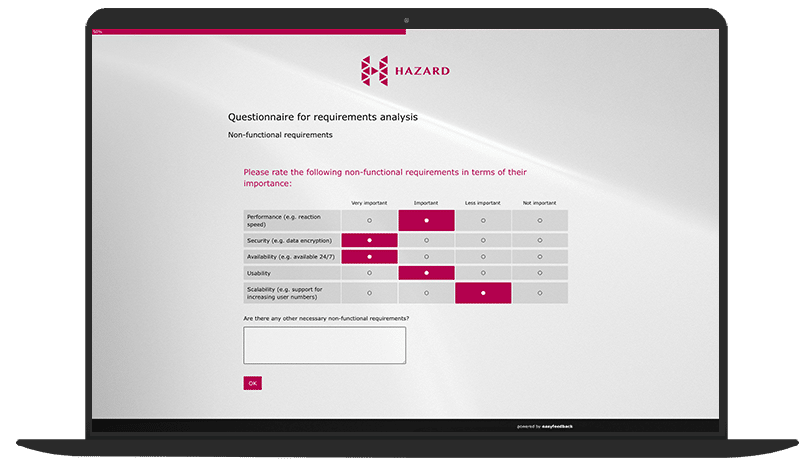
Use surveys to learn more about non-functional requirements, such as performance, security, usability, and more.
You can ask questions such as:
“How important is it to you that the app responds quickly?” or “Which security features do you require?”
5. Option: Documentation and analysis
easyfeedback enables simple, user-friendly, AI-supported evaluation of survey results, allowing you to quickly analyze and categorize responses and systematically organize them by priority.
Visual reports clearly present the collected requirements, making documentation easier to understand.