

“Identifying user needs is at the heart of our business. easyfeedback has been helping us with this task for several years now. We particularly appreciate its intuitive usability and professional support.”

“We use easyfeedback for internal and external surveys—it’s fast, convenient, and easy! The uncomplicated and friendly support puts a smile on our faces, and we are delighted with the continuous development of the platform.”
Since 2019, companies in the EU with more than 50 employees, those in the financial services sector, or public employers have been required to establish an internal whistleblower system for reporting violations and misconduct.
This system can be provided in writing, by phone, in person, via an (online) form, or through a specialized portal.
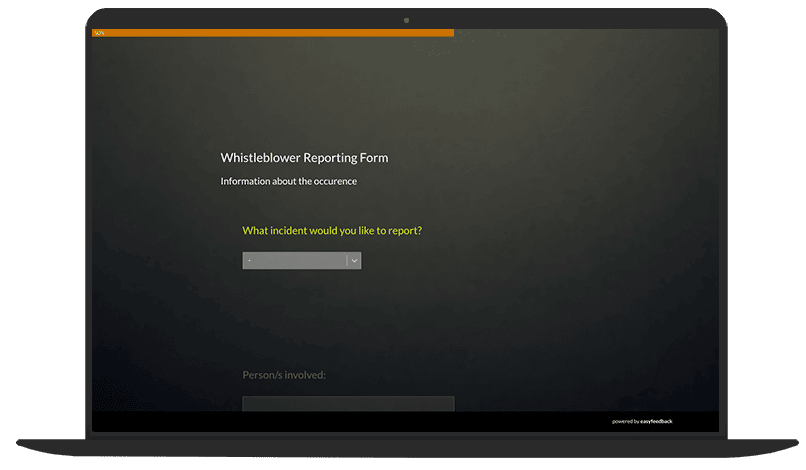
With our privacy-compliant form template, you can easily and efficiently implement EU guidelines regarding the establishment of a whistleblower system.
Sign up for easyfeedback, customize the template to your requirements, and place the whistleblower form flexibly wherever it is needed.
Enable whistleblowers to report violations and misconduct to you quickly, easily, and anonymously. This promotes transparency and strengthens trust in your company.
Contents of the template:
Objectives of the survey:
Helpful features for the survey:

Data protection „made in Germany“ (GDPR)

Anonymity function for honest feedback
A whistleblower is a person who reports violations and misconduct to a public authority or company before negative consequences occur.
Typical cases of misconduct related to whistleblowing include corruption and bribery, violations of laws and policies, criminal offenses, discrimination, workplace harassment, and more.
The most well-known examples of whistleblowing are Edward Snowden and WikiLeaks founder Julian Paul Assange.
What does a whistleblower do?
A whistleblower is a person who exposes misconduct, illegal actions, or unethical behavior within an organization.
This person informs either internal bodies or the public about violations, such as corruption, fraud, or risks to the public.
Whistleblowers often act out of moral or legal convictions to create transparency and stop wrongdoing, even when doing so involves personal or professional risks.
Why are whistleblowers important?
Whistleblowers are important because they often help uncover misconduct, corruption, or illegal activities that might otherwise remain unnoticed.
They promote transparency and accountability in companies and organizations and protect the public from potential harm, such as environmental pollution, health risks, or financial fraud.
Through their actions, they can initiate reforms, restore trust in institutions, and ensure the protection of human rights and legal requirements.
Whistleblowers are individuals who, out of moral conviction or a sense of responsibility, expose misconduct, illegal behavior, or threats to the public—often at considerable personal risk.
Their disclosures have made headlines around the world and sparked social and political debate.
Here are some of the best-known cases:
1. Example: Edward Snowden (2013)
A former NSA employee who revealed extensive surveillance programs operated by the United States and other countries.
He exposed that millions of people around the world were being monitored by government intelligence agencies.
2. Example: Chelsea Manning (2010)
A U.S. soldier who passed classified military documents and diplomatic cables to WikiLeaks.
These documents revealed war crimes and misconduct by the United States in Iraq and Afghanistan.
3. Example: Frances Haugen (2021)
A former Facebook employee who published internal documents and revealed that the company knew how harmful its platforms could be to society—particularly to young people—but did not respond appropriately.
4. Example: Jeffrey Wigand (1996)
A former tobacco company executive who made public that tobacco companies knowingly used harmful substances in cigarettes and concealed their addictive nature.
5. Example: Mark Felt (1970s)
Known as “Deep Throat,” he helped expose the Watergate scandal, which led to the resignation of U.S. President Richard Nixon.
These examples show how courageous individuals have helped expose serious misconduct in government, the military, business, and technology.
Despite considerable personal risks, whistleblowers around the world have helped promote transparency, accountability, and public debate.
However, their actions also raise legal and ethical questions—such as where to draw the line between disclosing secrets and serving the public interest.
The whistleblowing process involves several steps to ensure that misconduct or illegal behavior is reported effectively and safely.
Here is an overview:
Step 1: Identify a problem
The whistleblower identifies conduct or a situation that is illegal or unethical, such as fraud, corruption, or safety violations.
Step 2: Documentation
The whistleblower gathers evidence and documents the relevant incidents to support the report.
This may include emails, reports, or other relevant documents.
Step 3: Submit a report
The collected information is submitted through a whistleblowing system, hotline, email address, or another official reporting channel.
Depending on the system, this can be done anonymously or confidentially.
Step 4: Review and investigation
The reported information is reviewed by the responsible department, such as compliance or internal audit.
An investigation is initiated to verify the allegations and assess the situation.
Step 5: Take action
Once the investigation is complete, appropriate measures are taken to remedy the identified issue.
This may include disciplinary measures, legal action, or organizational changes.
Step 6: Provide feedback
In some cases, the whistleblower receives feedback about the progress or outcome of the investigation without their identity being disclosed.
Step 7: Ensure protection
Throughout the process, the whistleblower is protected from retaliation to ensure that the person reporting the misconduct does not suffer negative consequences.
The EU Whistleblower Directive (Directive (EU) 2019/1937) aims to protect reporting persons who report breaches of EU law.
Here are the key points of the Directive:
1. Point: Scope
The Directive covers a wide range of areas, including:
It applies to companies and organizations with at least 50 employees, as well as public administrations.
2. Point: Reporting channels
3. Point: Protection against retaliation
The Directive provides comprehensive protection for whistleblowers by prohibiting retaliation such as dismissal, demotion, bullying, or other disadvantages.
In addition, Member States must introduce legal protection measures for reporting persons.
4. Point: Anonymity and confidentiality
The whistleblower’s identity must remain protected throughout the entire process, and no information may be disclosed that could reveal the identity of the reporting person.
5. Point: Feedback and follow-up
Authorities and companies are required to provide the whistleblower with feedback within three months about the investigation of the incident and the measures taken.
6. Point: Penalties for violations
The Directive requires sanctions against companies or individuals who attempt to obstruct whistleblowers or circumvent protection measures.
7. Point: Transposition into national law
EU Member States were required to transpose the Directive into national law by 17 December 2021, adopting detailed rules on reporting procedures, sanctions, and protection measures.
Which companies in the EU must establish a whistleblowing reporting system?
According to the EU Directive on the introduction of a whistleblowing system, European companies with more than 50 employees that operate in the financial services sector, as well as public institutions, authorities, or municipalities with a population of 10,000 or more, must provide a whistleblowing reporting system.
Companies can offer the whistleblowing system by telephone, in writing—via email or letter—in person, through an online form, or via a dedicated reporting portal.
Who does the Whistleblower Directive apply to?
The Whistleblower Directive applies to a broad group of people who report breaches of EU law.
This includes:
The Directive also applies to individuals who have only planned to report misconduct but have not yet made a report, as well as those who have assisted with reporting violations.
What is the main purpose of a whistleblower policy?
The main purpose of a whistleblower policy is to protect individuals who report misconduct or legal violations within companies or organizations.
It is intended to ensure that whistleblowers can report violations without fear of retaliation such as dismissal, bullying, or discrimination.
This promotes transparency, strengthens compliance with the law, and helps combat corruption, fraud, and other legal violations.
In addition, it is intended to establish clear reporting channels and protection measures for whistleblowers in order to foster a culture of openness and accountability.
Here are some examples of situations that could fall under the German Whistleblower Protection Act (HinSchG):
1. Example: Corruption within a company
An employee discovers that a colleague is accepting bribes from a supplier and reports this through the internal reporting system.
2. Example: Violations of environmental regulations
An employee at a chemical company notices that hazardous waste is being disposed of improperly and reports this practice.
3. Example: Non-compliance with occupational health and safety regulations
An employee at a construction company observes that safety regulations at the construction site are regularly ignored and reports this.
4. Example: Inaccurate financial reports
An accountant discovers irregularities in the company’s financial reports that indicate possible fraud and submits a report.
5. Example: Discrimination or harassment
A person within the company witnesses sexual harassment or discrimination in the workplace and reports these incidents.
6. Example: Violations of data protection regulations
An employee learns that sensitive customer data is insufficiently protected and reports this through the designated reporting system.
The German Whistleblower Protection Act (HinSchG) protects individuals who report misconduct or legal violations in companies or institutions.
The scope of the Act includes:
1. Area: Public and private organizations
The Act requires both private and public organizations to implement appropriate measures. It applies to companies with 50 or more employees, although transitional periods apply to smaller organizations with between 50 and 249 employees.
Authorities, cities, municipalities, and other public institutions are also covered by the Act.
2. Area: Legal and regulatory violations
The HinSchG applies to reports of violations of German and European law in numerous areas.
These include, for example, labor law, environmental law, data protection, product safety, consumer protection, corruption, public procurement, competition law, tax and financial law, and health protection.
Violations of internal company policies may also be relevant, depending on the individual case.
3. Area: Reporting persons
The Act protects not only internal workers, such as employees, trainees, and interns, but also external individuals, such as former employees, applicants, suppliers, customers, and other business partners.
All persons who report misconduct in a professional context may invoke the protection of the Act.
4. Area: Protection measures
A key element of the HinSchG is protection against disadvantages.
Whistleblowers must not suffer negative consequences as a result of their report, such as dismissal, formal warnings, bullying, transfers, or reputational damage.
Companies that nevertheless take retaliatory action may face consequences.
The Act provides for a reversal of the burden of proof: the company must demonstrate that no retaliatory measure is connected with the report.
5. Area: Reporting systems
Companies and public authorities must establish internal reporting systems through which employees and other eligible persons can submit reports securely, confidentially, and, wherever possible, anonymously.
These reporting offices must be independent and staffed by qualified personnel.
There is also the option to report concerns to external reporting channels—for example, to the reporting office established at Germany’s Federal Office of Justice.
External reports are permitted in particular if there is no secure or functioning internal structure, or if previous reports received no response.
Implementing the German Whistleblower Protection Act (HinSchG) requires several steps to ensure that legal requirements are met and an effective system for protecting whistleblowers is established.
Here are the key aspects of implementation:
Step 1: Establish a whistleblowing system
Step 2: Protection measures for whistleblowers
Step 3: Information and training
Step 4: Processes and procedures
Step 5: Review and adjustment
Step 6: Compliance and legal certainty
A whistleblowing system gives employees, business partners, or other stakeholders the opportunity to report misconduct or illegal behavior anonymously or confidentially.
This is how it generally works:
Step 1: Submit a report
The whistleblower uses a dedicated platform, hotline, or online form to report violations or misconduct.
These may relate to issues such as fraud, corruption, discrimination, or safety violations.
Step 2: Anonymity or confidentiality
Most systems allow anonymous reports in order to protect the whistleblower.
Alternatively, reports can be submitted confidentially, with the individual’s identity known only to certain authorized persons.
Step 3: Investigation
Once the report is received, the responsible department—such as compliance or internal audit—initiates an investigation to examine the allegation and take appropriate action.
Step 4: Feedback
In some systems, the whistleblower receives feedback on the progress or outcome of the investigation without their identity being disclosed.
Step 5: Whistleblower protection
An important element is protection against retaliation, such as dismissal or discrimination, for the person who reports the misconduct.
The German Whistleblower Protection Act (HinSchG) also affects the works council.
Here are the key points on how the works council is involved in this context:
1. Point: Participation and information
The works council should be informed about the establishment and operation of the whistleblowing system.
It has a right to be involved in designing internal reporting offices and procedures in order to ensure that employees’ interests are safeguarded.
2. Point: Protection of whistleblowers
The works council plays a role in protecting whistleblowers from retaliation.
It can support and monitor measures that ensure protection against reprisals.
3. Point: Advice and support
The works council can offer whistleblowers advice and support, particularly regarding confidentiality and protection against disadvantages.
4. Point: Training and awareness
The works council can be involved in training measures to ensure that employees are informed about their rights and the whistleblowing system.
5. Point: Confidentiality and data protection
The works council helps ensure that reports remain confidential and that all data protection requirements are met.
6. Point: Monitoring and oversight
The works council can monitor implementation of the Whistleblower Protection Act and ensure that procedures function properly and employees’ rights are respected.
easyfeedback can be used as a survey tool to set up a whistleblowing system by providing the following features:
1. Feature: Anonymous surveys
easyfeedback enables the creation of anonymous surveys, allowing whistleblowers to report misconduct without disclosing their identity.
2. Feature: User-friendly design
easyfeedback’s user-friendly interface makes it easy to create a whistleblowing form and offers versatile access options.
This makes reporting misconduct considerably easier for reporting persons.
3. Feature: Secure data processing
easyfeedback offers features for the secure processing of data, which is crucial for protecting sensitive information provided by whistleblowers.
4. Feature: Customizable formats
Surveys can be customized individually to include specific questions about security or compliance topics relevant to reporting misconduct.
5. Feature: Real-time feedback and notifications
easyfeedback enables automatic notifications to be sent to the recipient as soon as an incident has been reported, allowing a prompt response.
6. Feature: Integration and accessibility
The tool can easily be integrated with existing systems and platforms, making access to the whistleblowing system simple and effective for employees.
By using easyfeedback as a whistleblowing system, organizations can ensure that misconduct is reported and handled efficiently while protecting whistleblowers and preserving their anonymity.
Is easyfeedback’s online whistleblower form data protection-compliant?
Yes, our whistleblower form is data protection-compliant.
Not only do we offer the option of designing forms in compliance with the GDPR, for example with a customized privacy notice and a consent checkbox, but collecting the data required to report violations and misconduct is also data protection-compliant with easyfeedback.
Thanks to our technical measures, such as data encryption and ISO 27001 certification for our German servers, we also offer maximum security for survey participation.
You can rely on our data protection practices!
Would you like to learn more? Click here.
Can whistleblowers complete the whistleblower form anonymously?
Yes, they can. As long as no personal data of the whistleblower is requested, participation in easyfeedback surveys and forms is anonymous.
We collect and process cookies and IP addresses anonymously. In terms of content, the author (customer) is responsible for ensuring anonymity.
Read more about anonymous participation in easyfeedback surveys.
How can I use easyfeedback’s whistleblower form?
After you register for free with easyfeedback, you can either use our whistleblower template directly or customize it to suit your needs.
For example, embed the survey via a link wherever you need it, or use our website integration, which lets you add surveys to your website as a button, feedback tab, pop-up, or focus layer—without an IT department.