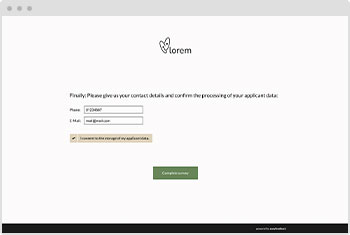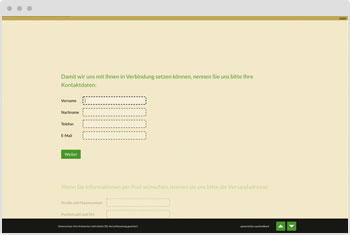
Pre-qualification of applicants using an applicant questionnaire

Use the applicant questionnaire to request additional information from your applicants

Use the applicant questionnaire to gather specific additional information from your applicants. This will help you ensure that you select the right candidates for a potential interview.

Immobilienscout 24 ist begeisterter easyfeedback Nutzer

“Identifying user needs is at the heart of our business. easyfeedback has been helping us with this task for several years now. We particularly appreciate its intuitive usability and professional support.”

Franziska Becker
Guild Lead User Experience Research
TUI ist begeisterter easyfeedback Nutzer

“We use easyfeedback for internal and external surveys—it’s fast, convenient, and easy! The uncomplicated and friendly support puts a smile on our faces, and we are delighted with the continuous development of the platform.”

Jennifer Fischer
Guest & Competitor Insights Analyst

Why use an applicant questionnaire in the application process?

Many companies receive a large number of applications in response to a job posting.

It is often difficult to identify the right candidate based solely on the submitted documents.

An applicant questionnaire offers a simple way to gather additional information from candidates and pre-screen them for an interview.

This gives you valuable insights into the applicants’ skills and experience, allowing you to make targeted decisions about who to invite for an interview.

In addition, the information gathered serves as valuable preparation for the interview.

Use our customizable survey form to streamline the application process.

Contents of the template:

  • Questions about motivation and expectations
  • Questions about strengths and weaknesses
  • Questions about strengths and weaknesses
  • Self-assessment questions
  • Question about the candidate’s suitability for the position

Objectives of the survey:

  • Get to know applicants better
  • Compare applicants
  • Pre-screen suitable candidates
  • Gather information in preparation for interviews

Helpful features for the survey:

  • Survey options: Anonymous, partially anonymous, personalized
  • Invitation options: Link, email, QR code, and more
  • AI analysis of results, including recommendations for action
DSGVO-konforme Online-Umfragen

Data protection „made in Germany“ (GDPR)

Anonyme Teilnahme an Umfragen

Anonymity function for honest feedback

Frequently asked questions about the applicant questionnaire

An application form, also known as an applicant questionnaire, is a standardized document that companies use to systematically collect relevant information during the recruitment process.

It complements the CV and cover letter, makes it easier to compare multiple applications, and supports an objective selection process.

It typically requests information about personal details, qualifications, professional experience, motivation, and availability.

The form can be used directly during the online application process or at later selection stages. Its advantage lies in comparability and efficiency.

A clear, data protection-compliant design is important: it should request only relevant information and be easy for applicants to complete.

  • Standardization: The application form consists of predefined fields and questions that all applicants answer in the same format. This standardization is essential to ensure a fair and objective selection process.


  • Systematic data collection: It specifically requests important data relevant to filling the position, such as personal details, professional qualifications, practical experience, motivation for applying, availability, and salary expectations.


  • Flexible use: The form can be used directly during the online application process, allowing applicants to provide all necessary information as part of their application, or it can be requested at later stages of applicant selection to obtain additional information.


  • Comparability: Its standardized structure makes it easier for HR professionals to compare and assess applications, as all data is provided in the same format.


  • Increased efficiency: Structured data collection simplifies data processing and evaluation, often through automated systems, speeding up the entire recruitment process and saving resources.


  • Data protection-compliant design: A key criterion is compliance with data protection laws, such as the GDPR. The form should request only necessary information, provide transparent information about data processing, and enable applicants to complete it easily and securely.

An applicant questionnaire is a tool used by companies to collect standardized information from applicants.

These questionnaires can include a wide range of questions, from basic personal details to specific questions about skills, experience, and attitudes.

Like any tool, applicant questionnaires have both advantages and disadvantages:

Advantages of an applicant questionnaire

1. Advantage: Standardization

  • Equal treatment: All applicants receive the same questions, which can result in a fairer and more objective assessment.
  • Comparability: Standardized questions enable direct comparison between applicants.


2. Advantage: Efficiency

  • Time savings: Questionnaires can speed up the pre-selection of applicants, as responses can be evaluated quickly and efficiently.
  • Automation: For online applications, data can be automatically transferred to and processed by a system, reducing administrative effort.


3. Advantage: Clarity

  • Structure: Questionnaires provide a clear structure and ensure that all relevant information is collected.
  • Focus: Questions can be tailored specifically to the requirements of the position, avoiding unnecessary information.


4. Advantage: Objectivity

  • Reducing bias: Standardized questions can help minimize subjective assessments and personal biases.


Disadvantages of an applicant questionnaire

1. Disadvantage: Limited depth

  • Superficial information: Questionnaires often provide only a snapshot and do not allow for deeper insights into an applicant’s personality and abilities.
  • Limited flexibility: Applicants have little room to present individual strengths and experience beyond the predefined questions.


2. Disadvantage: Lack of individuality

  • Standardized responses: Applicant questionnaires can encourage standardized answers that may not reflect an applicant’s true individuality and creativity.
  • Limited differentiation: Particularly for highly qualified positions, questionnaires may not sufficiently distinguish between the best candidates.


3. Disadvantage: Response bias

  • Social desirability: Applicants may tend to provide answers that present them in a better light rather than answering honestly.
  • Self-selection: Applicants who do not feel confident that they know the “right” answers may be discouraged from completing the questionnaire.


4. Disadvantage: Limited adaptability

  • Rigidity: Questionnaires are often rigid and cannot respond to unexpected answers or individual circumstances.
  • Lack of context: Without additional information or follow-up questions, certain responses may be misinterpreted.

An applicant questionnaire can include a wide range of questions aimed at collecting information about applicants’ qualifications, experience, skills, and personality traits.

Here are some sample categories and specific questions that may be included in an applicant questionnaire:

1. Category: Personal information

  • Name:
  • Address:
  • Telephone number:
  • Email address:
  • Date of birth:


2. Category: Education information

  • Highest level of education:
  • Institution and field of study:
  • Year of graduation:
  • Additional qualifications/certificates:


3. Category: Professional experience

  • Current or most recent employer:
  • Position:
  • Duration of employment (from – to):
  • Main tasks and responsibilities:
  • Reasons for changing jobs:


4. Category: Skills and competencies

  • Technical skills, e.g. programming or project management:
  • Language skills—please rate your proficiency:
  • Knowledge of specific software programs or tools:
  • Other relevant skills:


5. Category: Motivation and goals

  • Why have you applied for this position?
  • What do you know about our company, and why would you like to work here?
  • What professional goals do you have for the next five years?
  • What motivates you in your daily work?


6. Category: Work style and personality traits

  • How would you describe your work style?
  • Please name three of your strengths and one weakness:
  • How do you deal with stress or pressure?
  • Describe a challenge that you successfully overcame:


7. Category: Teamwork and communication

  • How would you assess your ability to work in a team?
  • Describe a situation in which you worked successfully as part of a team:
  • How do you deal with conflicts within a team?
  • What role do you typically take on in a team?


8. Category: Availability and salary expectations

  • When would you be able to start with us?
  • What are your salary expectations?
  • Would you be willing to relocate or commute?


9. Category: References

  • Please provide two references we may contact:
  • Name, position, company, contact information:


10. Category: Additional information

  • Do you have any additional information that may be relevant to your application?

An applicant questionnaire is a useful tool for employers to collect targeted information from applicants and make the selection process more efficient.

Here are some tips for creating an effective applicant questionnaire:

1. Tip: Clarity and precision

  • Ask unambiguous questions: Phrase your questions clearly and precisely to avoid misunderstandings.
  • Be direct: Ask direct questions to obtain specific answers.


2. Tip: Relevance of questions

  • Role-related questions: Focus on questions that are directly related to the advertised position.
  • Consider requirements: Ask about the qualifications, experience, and skills that are important for the role.


3. Tip: Questionnaire structure

  • Logical order: Arrange questions in a logical order, starting with general information and ending with specific professional questions.
  • Introduce categories: Group questions into categories, such as personal information, professional background, and technical skills.


4. Tip: Use a mix of question types

  • Open-ended questions: Allow applicants to provide detailed answers, for example: “Describe your previous professional experience in the field of XYZ.”
  • Closed questions: Use multiple-choice or yes/no questions for quick, comparable answers, for example: “Do you have experience with XYZ software? Yes/No.”
  • Scale questions: Use Likert scales to measure opinions or self-assessments, for example: “Rate your skills in XYZ on a scale of 1 to 5.”


5. Tip: Personality and soft skills

  • Teamwork and communication: Ask for examples in which the applicant worked as part of a team or demonstrated communication skills.
  • Conflict management: Ask about experience in dealing with conflicts or difficult situations.


6. Tip: Legal considerations

  • Non-discrimination: Ensure that you do not ask discriminatory questions, such as questions about age, gender, ethnic background, religion, or marital status.
  • Data protection: Inform applicants about how their data will be handled and obtain their consent.


7. Tip: Technical implementation

  • Online forms: Use online tools and platforms to make the questionnaire accessible and user-friendly.
  • Automation: Automate the evaluation of responses to save time and minimize errors.


8. Tip: Feedback and improvement

  • Gather feedback: Ask existing employees or colleagues for feedback on the questionnaire.
  • Make adjustments: Regularly revise the questionnaire based on feedback and the outcomes of the selection process.

Data protection is highly important in the context of an applicant questionnaire, as applicants’ personal data is collected and processed.

Here are some key aspects and best practices to consider:

Legal basis

  • GDPR: The European Union’s General Data Protection Regulation (GDPR) governs the handling of personal data. It applies to all companies that process the data of EU citizens.
  • BDSG: Germany’s Federal Data Protection Act (BDSG) supplements the GDPR in Germany and contains specific provisions on data protection.


Principles of data processing

1. Principle: Lawfulness, fairness, and transparency

The processing of personal data must be lawful and carried out in a way that is understandable to the data subject.

Applicants should be informed about which data is collected, for which purpose, and on which legal basis.


2. Principle: Purpose limitation

Data may only be collected for specified, explicit, and legitimate purposes and must not be further processed in a way that is incompatible with those purposes.

For example, applicant data may only be used within the scope of the application process.


3. Principle: Data minimization

Only data necessary for the purpose of processing should be collected.

Avoid collecting unnecessary data, such as information that is irrelevant to assessing an applicant’s suitability.


4. Principle: Accuracy

It must be ensured that processed data is accurate and up to date.

Applicants should have the opportunity to correct their data.


5. Principle: Storage limitation

Personal data may only be retained for as long as is necessary for the purposes for which it is processed.

Data from unsuccessful applicants should be deleted after an appropriate period, unless the applicant has agreed to longer storage, for example in a talent pool.


6. Principle: Integrity and confidentiality

Personal data must be processed in a way that ensures an appropriate level of data security, including protection against unauthorized or unlawful processing and against accidental loss, destruction, or damage.


Applicants’ rights

1. Right of access:

Applicants have the right to know which personal data is stored about them and for what purpose it is processed.


2. Right to rectification:

Applicants may request the correction of inaccurate or incomplete data.


3. Right to erasure (right to be forgotten):

Under certain conditions, applicants may request the deletion of their data.


4. Right to restriction of processing:

Under certain conditions, applicants may request the restriction of the processing of their data.


5. Right to data portability:

Applicants have the right to receive the personal data they have provided in a structured, commonly used, and machine-readable format and to transmit that data to another controller.


More form and questionnaire templates​

Survey Template Job Application Form

Job Application Form

Survey template details

Survey Template: Contact Form

Contact Form

Survey template details

Newsletter Registration Form Survey Template

Newsletter Subscription

Survey template details

Survey Template: Registration Form

Event Registration

Survey template details

Travel expense report questionnaire template

Travel Expense Report

Survey template details

Explore all survey templates  

You are in professional company

Immoscout 24 Logo
Tui Logo
Porsche Logo
Lufthansa Logo
Jaegermeister Logo

Over 740,000 participants in easyfeedback surveys every month

Result

STUDIO

The performance add-on for your analysis

easyfeedback Result Studio 2