

“Identifying user needs is at the heart of our business. easyfeedback has been helping us with this task for several years now. We particularly appreciate its intuitive usability and professional support.”

“We use easyfeedback for internal and external surveys—it’s fast, convenient, and easy! The uncomplicated and friendly support puts a smile on our faces, and we are delighted with the continuous development of the platform.”
A successful team is like clockwork — every cog must mesh perfectly.
But even the best team needs regular analysis to promote strengths and identify obstacles early on.
This is the only way it can continue to develop and remain successful in the long term.
Surveys are a valuable tool in this regard: they give everyone a voice, reveal moods, and show where improvements are needed.
Employees feel heard, which increases satisfaction and commitment.
Anonymous employee feedback provides valuable insights that help to strengthen communication, motivation, and collaboration in a targeted manner.
Managers gain a sound basis for deriving measures, resolving conflicts, and providing the best possible support to the team.
Those who listen regularly and ask the right questions create an open, trusting team culture in which everyone feels comfortable, actively contributes, and can develop their full potential.
Contents of the template:
Objectives of the survey:
Helpful features for the survey:

Data protection „made in Germany“ (GDPR)

Anonymity function for honest feedback
A team analysis is a systematic examination of collaboration, communication, and dynamics within a team.
The goal is to identify the team’s strengths and weaknesses and uncover opportunities for improvement.
A strong, well-functioning team is more than the sum of its members.
It is a key success factor for any company or project – regardless of industry or size.
Teams that communicate effectively, pursue a common goal, and trust one another achieve better results, are more innovative, and remain motivated in the long term.
A team analysis provides targeted support in:
A professional team analysis can examine a variety of areas.
These include:
A team analysis includes various methods for evaluating the structure, dynamics, and effectiveness of a team.
Here are some common methods:
1. Method: Observation
2. Method: Interviews & Questionnaires
3. Method: Sociometric Analysis
4. Method: SWOT Analysis
5. Method: Belbin Team Role Analysis
6. Method: Feedback (e.g. 360-degree feedback)
7. Method: Process Analysis & Retrospectives
8. Method: Team Diagnostic Tools
Here are some questions for a team analysis that can be used in interviews, questionnaires, or retrospectives:
1. Category: Team Structure & Role Distribution
2. Category: Communication & Collaboration
3. Category: Team Climate & Motivation
4. Category: Conflict Management & Problem Solving
5. Category: Efficiency & Productivity
6. Category: Strengths & Areas for Development
7. Category: Personal Satisfaction & Development
Team analysis in the context of team development is used to assess the current state of a team and derive targeted measures to improve collaboration, communication, and performance.
It is an important part of the team development process and helps identify strengths, weaknesses, and areas for development.
1. Objectives of Team Analysis in Team Development
2. Methods of Team Analysis in Team Development
a) Analyzing Team Roles & Collaboration
b) Communication & Conflict Analysis
c) Measuring Team Climate & Motivation
d) Analyzing Performance & Productivity
3. Integrating Team Analysis into the Team Development Process
4. Best Practices for Successful Team Development
Here is a more detailed explanation of how easyfeedback can help with team analysis as a survey tool:
1. Point: Collect Anonymous & Honest Feedback
One major challenge with internal feedback sessions is that team members often do not speak openly for fear of negative consequences.
easyfeedback enables anonymous employee surveys, allowing employees to feel safe and provide more honest responses.
Example:
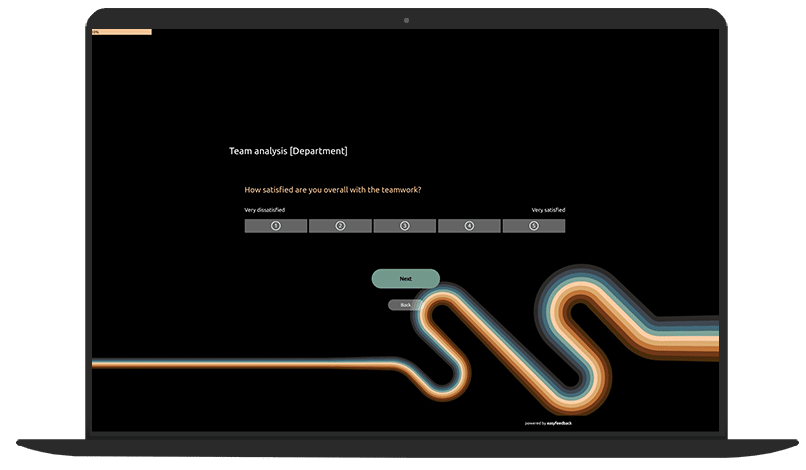
A question could be: “How comfortable do you currently feel in your team?” with a scale from 1–10.
2. Point: Create Individual Questionnaires
Every team faces different challenges.
easyfeedback allows you to put together individual questions that are tailored precisely to your team structure and objectives.
Example:
3. Point: Automatic Analysis & Reports
The tool takes care of the data analysis for you – you do not have to evaluate the results manually.
Example:
If you conduct a survey on team communication and the average score is only 4/10, you immediately know that action is needed in this area.
4. Point: Conduct Regular Pulse Surveys
Instead of conducting one large employee survey only once a year, easyfeedback allows you to regularly conduct short pulse surveys.
Example:
Every month, conduct a mini survey with questions such as:
5. Point: Identify Areas for Improvement
Based on the survey results, you can identify exactly where problems exist – and which measures may be appropriate.
Are there problems with management? Then workshops or one-on-one discussions may be a solution.
Are work processes inefficient? Then restructuring may help.
Do team members feel unappreciated? Then an employee recognition system could be introduced.
Example:
If many employees report feeling stressed, targeted measures such as home office options or more flexible working hours could be introduced.
6. Point: Comparability & Benchmarking
With easyfeedback, you can create more than just a one-time snapshot of your team. You can also track trends and developments over time.
Example:
After one year, you can compare current team satisfaction with the previous year’s results. Has it increased or decreased? Which measures were successful?