

“Identifying user needs is at the heart of our business. easyfeedback has been helping us with this task for several years now. We particularly appreciate its intuitive usability and professional support.”

“We use easyfeedback for internal and external surveys—it’s fast, convenient, and easy! The uncomplicated and friendly support puts a smile on our faces, and we are delighted with the continuous development of the platform.”
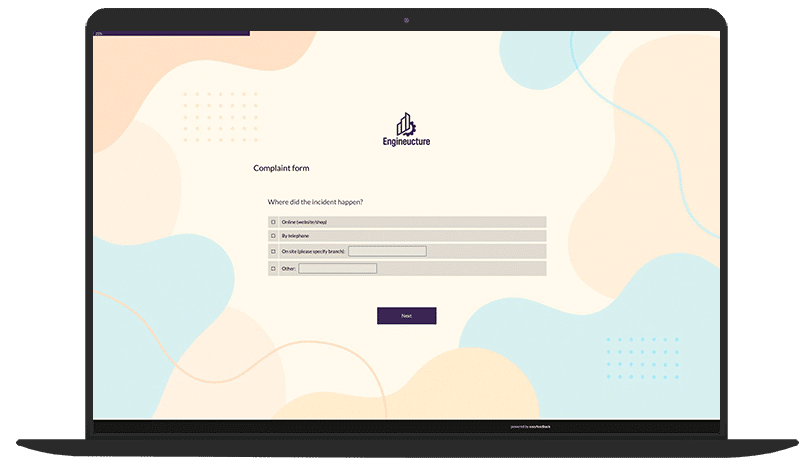
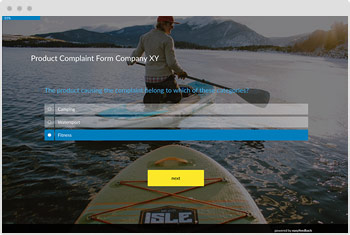
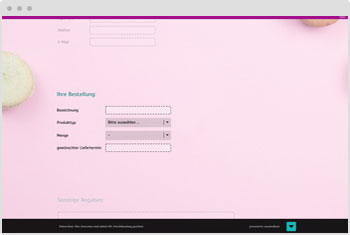
A complaint form in the form of a survey offers numerous benefits for both the organization and users.
Through dropdown menus, rating scales, and targeted questions, complaints can be systematically recorded, more easily evaluated, and forwarded more quickly to the appropriate departments.
Required fields and a clear structure ensure that all relevant information is fully captured.
For users, the structured format lowers the barrier to submission: The process feels less confrontational than a free-text field and provides guidance on what can be reported.
This saves time and is particularly helpful for those who struggle with free-form writing.
To still allow room for individual concerns, free-text fields can be added. Overall, this combination ensures user-friendly and efficient complaint handling.
Contents of the template:
Objectives of the survey:
Helpful features for the survey:

Data protection „made in Germany“ (GDPR)

Anonymity function for honest feedback
A complaint form is a standardized document used to record complaints in a structured, traceable, and efficient manner.
It ensures that feedback—whether criticism, dissatisfaction, or reports of misconduct—can be systematically documented and processed.
Such forms are used in a wide range of areas: companies use them to improve their service quality, public institutions use them to handle citizens’ concerns, and the healthcare sector uses them to collect patient experiences.
The goal is always to facilitate dialogue with those affected and create a basis for improvement.
A well-designed complaint form fulfills several key functions:
Complaint forms can be found across numerous industries and contexts:
A complaint form offers numerous benefits for both complainants—such as customers, citizens, or patients—and organizations—such as companies, public authorities, or institutions.
Here are the main benefits:
Benefits for organizations:
1. Benefit: Structured collection
Consistently designed fields—such as subject, description, and affected area—ensure that relevant information is collected systematically.
This makes categorization, prioritization, and assignment to the responsible departments easier.
2. Benefit: Traceability and documentation
Each complaint is recorded and archived with a timestamp.
This creates transparency and traceability—for example, during internal quality checks, audits, or disputes.
3. Benefit: Systematic quality management
Complaints provide valuable insights into systematic weaknesses in processes, services, or products.
Recurring points of criticism can be analyzed and turned into improvement measures, for example through a complaint management system.
4. Benefit: Legal certainty and evidence
Especially in public services or regulated industries, the documented collection of complaints can serve as evidence in the event of a complaint or review.
Transparency is also crucial in data protection-related matters.
5. Benefit: Efficient processing
Structured input enables complaints to be quickly forwarded to the responsible department.
Prioritization—for example by urgency or impact—is made easier, reducing processing time.
6. Benefit: Customer retention and trust-building
A professional complaint process demonstrates: “We take your opinion seriously.”
Even when a problem arises, the way it is handled can become a positive service experience—improving customer satisfaction and long-term customer loyalty.
Benefits for complainants:
1. Benefit: Easy way to submit a complaint
A complaint form is accessible around the clock—online or on site.
It lowers the barrier to submitting a concern, especially for people who do not like communicating in person or by telephone.
2. Benefit: Transparency about the process
Many forms include information about the next steps: What happens after submission? When can I expect a response? Who is responsible?
This clarity strengthens the feeling of being heard and taken seriously.
3. Benefit: Equal treatment and fairness
All submissions are collected in the same format—regardless of the person, language, or manner of expression.
This promotes equal treatment and objectivity in handling complaints.
4. Benefit: Security and discretion
Especially when dealing with sensitive issues—such as complaints about employees, arbitrary actions by public authorities, or medical errors—the form offers a discreet, less confrontational way to raise a concern.
5. Benefit: Feedback and traceability
Depending on the system, the complainant receives a confirmation of receipt or a case reference number.
This ensures that the complaint is not lost and can be followed up.
1. Tip: Keep it clear and well structured
2. Tip: Ask only for necessary information
Ask only the questions you truly need, for example:
Tip: Offer the option to submit complaints anonymously—this can lower barriers to reporting.
3. Tip: Combine multiple-choice options and free text
4. Tip: Explain the process
Briefly explain:
5. Tip: Consider data protection
6. Tip: Ensure accessibility
7. Tip: Enable feedback