
“Identifying user needs is at the heart of our business. easyfeedback has been helping us with this task for several years now. We particularly appreciate its intuitive usability and professional support.”

“We use easyfeedback for internal and external surveys—it’s fast, convenient, and easy! The uncomplicated and friendly support puts a smile on our faces, and we are delighted with the continuous development of the platform.”
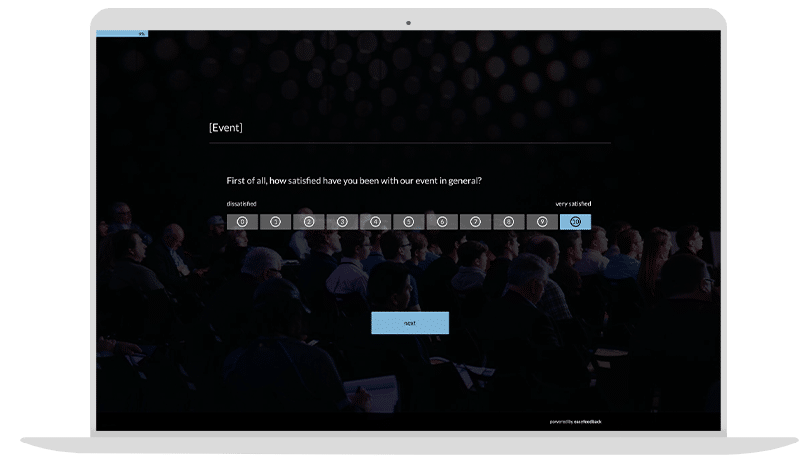
At the end of an event, we often see satisfied faces.
Some participants are satisfied because they enjoyed the content, while others are simply glad it’s over.
Would you like to know which is really the case? Ask the participants directly.
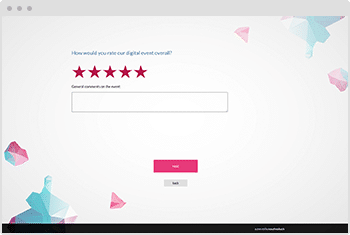
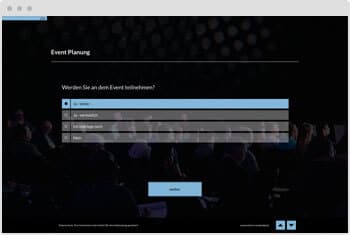
An anonymous online survey after the event gives you the opportunity to gather honest and constructive feedback.
This way, you’ll not only learn what went well, but also which details made the biggest difference and where there is still room for improvement.
By asking your participants for their opinions, you show appreciation and ensure that their feedback is taken into account for future events.
This allows you to convey appreciation that extends beyond the end of the seminar and enables long-term improvement of your offerings.
Contents of the template:
Objectives of the survey:
Helpful features for the survey:

Data protection „made in Germany“ (GDPR)

Anonymity function for honest feedback
An event is a planned occasion with a specific purpose that involves a group of people.
These events can take place virtually through online platforms or as in-person events.
The variety of events is vast, ranging from small educational gatherings such as seminars to major sporting and music events, or even international trade fairs.
Every event is designed to reach a particular target audience and achieve a specific objective.
For example, seminars are intended to share knowledge and exchange experience in smaller groups, while sporting events provide entertainment and competition.
Music events can create cultural experiences and emotional connections, while trade fairs give companies the opportunity to present their products and services to a broad audience and explore new business opportunities.
The number of participants varies considerably depending on the type of event, from a few dozen to thousands or even millions of people.
The purposes of events can also vary widely, ranging from education and entertainment to marketing and sales promotion, fostering exchanges between professionals, or spreading innovation.
Today, virtual event delivery is becoming increasingly important, particularly due to technological advances that enable people worldwide to connect without being physically present.
Virtual reality and other technologies open up new possibilities for immersive and interactive event experiences that were previously unimaginable.
Overall, events are an essential part of modern society and the economy, bringing people together, enabling the exchange of ideas, sharing knowledge, and creating cultural and economic momentum.
Events are important for several reasons:
Reason 1: Networking and Relationships
Events provide a platform for bringing together people from different industries and backgrounds.
They encourage networking and the exchange of ideas, creating new business opportunities, partnerships, and collaborations.
Reason 2: Knowledge Sharing and Continuing Education
Many events offer workshops, seminars, and presentations that share knowledge and help professionals develop their skills.
This contributes to professional development and allows participants to stay up to date.
Reason 3: Marketing and Promotion
Events serve as platforms for companies to introduce and promote their products and services to a broad audience.
They can help increase brand awareness and attract potential customers.
Reason 4: Cultural and Social Significance
Many events have cultural or social significance. They promote cultural diversity, strengthen communities, and contribute to cultural heritage.
Reason 5: Economic Impact
Events can provide a significant economic boost by attracting tourism, supporting local businesses, and creating temporary jobs.
Reason 6: Experiences and Emotions
Events often provide participants with a special experience and positive emotions. They can be inspiring, entertaining, or educational, creating lasting memories.
Events are characterized by several distinctive features that set them apart from other types of gatherings or activities.
Here are some typical characteristics of events:
Characteristic 1: Planned Organization
Events are planned and prepared in advance, often over an extended period.
Planning includes aspects such as program design, participant management, logistics, and marketing.
Characteristic 2: Specific Purpose
Every event has a particular purpose or clear objective.
This may include sharing knowledge and information, networking, entertainment, promotion, or charitable purposes.
Characteristic 3: Participants
Events bring together a group of people, such as participants, attendees, speakers, performers, or other stakeholders.
The number of participants can range from small, such as at workshops, to very large, such as at major conferences or festivals.
Characteristic 4: Location and Time
Events take place at a specific location and at a set time.
The venue may be physical or virtual, depending on the type of event and the available technology.
Characteristic 5: Program Design
Events have a structured program or agenda comprising various activities, such as presentations, discussions, performances, workshops, exhibitions, or competitions.
Characteristic 6: Interaction and Engagement
Events often promote interaction and engagement among participants, as well as between participants and organizers.
This can take place through discussions, Q&A sessions, networking opportunities, or interactive activities.
Characteristic 7: One-Time or Recurring Nature
Events can be one-time occasions held for a specific purpose or regularly recurring occasions, such as annual conferences or monthly meetups.
Characteristic 8: Emotional Significance
Many events have an emotional component and are intended to create positive feelings, experiences, or memories for participants—whether through entertainment, inspiration, or the experience of special moments.
There are numerous types of events, which can differ greatly depending on their purpose, number of participants, format, and industry.
Here are some common types of events:
Type 1: Conferences and Congresses
Large events that often last several days and focus on knowledge sharing, networking, and discussions.
They may be industry-specific or cover a range of topics.
Type 2: Seminars and Workshops
Educational events held in smaller groups that often focus on specific topics or skills.
They offer practical learning opportunities and discussions.
Type 3: Marketing and Promotional Events
Events where companies can present their products and services to a broad audience.
They often attract industry experts, buyers, and prospective customers.
Type 4: Cultural Events
Events such as festivals, concerts, theater performances, art exhibitions, and film screenings that provide cultural and artistic experiences and often attract a broad audience.
Type 5: Sporting Events
Competitions, games, and tournaments in various sports that attract both local and international athletes and spectators.
Type 6: Networking Events and Meetups
Events aimed at building business relationships, such as business breakfasts, after-work events, or dedicated networking events.
Type 7: Gala Dinners and Charity Events
Events often held for fundraising purposes that attract special guests, donors, and supporters.
Type 8: Hybrid and Virtual Events
With increasing digitalization, more and more events are taking place online — either entirely virtually or as hybrid events that bring together both in-person and virtual participants.
These are just a few examples, and the range of events is extensive. Each event has its own objectives, target groups, and formats tailored to the specific needs and expectations of participants.
Events can be designed in different formats depending on their objectives, target audience, and circumstances.
Here are some common event formats:
Format 1: Conference
A formal event focused on knowledge sharing and networking.
It often includes keynote speakers, expert presentations, panels, and discussions on specific topics.
Format 2: Seminar/Workshop
Educational events that give participants the opportunity to learn new skills or improve existing ones.
They are often interactive and practically oriented.
Format 3: Trade Fair/Exhibition
An event where companies and organizations present products, services, or ideas.
It may be an industry-specific or general trade fair.
Format 4: Gala/Dinner
Formal events that are often held to honor individuals or support charitable causes.
They often include speeches, entertainment, and a festive dinner.
Format 5: Festival/Concert
Public events that often emphasize cultural, musical, or artistic aspects.
They frequently attract a broad audience and offer live performances, food, drinks, and often market stalls.
Format 6: Sporting Event
Competitions or games in different sports that attract spectators and often foster a sense of community.
Format 7: Networking Event
Events aimed at building business relationships and making connections.
They can be formal or informal and take various forms, such as after-work events, speed networking, or industry meetups.
Format 8: Hackathon
An event in which teams come together for a limited period to work intensively on solving a specific problem, often in technology or innovation.
Format 9: Pop-Up Event
Temporary events held in unusual or unexpected locations to attract attention or offer a unique experience.
Format 10: Hybrid/Virtual Event
Events that take place both in person and online. They use technology to connect participants who cannot attend in person or to increase reach and interactivity.
Events have different requirements depending on their type and objectives.
Here are some typical requirements to consider when planning and delivering events:
Requirement 1: Objectives and Concept
Clearly defined objectives and a well-developed concept are essential.
These should cover the type of event, the target audience, participant expectations, and the desired outcomes.
Requirement 2: Budget and Funding
Detailed budget planning is important to ensure that all costs—including the venue, technology, catering, marketing, and staff — are covered.
Funding and potential revenue must also be considered.
Requirement 3: Venue
Choosing the right venue depends on the number of participants, the program, and logistical requirements.
The venue should be easily accessible and have the necessary infrastructure, such as technical equipment, parking, and accessibility features.
Requirement 4: Technical Equipment
Depending on the type of event, technical requirements may include sound and lighting equipment, video projection, internet access, and event apps.
Early planning and coordination with technical experts are essential.
Requirement 5: Safety and Emergency Planning
The safety of participants, staff, and the venue is a top priority.
A detailed emergency plan and safety measures should be in place, including first-aid provision, evacuation plans, and, where necessary, security personnel.
Requirement 6: Permits and Legal Considerations
Event planners must obtain all necessary permits, for example for using the venue, selling alcohol, music performances, or road closures.
Legal matters such as insurance and contracts should also be clarified.
Requirement 7: Logistics and Scheduling
Detailed logistics planning includes coordinating transportation, guest accommodation, catering, venue setup and dismantling, and maintaining a tight schedule for all event activities.
Requirement 8: Marketing and Promotion
Effective marketing strategies are important for reaching the intended target audience and maximizing attendance.
This includes online advertising, social media, public relations, printed materials, and, where appropriate, partnerships with media outlets or sponsors.
Requirement 9: Participant Management
Efficient participant management includes registration, ticket sales, name badges, guest lists, and communication before, during, and after the event to ensure participant satisfaction and engagement.
Requirement 10: Evaluation and Follow-Up
After the event, it is important to evaluate the results and conduct follow-up activities to analyze what worked well and where improvements can be made.
Feedback from participants and stakeholders is essential.
Here are some creative event ideas that can be adapted and developed further depending on the target audience and occasion:
Idea 1: Themed Dinner Party
Organize a dinner party around a specific theme, such as a particular culture, era, or film genre.
Guests can dress accordingly, while the menu and decorations can match the theme.
Idea 2: Outdoor Team-Building Event
Plan an outdoor event that promotes teamwork and collaboration, such as a hike with team games, survival training, or a team challenge at an adventure park.
Idea 3: Arts and Crafts Workshop
Offer a creative workshop where participants can learn to make something new, whether it is painting, pottery, jewelry making, or another craft.
Idea 4: Pop-Up Market or Trade Fair
Organize a temporary market or trade fair where local artisans, designers, or small businesses can showcase and sell their products.
Idea 5: Themed Run or Hike
Host a charity run or hike with a specific theme or cause, such as environmental protection, health, or community support.
Idea 6: Hackathon or Idea Competition
Invite teams to develop creative solutions to a specific problem, whether in technology, social innovation, or entrepreneurship.
Idea 7: Concert or Cultural Festival
Organize a live concert or cultural festival featuring music, dance, art exhibitions, food offerings, and cultural performances.
Idea 8: Digital or Virtual Event
Create an interactive online event that offers unique experiences and opportunities through webinars, virtual trade fairs, online games, or collaborative platforms.
Idea 9: Health and Wellness Day
Organize a day of health and wellness activities, such as yoga classes, massages, healthy cooking demonstrations, and well-being seminars.
Idea 10: Escape Room Challenge
Create an immersive escape room experience in which teams must solve puzzles to overcome a challenge or experience a story.