
Determine willingness to pay using a survey

Determine willingness to pay with a survey

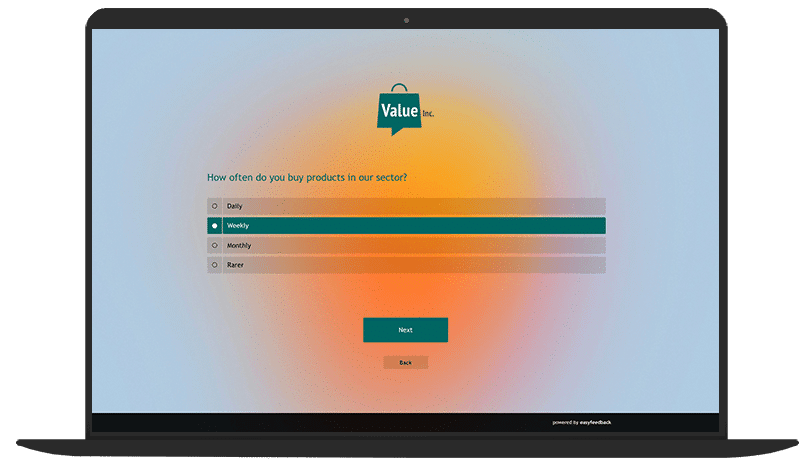
This ready-made survey template helps you find out how much a customer is willing to pay for a product or service.

Immobilienscout 24 ist begeisterter easyfeedback Nutzer

“Identifying user needs is at the heart of our business. easyfeedback has been helping us with this task for several years now. We particularly appreciate its intuitive usability and professional support.”

Franziska Becker
Guild Lead User Experience Research
TUI ist begeisterter easyfeedback Nutzer

“We use easyfeedback for internal and external surveys—it’s fast, convenient, and easy! The uncomplicated and friendly support puts a smile on our faces, and we are delighted with the continuous development of the platform.”

Jennifer Fischer
Guest & Competitor Insights Analyst

Why conduct a survey to determine willingness to pay?

Determining willingness to pay through surveys is an effective method for understanding customers’ price expectations.

It allows you to specifically ask about the maximum amount customers are willing to pay and provides valuable insights into the target audience’s expectations that go beyond mere sales data.

Thanks to their flexibility, surveys can be tailored to specific target groups to account for factors such as income, preferences, or purchasing habits.

They offer not only a snapshot of willingness to pay but also information about the perceived value of an offer and potential price limits.

The results help position new products, adjust pricing strategies, and target specific audiences.

Combined with other data sources, customer surveys create a solid foundation for setting competitive and customer-centric prices.

Contents of the template:

  • Questions about purchasing behavior
  • Questions about price perception
  • Questions about preferred payment methods

Objectives of the survey:

  • Determining the optimal price threshold
  • Understanding perceived value
  • Identifying price thresholds
  • Assessing price sensitivity
  • Preparing for new products
  • Evaluating competitiveness

Helpful features for the survey:

  • Survey options: Anonymous, partially anonymous, personalized
  • Invitation options: Link, email, QR code, and more
  • Segment analysis based on survey groups or response patterns
DSGVO-konforme Online-Umfragen

Data protection „made in Germany“ (GDPR)

Anonyme Teilnahme an Umfragen

Anonymity function for honest feedback

Frequently asked questions about willingness to pay

The willingness to pay refers to the maximum amount a customer is willing to pay for a product or service.

It reflects the subjective value that a customer places on an offering and depends on individual factors such as income, needs, and preferences, as well as on external influences such as the market and competitive situation.

Willingness to pay is a key concept in pricing, as it helps companies set prices that both maximize demand and optimize profits.

A better understanding of willingness to pay can be gained through market research, surveys, or analysis of purchasing behavior.

The marginal willingness to pay refers to the additional amount a customer is willing to pay for one more unit of a product or service.

It indicates how much value a customer places on an additional unit and generally decreases as the quantity increases—an effect known as diminishing marginal utility.

Example:

A customer buys a bottle of water for €2.

If they already have one bottle, they may only be willing to pay €1 for a second bottle because the additional benefit is lower.

The €1 represents their marginal willingness to pay for the second unit.

Practical Significance:

  • Pricing: Companies can use marginal willingness to pay to set different prices for different quantities, for example through volume discounts.
  • Market Analysis: Marginal willingness to pay helps companies understand how customers respond to price changes and supports the optimization of supply and demand.
  • Product Variations: It can be used to offer premium products or additional services in a targeted manner.


Understanding marginal willingness to pay is particularly important for maximizing profits by setting prices as close as possible to customers’ individual perceived value.

A customer’s willingness to pay is influenced by a wide range of factors, including both personal and external aspects.

These factors determine how much a customer is willing to pay for a product or service.

Here are the most important influencing factors:

1. Factor: Personal

  • Income and Financial Situation:
    Customers with higher incomes often have a higher willingness to pay because they can afford to spend more.


  • Needs and Priorities:
    How important a product is to a customer influences how much they are willing to spend on it.


  • Experiences and Preferences:
    Positive customer experiences or a preference for certain brands can increase willingness to pay.


  • Perceived Risk:
    If a customer perceives a product as low-risk, they are more likely to be willing to pay more for it.


2. Factor: Product- and Service-Related

  • Quality and Benefits:
    Customers are willing to pay more for products that are high quality or provide significant benefits.


  • Exclusivity:
    Unique or limited-edition products can increase willingness to pay.


  • Brand Image:
    Strong brands with a good reputation often have customers who are willing to pay higher prices.


  • Innovation:
    New and innovative products generally achieve a higher willingness to pay.


3. Factor: Market- and Competition-Related

  • Supply and Demand:
    Scarcity can increase willingness to pay, while an oversupply can reduce it.


  • Competitor Prices:
    Customers often use the prices of similar products on the market as a reference point.


  • Market Dynamics:
    In saturated markets, willingness to pay often decreases, while it can be higher in niche markets.


4. Factor: Psychological

  • Perceived Value:
    Customers are willing to pay more when they feel that a product is worth its price.


  • Price Psychology:
    Prices such as €9.99 can appear cheaper than €10, which may increase willingness to pay.


  • Emotional Attachment:
    Customers may pay more for products or brands with which they have an emotional connection.


5. Factor: Situational

  • Urgency:
    In emergency situations, such as when a repair is urgently needed, willingness to pay may increase.


  • Timing and Season:
    At certain times, such as Christmas, customers may be willing to spend more.


  • Geographical Location:
    Regional differences in income and the cost of living can influence willingness to pay.


6. Factor: Social and Cultural

  • Social Norms:
    Within certain social groups, willingness to pay can be influenced by expectations or trends.


  • Cultural Values:
    In cultures that place a high value on quality or prestige, willingness to pay is often higher.

Measuring willingness to pay is crucial for companies to develop optimal pricing strategies and maximize profits.

There are various methods for determining the maximum amount a customer is willing to pay for a product or service.

These approaches can be divided into direct and indirect methods.

Direct Methods for Measuring Willingness to Pay

1. Method: Surveys

Customers are asked directly how much they would be willing to pay for a product.

  • Example: “How much would you be willing to spend on Product X?”
  • Advantages: Quick and easy to implement.
  • Disadvantages: Customers may provide unrealistic answers because no actual purchase decision is involved.


2. Method: Conjoint Analysis

Customers evaluate different product combinations with varying prices and features.

  • Objective: Determine which features have the greatest influence on willingness to pay.
  • Advantages: Provides deeper insights into preferences and price perception.
  • Disadvantages: Time-consuming and costly to conduct.


3. Method: Auctions

Customers bid in an auction based on what they are willing to pay for a product.

  • Example: eBay auctions.
  • Advantages: Shows actual willingness to pay in a competitive situation.
  • Disadvantages: Not suitable for all products or services.


Indirect Methods for Measuring Willingness to Pay

1. Method: Analysis of Purchasing Behavior

Willingness to pay is derived from past transactions.

  • Example: If a customer makes a purchase at a price of €100, their willingness to pay is at least this amount.
  • Advantages: Realistic and based on actual data.
  • Disadvantages: Provides limited insight into the customer’s maximum willingness to pay.


2. Method: Price Experiments

Different customer groups are offered different prices to test how demand changes.

  • Example: An online store offers the same product at different prices in different regions.
  • Advantages: Provides valuable data on price elasticity.
  • Disadvantages: Customers may react negatively if they discover that different prices are being charged.


3. Method: Van Westendorp Price Sensitivity Meter

Customers answer a series of questions about perceived price thresholds:

      • At what price would the product be too expensive?
      • At what price would the product seem too cheap?


  • Advantages: Quickly provides a price range in which willingness to pay is likely to fall.
  • Disadvantages: Subjective and dependent on customers providing honest answers.


Technological Approaches to Measuring Willingness to Pay

1. Approach: Data Analysis and AI

Using Big Data and artificial intelligence, companies can predict willingness to pay based on customer data such as purchases, click behavior, and demographic information.

  • Advantages: Scalable and automated.
  • Disadvantages: Requires significant initial effort for data integration and model training.


2. Approach: A/B Testing

Two different pricing variants are tested to determine which performs better.

  • Advantages: Practical and easy to implement.
  • Disadvantages: Only works effectively with a sufficient amount of data.

The calculation of willingness to pay is not an exact science, as it strongly depends on individual customer preferences.

Nevertheless, companies can use various approaches to determine approximate values.

These methods are based on direct customer feedback, purchasing behavior, or market data.

Here are the most common steps and approaches for calculating willingness to pay:

1. Approach: Direct Customer Survey

  • Question: Determine the maximum willingness to pay directly through a customer survey.
  • Example: “How much would you be willing to pay for this product?”
  • Calculation: Calculate the mean or median of the responses.
  • Formula: Willingness to pay = Sum of the stated prices / Number of respondents


2. Approach: Analysis of Purchasing Behavior

  • Data Source: Past transactions or sales data.
  • Approach: Calculate willingness to pay based on the prices actually paid and customers’ responses to price changes.
  • Example: If customers purchase a product more frequently after the price is reduced, their willingness to pay is likely close to the original price.
  • Formula: Maximum willingness to pay – highest price at which sales are created


3. Approach: Van Westendorp Price Sensitivity Analysis

Customers state how much they would be willing to pay for a product in a survey.

  • Example: Price perception questions based on different price thresholds.
  • Advantages: Provides insights into customers’ perceived acceptable price range.
  • Disadvantages: Subjective and dependent on customers’ responses.


4. Approach: Price Experiments (A/B Tests)

  • Approach: Test different prices with different customer groups to determine at which price demand is highest.
  • Calculation: Willingness to pay can be estimated from the highest tested price that still generates significant demand.


5. Approach: Conjoint Analysis

  • Approach: Customers evaluate product packages with different prices and features.
  • Calculation: Statistical models, such as regression analysis, determine how much each feature contributes to willingness to pay.
  • Example: A customer is willing to pay €100 for Product X. The analysis shows that design accounts for 30%, functionality for 50%, and the brand name for 20% of the perceived value.


6. Approach: Price Elasticity of Demand

  • Use price elasticity to estimate how customers respond to price changes.
  • A low elasticity value indicates that demand is less sensitive to price changes, which can indicate a higher willingness to pay.
  • Formula: Price elasticity = % change in demand / % change in price


7. Approach: Data Analysis and AI

  • Approach: Machine-learning models analyze historical purchasing data, demographic characteristics, and customer behavior to predict willingness to pay.
  • Calculation: Algorithms calculate the probability that a customer will accept a particular price.

More customer survey templates

Survey Template: Product satisfaction

Product Satisfaction

Survey template details

Survey Template NPS

Net Promoter Score

Survey template details

Customer Satisfaction Score Questionnaire Template

Customer Satisfaction Score

Survey template details

Customer Effort Score Survey Template

Customer Effort Score

Survey template details

Survey Template: Customer Cancellation

Customer Cancellation

Survey template details

Explore all survey templates  

You are in professional company

Immoscout 24 Logo
Tui Logo
Porsche Logo
Lufthansa Logo
Jaegermeister Logo

Over 740,000 participants in easyfeedback surveys every month

Result

STUDIO

The performance add-on for your analysis

easyfeedback Result Studio 2