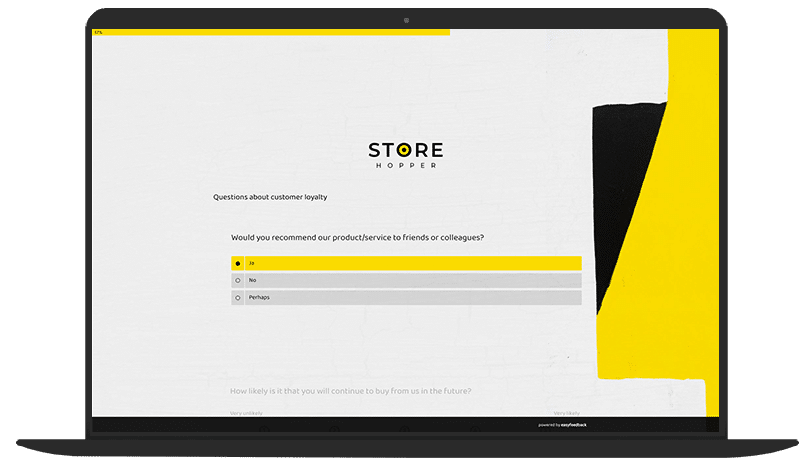

Get direct customer feedback for your analysis — it’s easy with a survey.

Conduct customer analysis via survey

This survey template helps you better understand your target audience and make informed decisions about product optimization and customer retention.

Immobilienscout 24 ist begeisterter easyfeedback Nutzer

“Identifying user needs is at the heart of our business. easyfeedback has been helping us with this task for several years now. We particularly appreciate its intuitive usability and professional support.”

Franziska Becker
Guild Lead User Experience Research
TUI ist begeisterter easyfeedback Nutzer

“We use easyfeedback for internal and external surveys—it’s fast, convenient, and easy! The uncomplicated and friendly support puts a smile on our faces, and we are delighted with the continuous development of the platform.”

Jennifer Fischer
Guest & Competitor Insights Analyst

Why is it important to analyze your customers?

Analyzing customers is crucial for better understanding the needs, expectations, and behaviors of the target audience.

It enables companies to make informed decisions, improve products and services in a targeted manner, and build long-term customer loyalty.

Customer surveys play a central role in this process because they establish a direct connection with customers and provide authentic feedback.

They offer a structured approach to identifying opinions, wishes, and potential issues.

In this way, they not only help capture the customer’s perspective but also develop measures that benefit both the customer and the company.

Contents of the template:

  • Demographic questions
  • Questions about purchasing behavior
  • Questions about satisfaction and loyalty
  • Questions about brand perception
  • Identifying areas for improvement

Objectives of the survey:

Helpful features for the survey:

  • Survey options: Anonymous, partially anonymous, personalized
  • Invitation options: Link, email, QR code, and more
  • Segment analysis based on survey groups or response patterns
DSGVO-konforme Online-Umfragen

Data protection „made in Germany“ (GDPR)

Anonyme Teilnahme an Umfragen

Anonymity function for honest feedback

Frequently asked questions about customer analysis

Customer analysis is a strategic process in which companies systematically collect, evaluate, and interpret information about their customers.

The aim is to gain a comprehensive understanding of customer needs, preferences, and behaviors in order to derive targeted measures for customer acquisition, retention, and development.

Systematic customer analysis offers companies numerous advantages.

It not only supports better customer retention, but also helps optimize business processes and strategic direction.

1st Advantage: Better Customer Retention

  • Explanation: Companies gain a more precise understanding of their customers’ needs and expectations.
  • Benefit: Targeted communication and tailored offers increase customer satisfaction and loyalty.
  • Example: A company recognizes that customers expect better service and subsequently offers improved support options.


2nd Advantage: Identification of Target Groups

  • Explanation: Customers can be segmented and assigned to specific groups.
  • Benefit: Marketing and sales activities can be targeted more precisely, reducing wasted reach.
  • Example: A campaign is developed specifically for young, tech-savvy customers.


3rd Advantage: Increased Revenue

  • Explanation: Analyzing purchasing behavior and preferences helps identify cross-selling and upselling opportunities.
  • Benefit: Companies generate higher revenue by offering suitable add-on or premium products.
  • Example: Customers who regularly buy smartphones are specifically offered accessories such as headphones.


4th Advantage: Improved Product Development

  • Explanation: Customer feedback and behavioral data provide important insights into market needs.
  • Benefit: Products can be further developed or adapted to better meet customer requirements.
  • Example: A survey shows that customers would like an additional feature in a software product.


5th Advantage: Optimized Customer Communication

  • Explanation: Customer analysis helps identify customers’ preferred communication channels and styles.
  • Benefit: Companies can communicate more effectively and increase the impact of their messages.
  • Example: Older customers prefer email contact, while younger customers want to be reached via social media.


6th Advantage: Reduced Customer Churn

  • Explanation: An analysis can identify early signs that customers are dissatisfied or may leave.
  • Benefit: Timely measures can help win back or retain customers.
  • Example: A discount offer is sent specifically to customers who have not made a purchase for a long time.


7th Advantage: More Effective Pricing

  • Explanation: The willingness to pay and price perception of different customer segments can be analyzed.
  • Benefit: Companies can better adapt their prices to the market and target groups.
  • Example: Premium customers are willing to pay higher prices for additional services.


8th Advantage: Competitive Advantage

  • Explanation: Companies gain detailed insights into customer needs and can respond more quickly to changes.
  • Benefit: This gives them an advantage over competitors that work in a less data-driven way.
  • Example: A company identifies a new trend and develops a suitable product before competitors react.


9th Advantage: Long-Term Planning Certainty

  • Explanation: Customer analyses provide data-based insights for forecasts and strategic decisions.
  • Benefit: Companies can plan well-founded measures and minimize risks.
  • Example: Based on analyses, a decision is made about which customer segments should be targeted more intensively in the future.


10th Advantage: More Efficient Resource Allocation

  • Explanation: Resources such as budget and working time can be specifically directed toward profitable customer groups.
  • Benefit: Greater efficiency in the use of marketing and sales resources.
  • Example: More budget is allocated to acquiring A-tier customers rather than less lucrative segments.

Customer analysis is a strategic approach based on various theoretical models for understanding customer needs, behaviors, and values.

These theories provide the foundation for effective analysis and help interpret relevant data and develop measures based on it.

1. Theory: Maslow’s Hierarchy of Needs

  • Core idea: People have different needs arranged hierarchically, ranging from basic needs (e.g., safety) to self-actualization.
  • Relevance for customer analysis: It helps segment customer preferences based on their needs. Products and services can be specifically tailored to particular levels of the hierarchy of needs.
  • Example: A premium product often addresses self-actualization, whereas basic products fulfill fundamental needs.


2. Theory: AIDA Model

  • Core idea: The model describes the four stages a customer goes through before making a purchase decision:
      • Attention
      • Interest
      • Desire
      • Action


  • Relevance for customer analysis: It helps analyze the customer journey and identify optimization opportunities at each stage. It is often used in conjunction with marketing activities.
  • Example: Identifying weak points, such as when many customers show interest but do not proceed to purchase.


3. Theory: Customer Lifecycle Theory

  • Core idea: Customers go through different stages in their relationship with a company: acquisition, growth, maturity, and decline.
  • Relevance for customer analysis: It supports customer segmentation according to their lifecycle stage and enables the development of targeted measures for each stage.
  • Example: New customers require different communication, such as onboarding measures, than long-standing customers, such as loyalty programs.


4. Theory: Customer Value Theory

  • Core idea: A customer’s value to a company is viewed as a combination of current and future benefit.
  • Relevance for customer analysis: It enables the assessment of long-term customer potential using metrics such as Customer Lifetime Value (CLV). It also helps identify A-tier customers who make the greatest contribution to business success.
  • Example: Customers with a high CLV are prioritized, for example through exclusive offers.


5. Theory: Behavioral Economics

  • Core idea: Customer behavior is influenced not only by rational considerations, but also by emotional, social, and psychological factors.
  • Relevance for customer analysis: It helps identify irrational patterns in purchasing behavior and supports the optimization of pricing, advertising, and customer experiences.
  • Example: Customers respond more strongly to discounts presented as a “loss,” such as “Save 20% now!”


6. Theory: Customer Experience Theory

  • Core idea: Customers evaluate a company based on the sum of their experiences across all touchpoints.
  • Relevance for customer analysis: It enables systematic assessment of the customer journey and highlights which experiences strengthen or weaken customer retention.
  • Example: Poor customer service experiences can negatively affect overall brand loyalty, even if the product itself is satisfactory.


7. Theory: Rogers’ Diffusion of Innovations Theory

  • Core idea: It describes how new products or innovations are adopted by different customer groups: innovators, early adopters, early majority, late majority, and laggards.
  • Relevance for customer analysis: It supports target-group segmentation for new products and helps develop suitable communication strategies for each group.
  • Example: Marketing for early adopters highlights a product’s novelty, while marketing for the late majority focuses on stability and benefits.


8. Theory: Social Identity Theory

  • Core idea: Customers identify with brands that align with their personal or social identity.
  • Relevance for customer analysis: It provides insights into the relationship between brand image and customer perception, helping develop brand messages tailored to specific target groups.
  • Example: A brand that emphasizes sustainability specifically appeals to environmentally conscious customers.


9. Theory: Pareto Principle (80/20 Rule)

  • Core idea: Often, 80% of revenue is generated by 20% of customers.
  • Relevance for customer analysis: It helps identify and target profitable customer groups.
  • Example: Prioritizing the support of key accounts or long-standing customers.

Customer analysis pursues several strategic and operational goals aimed at better understanding customers, meeting their needs, and increasing business success.

Here is an overview of the key objectives:

Objective 1: Deepen Customer Understanding


Objective 2: Conduct Customer Segmentation

  • Objective: Divide customers into homogeneous groups based on criteria such as demographics, purchasing behavior, or revenue.
  • Benefit: More effective and targeted marketing and sales strategies.


Objective 3: Strengthen Customer Loyalty

  • Objective: Identify measures to increase customer loyalty.
  • Benefit: Reduced customer churn and stronger long-term relationships.


Objective 4: Identify Valuable Customers

  • Objective: Differentiate between A, B, and C customers, for example based on revenue or contribution margin.
  • Benefit: Resources can be focused specifically on the most profitable customers.


Objective 5: Personalize Offers


Objective 6: Improve Customer Communication

  • Objective: Understand which communication channels and messages resonate best with customers.
  • Benefit: More efficient and effective customer communication.


Objective 7: Unlock Revenue Potential

  • Objective: Identify cross-selling and upselling opportunities.
  • Benefit: Maximize customer lifetime value (Customer Lifetime Value).


Objective 8: Increase Competitiveness

  • Objective: Analyze customer feedback and market requirements to optimize offerings and processes.
  • Benefit: Companies can position themselves more effectively in the market.

Customer analysis is based on specific criteria that help companies systematically evaluate and segment their customers.

These criteria may vary depending on the purpose of the analysis and are often aligned with the company’s needs and business objectives.

1. Criterion: Demographic Criteria

  • Description: Collection of customers’ personal characteristics.
  • Examples:
      • Age
      • Gender
      • Place of residence
      • Education level
      • Occupation


  • Benefit: Target group-specific communication and identification of relevant market segments.


2. Criterion: Sociocultural Criteria

  • Description: Consideration of lifestyle, values, and social groups.
  • Examples:
      • Hobbies and interests
      • Values and beliefs
      • Membership in social classes


  • Benefit: Development of marketing strategies aligned with lifestyles and social norms.


3. Criterion: Purchasing Behavior

  • Description: Analysis of customers’ purchasing and decision-making behavior.
  • Examples:
      • Purchase frequency
      • Average basket value
      • Preferred channels (e.g., online vs. in-store)
      • Price sensitivity


  • Benefit: Optimization of sales and marketing measures as well as targeted communication.


4. Criterion: Revenue-Related Criteria

  • Description: Evaluation of a customer’s financial contribution to the company’s success.
  • Examples:


  • Benefit: Customer prioritization and resource allocation based on customer value.


5. Criterion: Psychographic Criteria

  • Description: Examination of customers’ psychological characteristics.
  • Examples:
      • Motivations and needs
      • Attitudes toward products or brands
      • Purchase decision-making processes


  • Benefit: A deeper understanding of customer preferences and more personalized communication.


6. Criterion: Behavioral Criteria

  • Description: Analysis of interactions between customers and the company.
  • Examples:
      • Frequency of service use
      • Customer responses to marketing campaigns
      • Feedback and complaints


7. Criterion: Geographic Criteria

  • Description: Consideration of location and regional differences.
  • Examples:
      • Region
      • Urban or rural area
      • Distance to the store


  • Benefit: Optimization of logistics, sales, and regional marketing.

Customer analysis encompasses various tools and methods that enable companies to systematically collect, analyze, and use customer data.

They help generate a deep understanding of customer needs, purchasing behavior, and market potential.

Customer Analysis Tools

1. Tool: CRM Systems (Customer Relationship Management)

  • Description: Software that centrally stores and manages customer information.
  • Benefit: Structured collection of customer data, including contact information, purchase history, and feedback. Creation of customer profiles and behavioral patterns. Automation of marketing and service processes.


2. Tool: Surveys

  • Description: Direct customer surveys to determine opinions, preferences, and satisfaction.
  • Benefit: Detailed insights into customer experiences and preferences. Flexible application online, by phone, or in person.


3. Tool: Google Analytics and Web Tracking Tools

  • Description: Analysis of customers’ online behavior on websites.
  • Benefit: Identification of traffic sources and time spent on site. Understanding which products or content receive the most attention.


4. Tool: Social Media Monitoring

  • Description: Monitoring and analysis of customer interactions on social platforms.
  • Benefit: Identification of trends and customer sentiment. Understanding brand perception and improving customer retention.


5. Tool: ERP Systems (Enterprise Resource Planning)

  • Description: Software for integrating business processes, including customer information.
  • Benefit: Collection of orders, revenue, and deliveries. Connecting customer and operational data to support informed decisions.


Customer Analysis Methods

1. Method: ABC Analysis

  • Description: Classification of customers into A, B, and C groups based on their revenue or profit contribution.
  • Benefit: Prioritization of customer support and resource allocation.


2. Method: Customer Segmentation

  • Description: Dividing customers into homogeneous groups according to demographic, geographic, or psychographic criteria.
  • Benefit: Development of specific marketing strategies for different target groups.


3. Method: Customer Journey Mapping

  • Description: Visualization of all touchpoints between a customer and the company.
  • Benefit: Understanding how customers make decisions and which steps they take before making a purchase.


4. Method: Net Promoter Score (NPS)

  • Description: Measurement of customers’ willingness to recommend a company on a scale from 0 to 10.
  • Benefit: Identification of drivers of loyalty and areas for improvement.


5. Method: Purchase Behavior Analysis

  • Description: Examination of the frequency, type, and value of customer purchases.
  • Benefit: Identification of trends and potential cross-selling and upselling opportunities.


6. Method: Customer Lifecycle Analysis

  • Description: Examination of a customer’s relationship with the company, from acquisition through retention or churn.
  • Benefit: Development of targeted measures for every stage of the customer lifecycle.


7. Method: SWOT Analysis

  • Description: Assessment of strengths, weaknesses, opportunities, and threats in the customer relationship.
  • Benefit: Strategic planning to optimize customer retention.

A systematic customer analysis follows a clearly structured process that enables companies to efficiently collect and evaluate customer data and derive strategic measures from it.

Step 1: Define Objectives

  • What is being analyzed?
    Define the specific objectives of the customer analysis, such as customer satisfaction, segmentation, or loyalty.


  • Why is it important?
    Defining objectives gives the analysis a clear direction and ensures that relevant data is collected.


  • Example:
    Analyze purchasing behavior to identify cross-selling potential.


Step 2: Collect Data

  • What data is needed?
      • Internal: purchase histories, CRM data, feedback, and complaints.
      • External: market research data, social media, and competitor analyses.


  • Data sources:
      • Direct collection, e.g., surveys and interviews.
      • Indirect collection, e.g., web tracking and data from ERP and CRM systems.


Step 3: Segment Customers

  • What happens?
    Group customers according to criteria such as demographics, purchasing behavior, revenue contribution, or loyalty.


  • Why is it important?
    Segments enable targeted communication and differentiated measures for different customer groups.


  • Example:
    Segment customers into new customers, regular customers, and former customers.


Step 4: Analyze and Evaluate Data

  • How is the data processed?
    Apply statistical methods such as cluster analysis, ABC analysis, and Customer Lifetime Value calculations.


  • Objectives of the analysis:
    Identify trends, needs, and potential problem areas.


  • Example:
    Determine that a particular customer group is especially price-sensitive.


Step 5: Interpret the Results

  • What do the results mean?
    Derive insights from the analyzed data.


  • Questions for interpretation:
      • Which customers are particularly important to the company?
      • Where are there opportunities for improvement?
      • Which customer needs are currently not being met?


Step 6: Derive Strategic Measures


  • Examples of measures:
      • Introduce a loyalty program for A-tier customers.
      • Adapt the product portfolio to specific customer needs.


Step 7: Monitor Success and Make Adjustments

  • Why is it important?
    Verify whether the implemented measures are achieving the desired results.


  • How is it monitored?
    Continuously monitor relevant key performance indicators, such as customer satisfaction and repeat purchase rate.


A customer analysis is essential for gaining a better understanding of target groups and developing effective strategies.

Here is a structured approach:

Step 1: Define the Objective of the Analysis

Why is the analysis being conducted?


Step 2: Describe the Target Group

  • Demographic characteristics:
      • Age
      • Gender
      • Income
      • Education level
      • Geographic characteristics:
      • Place of residence (city, country, region)
      • Local or global focus


  • Psychographic characteristics:
      • Values, lifestyle, and interests
      • Purchase motivations, e.g., price sensitivity or luxury


  • Behavioral characteristics:
      • Purchase frequency
      • Brand loyalty
      • Channel preferences (online, offline, social media)


Step 3: Segment Customers

  • Segment customers according to shared characteristics, such as “price-sensitive buyers,” “technology enthusiasts,” or “sustainability-conscious customers.”
  • Focus on core segments that generate the highest revenue or offer the greatest potential.


Step 4: Identify Needs and Expectations

  • What problems do you solve for the customer?
    Convenience, time savings, status, security


  • Expectations of your product or service:
    Quality, availability, customer service


Step 5: Analyze the Purchase Process

How does the customer reach a purchase decision?

  • Information sources, e.g., reviews and social networks
  • Decision factors, e.g., price, trust, and brand image
  • Barriers, e.g., price resistance and a lack of trust


Step 6: Analyze Competitors from the Customer’s Perspective

What alternatives do your customers have?

  • Competitors’ strengths and weaknesses
  • Why do customers choose you—or decide against you?


Step 7: Customer Feedback and Data Analysis

  • Use of customer feedback: Surveys, reviews, and interviews
  • Analysis of data sources: CRM systems, sales data, and social media interactions


Step 8: Conclusion and Measures

Summary of findings:

  • Strengths in customer understanding
  • Identified gaps or weaknesses


Recommended actions:

  • Adapt the product offering
  • Develop targeted marketing campaigns
  • Improve customer service

A well-designed customer analysis questionnaire should provide valuable insights into customer needs, purchasing behavior, and preferences.

Here are possible questions, organized into relevant categories:

1. Category: Demographic Questions

  • How old are you?
  • What is your gender?
  • Where do you live? (Urban/rural area, region)
  • What is your professional background?


2. Category: Purchasing Behavior

  • How often do you shop with us?
  • Do you prefer shopping online or in-store?
  • Which factors are most important in your purchasing decision? (Price, quality, brand, service, etc.)
  • How much do you spend on average per purchase?


3. Category: Satisfaction and Experiences

  • Overall, how satisfied are you with our products/services? (Scale of 1–10)
  • How would you rate the quality of our products/services?
  • Have you ever experienced issues with our products/services? If so, what were they?
  • How satisfied are you with our customer service?


4. Category: Customer Needs and Expectations

  • Which products or services are missing from our range?
  • What could we improve to better meet your needs?
  • Which additional services or features would you like to see?


5. Category: Brand Perception

  • Why did you choose our company?
  • How would you rate our company compared with competitors?
  • Which values do you associate with our brand?


6. Category: Communication Preferences

  • How do you prefer to receive information about our offers? (Email, social media, mail, app, etc.)
  • Which communication channels do you use most often?
  • How often would you like to be contacted by us?


7. Category: Customer Loyalty and Recommendations

  • Would you recommend us to friends or family? (Yes/No – Why?)
  • What motivates you to continue shopping with us?
  • Have you ever purchased from a competitor? If so, why?


8. Category: Price Perception

  • How would you rate our value for money?
  • Would you be willing to pay a higher price for better quality?
  • Do you use promotional offers or loyalty programs?


9. Category: Open-Ended Questions

  • What do you particularly appreciate about our company?
  • What could we improve?
  • Is there anything else you would like to tell us?


Notes for the Questionnaire:

  • Clarity and precision: Phrase questions simply and clearly.
  • Offer response options: Use rating scales, multiple-choice options, or open-ended questions depending on your objective.
  • Guarantee anonymity: This encourages honest responses, especially for sensitive topics.
  • Consider the length: Keep the questionnaire as short as possible to increase the response rate.

easyfeedback is an excellent tool for customer analysis because it provides a user-friendly and effective platform for collecting, analyzing, and turning customer feedback into actionable insights.

Here are the main reasons why easyfeedback is ideal for customer analysis:

Reason 1: User-Friendliness

  • Intuitive interface: The platform is designed so that even people without technical expertise can create and manage surveys.


  • Easy survey creation: Pre-built templates and drag-and-drop functionality make it quick to create professional surveys.


Reason 2: Comprehensive Analysis Options with AI Features

  • Data visualization: Results are clearly displayed in real time, for example in charts and tables.
  • Detailed analysis: Filters and segmentation enable the analysis of specific customer groups.
  • Export options: Data can be exported for further analysis, for example to Excel or as a PDF.


Reason 3: Flexible Survey Formats

  • Various question types: Supports a wide range of question formats, including multiple choice, open-text responses, rating scales, and matrix questions.


  • Multi-channel availability: Surveys can be shared through various channels, such as email, QR codes, social media, or embedded on websites.


Reason 4: Data Protection and Security

  • easyfeedback is GDPR-compliant and places great importance on data protection. This is particularly important when sensitive customer data is processed.


Reason 5: Customer-Centric Focus

  • Feedback as a basis for decision-making: Companies can better understand what customers want, the issues they face, and how their offering can be optimized.


Reason 6: Cost and Time Savings

  • Automation: Automating the feedback process saves companies time and resources.


  • Greater efficiency: Easily accessible reports and dashboards reduce manual work.


Reason 7: Scalability

  • Whether for small businesses or large enterprises, easyfeedback can be adapted to a company’s specific needs and size.


Reason 8: Cross-Industry Applications

From customer satisfaction analysis and product feedback to employee surveys: our platform offers a wide range of applications.


More customer survey templates​

Survey-Template-Measure Customer Satisfaction

Customer Satisfaction

Survey template details

Survey Template NPS

Net Promoter Score

Survey template details

Survey Template: Customer care and Support Feedback

Support & Service Feedback

Survey template details

Willingness to pay Template

Willingness to Pay

Survey template details

Survey Template: Customer Cancellation

Customer Cancellation

Survey template details

Explore all survey templates  

You are in professional company

Immoscout 24 Logo
Tui Logo
Porsche Logo
Lufthansa Logo
Jaegermeister Logo

Over 740,000 participants in easyfeedback surveys every month

Result

STUDIO

The performance add-on for your analysis

easyfeedback Result Studio 2